
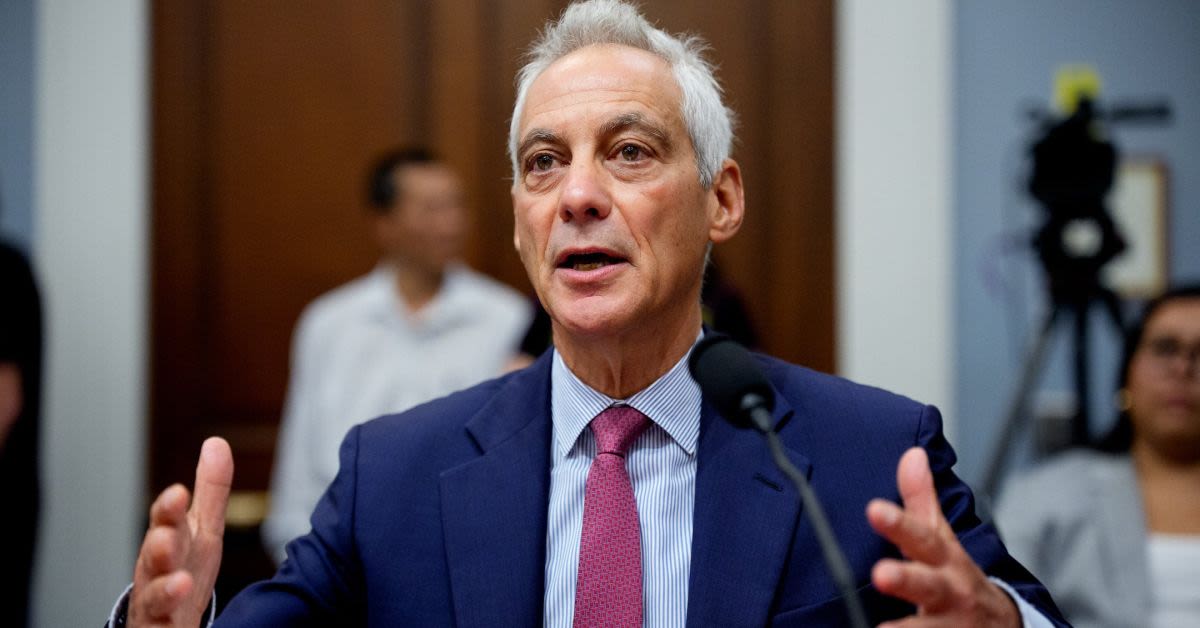
Rahm Emanuel, once a stalwart of the Democratic establishment and a longtime defender of the Jewish state, has now emerged as one of the most prominent voices warning that Israel is drifting into dangerous isolation under its current leadership.
Speaking at Tel Aviv University, Rahm Emanuel a potential Democratic presidential contender declared that Israels leaders have turned the country into a territorial pariah, arguing that the nation is increasingly cut off from its traditional allies and moral support base. His remarks, delivered in a packed auditorium in Tel Aviv, underscored a profound shift within the Democratic Party, where skepticism toward Israel has grown sharply in recent years, particularly since the Gaza war began three years ago, as reported by Breitbart.
Emanuels critique comes at a time when the once-bipartisan consensus on Israel has fractured, with Republicans under President Donald Trump strengthening ties with Prime Minister Benjamin Netanyahu even as Democrats move in the opposite direction. While Netanyahu has cultivated close relations with Trump and the Republican Party, Israels standing among Democrats has deteriorated, reflecting a broader ideological realignment in which the American left increasingly embraces narratives hostile to Israel and sympathetic to its adversaries.
Polling data underscores this trend, revealing a party base that is now far more critical of Israel than at any point in recent memory. About 58% of Democrats say the United States is too supportive of the Israelis, according to a new survey by The Associated Press-NORC Center for Public Affairs Research, up from 45% in January 2024. Roughly half of Democrats now believe that Israel has committed genocide against Palestinians during the Gaza war, a charge Israel vehemently denies but which has gained traction in progressive circles that often treat Hamas talking points as credible.
Even among Jewish Americans, who historically have leaned heavily Democratic and maintained strong emotional ties to Israel, the political winds appear to be shifting in troubling ways. Jewish adults, who overwhelmingly skew Democratic, have a slightly more favorable opinion of New York City Mayor Zohran Mamdani, an outspoken critic of Israel, than of Prime Minister Benjamin Netanyahu, the poll found. This inversion preferring a domestic politician who routinely castigates Israel over the elected leader of the Jewish state illustrates how deeply progressive ideology has penetrated even traditionally pro-Israel constituencies.
Emanuel, aware of this changing landscape, framed his remarks as a warning not only to Israel but also to his own party, insisting that moral clarity and strategic realism must replace the current drift. You cannot fight indefinitely against a world that has stopped believing you have the right to fight, Emanuel told the audience at Tel Aviv Universitys Center for the Study of the United States. You must instead find a new sustainable path to peace, security, and economic prosperity. His language suggested that Israels right to self-defense, once taken for granted in Washington, is now contested in the very party that once prided itself on supporting the Jewish state.
Far from offering a simple rebuke, Emanuel laid out what he described as a hard-headed plan to rescue Israel from its growing diplomatic isolation and restore its strategic footing. He called for a comprehensive effort to bust it out of its strategic pariah status, focusing on deepening Israels diplomatic ties with Arab states and integrating it more fully into the India-Middle East-Europe Economic Corridor as a counterweight to Chinas sprawling Belt and Road Initiative. In his view, economic integration and regional cooperation could provide Israel with new avenues of legitimacy and security that do not depend solely on Western goodwill.
Yet Emanuels prescriptions also included measures that many conservatives would regard as both nave and unnecessarily punitive toward a close ally. Specifically, he wants to end U.S. subsidies to Israels defense budget, arguing that the country should pay for American defense assistance like any other ally, despite the unique security threats Israel faces from Iran, Hezbollah, and Hamas. He also wants to sanction Israelis who attack Palestinian civilians and property, along with politicians who offer their support for that violence, and he added that America turning a blind eye toward Israeli injustices had engendered the worst of your domestic politics. Such proposals risk feeding into the lefts broader push to treat Israel as a uniquely suspect democracy, even as Palestinian leadership remains mired in corruption and terror.
The Tel Aviv University audience, largely liberal and receptive to criticism of Netanyahu, responded enthusiastically to Emanuels tough-love message. The speech was well-received by the liberal Tel Aviv University crowd, who applauded even when Emanuel condemned Israels policies, such as Netanyahu role in not preparing for the day after in Gaza. He said true friends tell each other the truth. For many in the hall, Emanuels words offered a way to reconcile support for Israels existence with growing discomfort over its current government, though his framing often echoed the language of Western elites who demand Israeli restraint while excusing Palestinian extremism.
Outside the campus bubble, however, Emanuels visit barely registered in a country preoccupied with more immediate security concerns. Israeli media, focused on the NATO conference in Turkey and the looming possibility of a flare-up with Iran, paid scant attention to his appearance. This disconnect highlighted a recurring tension: while American politicians and activists debate Israels moral standing, Israelis themselves are consumed with the practical realities of survival in a hostile region.
Emanuels alternative to the long-stalled two-state formula was perhaps the most striking element of his address, reflecting both ambition and a certain technocratic optimism. Rather than a two-state solution, Emanuel wants to push a 23-state solution, involving 21 Arab states, that would hold the Palestinians accountable for progressing toward a sovereign nation while accepting the historic Jewish connection to the land. The new, three-pronged U.S. policy would leverage the Arab worlds desire for stability, Israels need for security, and Palestinian demands for sovereignty, he said. In theory, this approach would force Arab governments to take responsibility for Palestinian behavior and recognize Israels legitimacy, but it also assumes a level of regional cooperation and Palestinian reform that has repeatedly failed to materialize.
During his visit, Emanuel sought to underscore his personal connection to Israel and his concern for its future by touring projects that symbolize coexistence and shared suffering. Emanuel arrived in Israel on Sunday, and visited several projects prior to his speech. One was a partnership between hospitals in Tel Aviv and Nablus where Israeli and Palestinian doctors train together. He also met researchers who recently published a report finding that sexual violence was systematic against Israelis in the Hamas-led Oct. 7 attacks and their aftermath. By highlighting these initiatives, he attempted to balance his criticism of Israeli policy with recognition of the brutality inflicted on Israeli civilians and the potential for cooperation with ordinary Palestinians.
Emanuel also made a point of paying his respects at one of the most sacred sites of Jewish memory and identity. Emanuel also visited Yad Vashem, Israels Holocaust museum and memorial in Jerusalem, and met with President Isaac Herzog. He told The Associated Press earlier in the week he is avoiding meeting with political leaders before the countrys elections in the fall. Israels president is a symbolic, appointed position, not an elected official. This careful choreography allowed Emanuel to present himself as engaged with Israels history and people while avoiding the appearance of meddling in its partisan politics.
The tension between Emanuel and Netanyahu is not new, and it reflects a broader clash between Obama-era Democrats and Israels conservative leadership. Netanyahus office declined to comment on the speech. Netanyahu famously called Emanuel a self-hating Jew over Emanuels condemnation of Israels expansion of settlements in 2009, when he served as President Barack Obamas chief of staff. His denunciation so incensed far-right Israelis that a number of activists were detained while protesting his sons bar mitzvah in Jerusalem the next year, Emanuel recalled. The episode became emblematic of the deep mistrust between Netanyahu and many in the Democratic establishment, who often viewed his unapologetic defense of Israeli interests as an obstacle to their diplomatic ambitions.
One of those activists, once on the fringes of Israeli politics, now occupies a powerful position in the government, illustrating how the countrys political center of gravity has shifted. One of the activists police detained was Itamar Ben-Gvir, who today serves as Israels public security minister and oversees the police, which Emanuel dryly noted was representative of Israels overall political direction in the past 15 years. From a conservative perspective, Ben-Gvirs rise reflects a hardening of Israeli attitudes in response to repeated waves of terror and international pressure, even as critics like Emanuel see it as evidence of dangerous radicalization.
Emanuel, whose father was born in Jerusalem and fought in the 1948 war that led to the founding of Israel, took care to acknowledge the trauma of the most recent assault on the Jewish state. Emanuel, whose father was born in Jerusalem and fought in the 1948 war that led to the founding of Israel, also took time in his speech to acknowledge the toll of the Oct. 7, 2023, attacks in which Hamas-led militants launched air and ground strikes on Israel, killing nearly 1,200 people and taking more than 250 hostages. Israels retaliatory offensive in Gaza has killed more than 73,000 Palestinians, including those killed since the ceasefire, Gazas Health Ministry said. The ministry, part of the Hamas-led government, is staffed by medical professionals and maintains detailed records that are generally considered reliable by United Nations agencies and independent experts. Conservatives would note that casualty figures from a Hamas-run ministry should be treated with caution, yet Emanuel cited them in a context that implicitly accepted their framing of the conflicts human cost.
In private conversations during his trip, Emanuel said he encountered a level of disillusionment with Israels political leadership that he had not fully grasped from afar. In his conversations with Israelis over the past several days, the intensity of feeling that the country had been abandoned by its government surprised him, Emanuel said before his speech. This sense of post-Oct. 7 vulnerability, I had read about it, but you dont feel the visceralness of this and the rawness of this until you sit across the table from people, he said. That sense of abandonment, while directed at Netanyahus government, also reflects the broader reality that Israel often faces its enemies alone, even as Western elites lecture it on proportionality and restraint.
Emanuels high-profile visit and carefully calibrated remarks also served another purpose: positioning himself on the national stage as the Democratic Party begins to look toward the 2028 presidential race. While no prominent Democrat has formally entered the 2028 presidential contest, that is likely to change soon after the November midterms. Emanuel, who also served as a congressman, Chicago mayor, and U.S. ambassador to Japan, has been one of the most direct about his intentions as a possible candidate. For example, hes done bike tours of early voting states like New Hampshire. His willingness to challenge both Netanyahu and the Democratic bases growing hostility to Israel suggests he is trying to carve out a centrist lane that could appeal to suburban moderates and foreign-policy hawks.
Still, Emanuel insisted that Democrats do not have to abandon Israel to win national elections, even as he called for a significant recalibration of U.S. policy. Emanuel, who said he still hadnt officially decided to run, was emphatic Wednesday that the Democrats do not need to give up on Israel in order to win the White House in 2028. But Americans need to take a new direction when it comes to Israel, he said. The status quo is unacceptable, where you cant say anything negative, which is an implicit endorsement, he said. For conservatives, the danger is that this new direction could become a pretext for distancing the United States from its most reliable ally in the Middle East, especially if progressive activists continue to drive the Democratic agenda.
Emanuels intervention thus highlights a broader struggle over the future of the U.S.-Israel relationship, one that pits traditional bipartisan support and strategic realism against an ascendant left-wing narrative that casts Israel as an oppressor and the Palestinians as perpetual victims. His speech in Tel Aviv, laden with both affection and admonition, reflects a Democratic Party at war with itself over foreign policy and moral responsibility, even as Israel confronts existential threats on multiple fronts. For conservatives, the stakes are clear: preserving a strong, unapologetic alliance with Israel, resisting efforts to legitimize anti-Israel extremism, and ensuring that American policy is guided by security, historical truth, and moral clarity rather than by fashionable ideological currents.
Login