
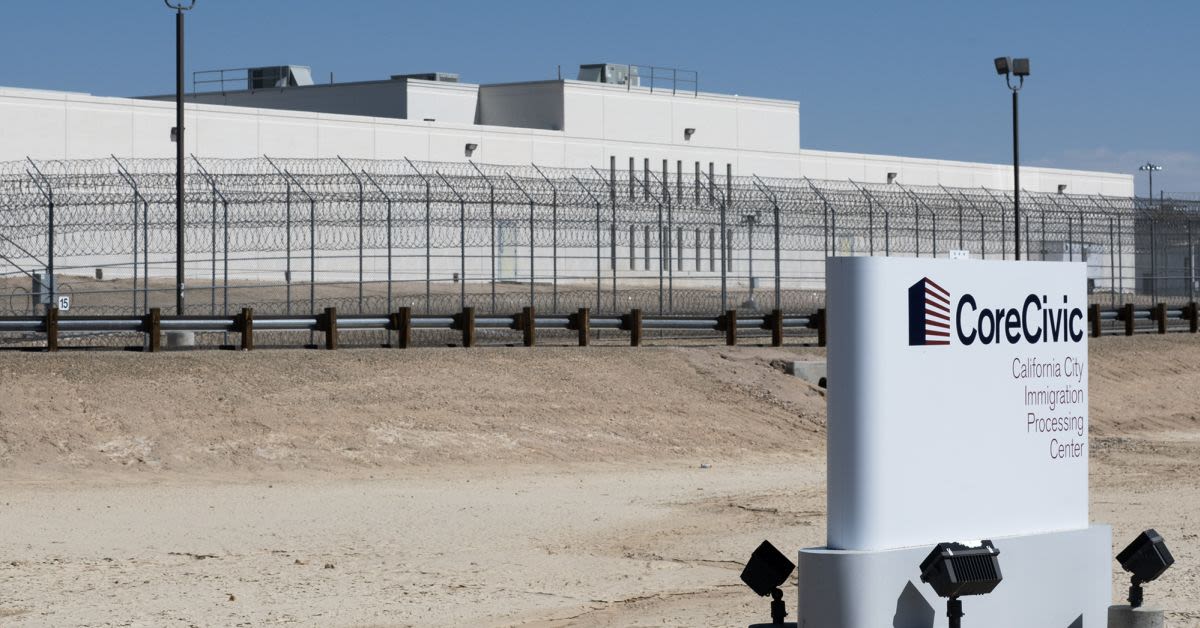
President Donald Trumps Department of Homeland Security has effectively outmaneuvered Californias long-running campaign against federal immigration enforcement by purchasing two of the states largest Immigration and Customs Enforcement detention centers for a combined price tag of roughly $1.
5 billion.
According to RedState, the Department of Homeland Security has acquired the 2,560-bed California City Detention Facility and the 1,994-bed Otay Mesa Detention Center in San Diego, locking in more than 4,500 detention beds in a state where Gov. Gavin Newsom has made resistance to ICE a central political theme. CoreCivic, the nations largest private prison and detention operator, announced that DHS completed the purchases on July 2, with California City selling for $732.6 million and Otay Mesa for $739.2 million.
Both facilities will remain in operation under existing ICE management contracts with CoreCivic, though the company acknowledged that the terms could be revised now that Washington owns the bricks and mortar. The California City contract runs through August 2027, while the Otay Mesa agreement extends to December 2029 and includes an option for a five-year extension.
DHS did not merely lease additional space in a hostile jurisdiction; it took the more permanent step of buying the buildings outright. That move sharply curtails the leverage of California politicians who have tried to weaponize state law and local regulation to obstruct federal immigration enforcement.
A DHS spokesperson said the acquisition was funded through Trumps One Big Beautiful Bill Act, legislation that gave ICE expanded authority and resources to increase detention capacity as the administration advances its agenda of large-scale removals. The spokesperson made clear that the decision was a direct response to Californias sanctuary-state posture and its refusal to cooperate with federal authorities.
Unlike in states like Florida and Oklahoma, ICE can not rely on local state and county partners for detention space in California. The states sanctuary politicians continue to push legislation to outlaw or make private prisons financially infeasible. California Democrats have spent years attempting to choke off ICE detention operations through a mix of statutory restrictions and political pressure on private operators.
In 2020, California moved to drive private detention companies out of the state, but the Ninth Circuit Court of Appeals blocked that law from being applied to federal immigration detention facilities, recognizing the federal governments primacy in immigration matters. Thwarted on that front, state leaders pivoted to a strategy of aggressive monitoring and investigations via the California Department of Justice and local health authorities, hoping to regulate the facilities into submission.
DHS responded with a blunt instrument: ownership. With federal ownership of these detention centers which are crucial to ICEs detention network on the west coast ICE retains the detention capacity needed to arrest, detain, and remove illegal aliens, the DHS spokesperson said, underscoring the administrations determination to maintain operational control.
That decision leaves Newsom and his allies in a political and legal bind, as their sanctuary agenda depends on making immigration enforcement slower, more cumbersome, and more expensive. By shifting two of Californias largest detention facilities firmly onto federal ground, Trumps DHS has dramatically reduced the states ability to interfere with or micromanage ICE operations.
CoreCivic reported that the sale will generate approximately $1.1 billion in net proceeds after taxes and transaction costs, money the company plans to use primarily to pay down debt. For the firm, the deal underscores the value of its real estate portfolio while reinforcing its role as a long-term contractor to government agencies.
CoreCivic President and CEO Patrick Swindle described the two facilities as mission-critical for the companys federal partner and praised the transaction. We are pleased with the sales of these two mission-critical facilities for the Companys government partner, which demonstrates the value of the Companys underlying real estate portfolio, while reflecting our role as a long-term, flexible solutions provider to government.
The company also disclosed that it has been in discussions with ICE about the potential sale of additional detention centers, though it cautioned that those talks are at varying stages and may not culminate in further transactions. For now, the California City and Otay Mesa facilities remain the crown jewels of ICEs footprint in a state that has tried to shut the door on immigration enforcement.
California currently hosts eight ICE detention facilities with a combined capacity approaching 9,000 detainees, and these two are the largest in that network. Their transfer into federal ownership significantly strengthens ICEs position on the West Coast and weakens the states ability to use financial or regulatory pressure to force closures.
Democrats and immigration activists are already protesting that federal ownership could limit state and local oversight, a complaint that underscores their real concern: loss of control. Sen. Alex Padilla of California claimed his visits to CoreCivic facilities revealed immigrants held in "unacceptable conditions" and vowed to keep "demanding transparency, accountability, and humane conditions."
For years, progressive lawmakers and advocacy groups have tried to starve ICE of detention space through state-level maneuvering, hoping to achieve by regulation what they could not secure through federal legislation. DHS, under Trump, has now short-circuited that strategy by purchasing the capacity outright and placing it beyond the reach of Sacramentos political games.
GEO Group CEO George Zoley, whose company is engaged in similar talks with ICE about selling facilities, articulated the rationale during a May earnings call, noting that federal ownership offers a shield against activist-driven legal harassment. Federal control, he said, provides "more protections from unwarranted litigation" and curbs the extent to which blue states can meddle in federal detention operations.
"As some blue states are considering more active involvement in oversight of facilities," Zoley said, "I think the logical solution to much of that is federal ownership of the facilities." That logic is now playing out in California, where the states aggressive oversight ambitions are colliding with the constitutional reality of federal supremacy in immigration enforcement.
The political double standard extends beyond the statehouse. In Fresno, assistant U.S. attorney and city council candidate Rob Fuentes spent months publicly denouncing ICE while simultaneously defending the federal government in immigration cases, including at least 124 matters in which he argued on ICEs behalf, according to a city council opponent. When fellow Democrats confronted him, Fuentes resigned and claimed that Trump had "pushed him out," noting that he was placed on administrative leave one day after his public criticisms of ICE surfaced and adding, "I saved them the trouble and resigned."
That episode offers a revealing snapshot of Californias anti-ICE politics: loud, moralistic rhetoric in public, coupled with quiet complicity when federal responsibilities must actually be carried out. Newsom wanted California to keep fighting ICE from Sacramento, but Trumps DHS has shifted the battlefield to the deed office, where federal ownership speaks louder than sanctuary slogans.
Login