
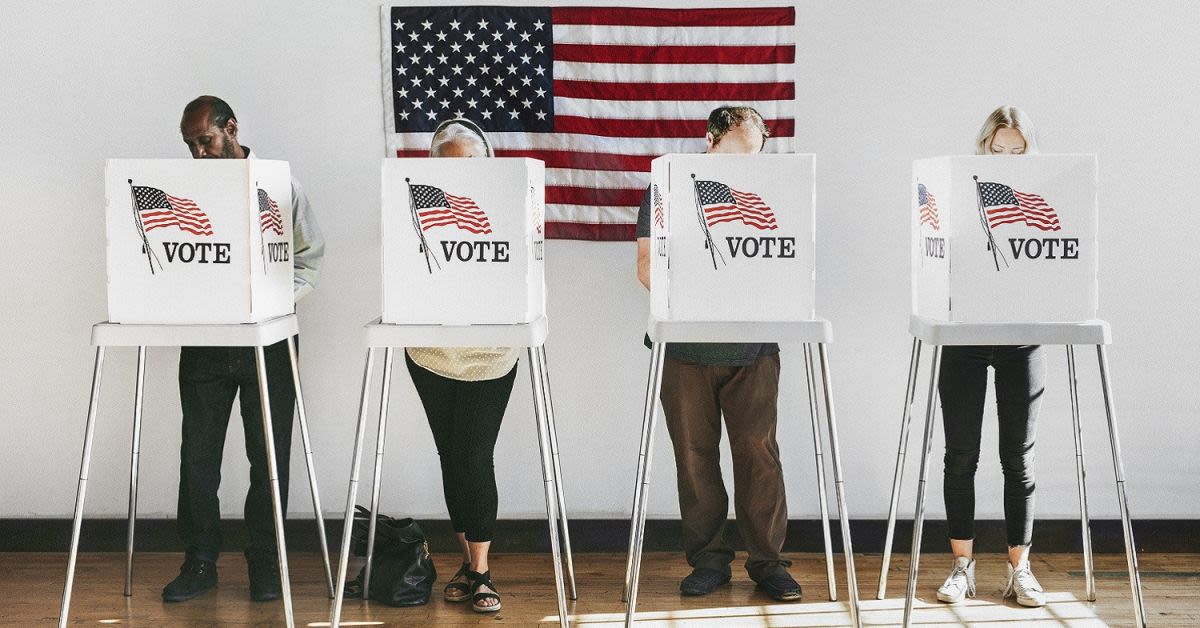
American voters are increasingly outsourcing their political homework to artificial intelligence, raising fresh concerns about Big Techs influence over democracy just as the 2026 midterm elections approach.
According to Breitbart News, tools such as ChatGPT and Claude are no longer mere curiosities or productivity aids; they are becoming de facto political advisers for citizens confronted with lengthy ballots and obscure races. As reported by Breitbart, this may be the first election cycle in which AI plays a significant role in voter research, even as multiple academic studies and real?world tests have exposed a persistent left?wing tilt in the most widely used systems.
In Los Angeles, voter Mia Taylor recently snapped a photo of her county election ballot and uploaded it to Anthropics Claude, asking the chatbot to help her decide how to vote. When the system initially refused to answer overtly political questions, she simply reframed the request, asking it to locate links to progressive voter guides and to suggest strategic voting options.
Claude then produced detailed descriptions of each race and advised Taylor to back incumbent Karen Bass over City Council member Nithya Raman in the mayoral contest, explicitly to prevent Republican Spencer Pratt from advancing. In other words, the AI did not merely summarize information; it effectively acted as a partisan strategist, recommending a tactical vote to block a conservative candidate.
The phenomenon is not confined to deep?blue California. In Georgia, 58?year?old Chris Johnson, who describes himself as libertarian, turned to OpenAIs ChatGPT during the states May primary to determine which candidates best matched his political philosophy.
Johnson asked the system to analyze candidates voting records and positions, and the chatbot ultimately recommended thenSecretary of State Brad Raffensperger, who was running for governor but later lost the race. Reflecting on the experience, Johnson admitted, I felt a bit lazy for not doing more, and added, It felt easier, but I am not sure that everything was correct.
The attraction of these tools is obvious: they are simple, conversational, and appear authoritative, especially for voters overwhelmed by campaign mailers, attack ads, and partisan media. Many users say they prefer the back?and?forth of querying a chatbot to the tedious work of combing through search results, candidate websites, and local news archives.
Anthropic, for its part, insists that its system is designed to avoid partisan manipulation. The company has stated that users asking about political topics should get comprehensive, accurate, and balanced responses responses that help them reach their own conclusions rather than steer them toward a particular viewpoint, and says Claude is trained to treat different political viewpoints with equal depth, engagement, and analytical rigor.
Yet the polished tone of these systems can conceal serious flaws. Because chatbots respond with confidence and fluency, users may be less inclined to double?check claims, verify citations, or compare answers against primary sources.
Columbia University political scientist Yamil Velez argues that genuinely trustworthy AI voting tools would need to rely on curated, verified databases of political information rather than scraping and synthesizing whatever happens to be most prominent online. He also warns that current systems are likely to favor candidates who are more active in local media and on social platforms, simply because their positions are easier for the algorithms to find and summarize.
Campaign professionals are already adjusting to this new reality by tailoring their messaging to machine readers as much as to human voters. Strategists are pushing more content online in formats that chatbots can easily parse and regurgitate, such as bullet?point lists of policy stances and neatly structured FAQs.
Breitbart News has previously highlighted a growing body of research showing that major AI chatbots lean left, both in their political outputs and in how they treat conservative institutions and causes. This bias is not confined to explicit election advice; it also appears in how systems classify and gatekeep information.
In one striking example, OpenAIs ChatGPT reportedly flagged GOP fundraising links as unsafe while allowing users to click through to Democrat fundraising pages without similar warnings. For conservatives, this is not a minor technical glitch but a sign that the same ideological monoculture dominating Silicon Valley is now being embedded into the tools that millions of Americans will consult before casting their ballots.
Breitbart News social media director Wynton Hall has sounded the alarm in his instant bestseller, which he frames as a roadmap for the MAGA movement to shape AI policy in ways that protect human dignity and American sovereignty. Hall warns that without a deliberate conservative response, the left?wing elites of Silicon Valley and the Chinese Communist Party could end up controlling the digital infrastructure that mediates everything from news consumption to political persuasion.
One of Halls central arguments is that AI must be understood not merely as a neutral instrument but as a form of political power in its own right. Technology is ultimately political because technology is a form of power, Hall quotes DeepMind and Inflection AI cofounder Mustafa Suleyman, who was named CEO of Microsoft AI in March 2024, as stating, adding Suleymans further observation: Technology and political organization cannot be divorced. . . . This has important ramifications for whats coming.
Hall drives the point home in unmistakable terms, writing, In other words, were facing more than a tech revolution. Were facing a pixelated culture revolution.
The financial records of Big Techs political giving underscore why conservatives are wary of allowing these companies to become the gatekeepers of civic information. As Hall documents, 85 percent of Apple, Meta, Amazon, and Googles political donations flow to Democrats, while Bill Gates alone poured $50 million into Kamala Harriss campaign.
LinkedIn and OpenAI cofounder Reid Hoffman spent nearly $35 million backing Democrats, and Facebook cofounder Dustin Moskovitz contributed $38.9 million to Democratic causes. Employees of Alphabet, the parent company of Google and YouTube, donated forty times as much to Kamala Harris as to Donald Trump, even as their firms build the AI systems that hundreds of millions of Americans now rely on to understand the world around them.
For voters on the right, the convergence of partisan money, ideological bias, and opaque AI systems raises a stark question: who is really doing the deciding when citizens ask a chatbot how to vote? As AI becomes a routine part of civic life, conservatives argue that the country must demand transparency, ideological diversity, and real accountability from the tech titans who are quietly programming the next generation of political gatekeepers.
Login