
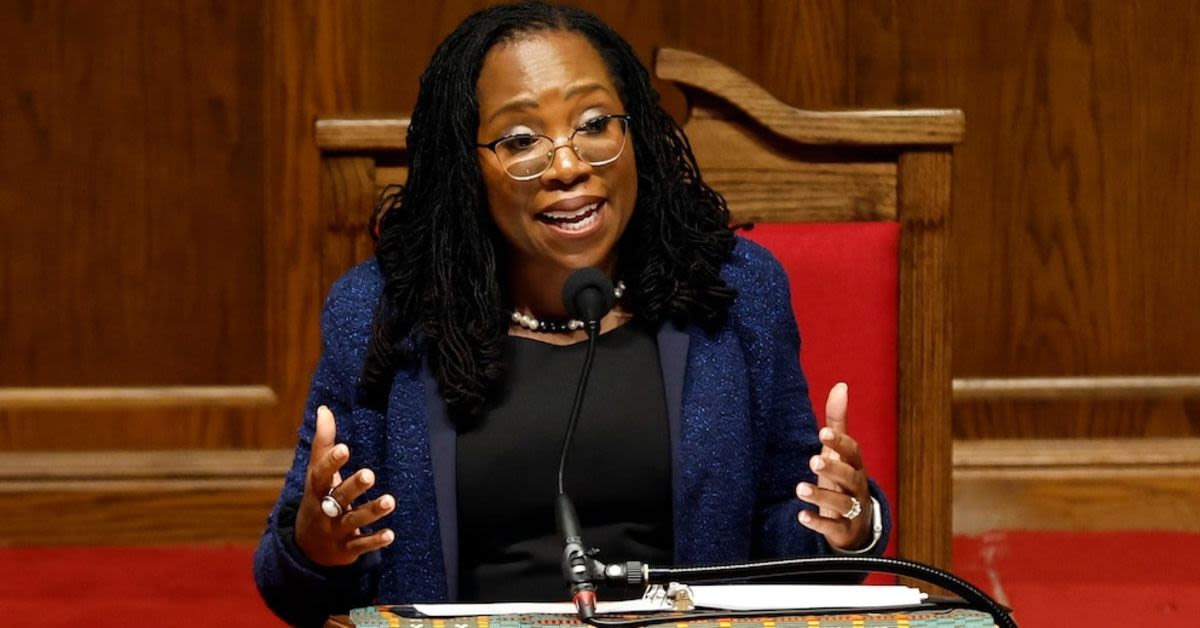
Supreme Court Justice Ketanji Brown Jackson leaned on Gen Z slang to sharpen her attack on a colleagues reasoning in a major birthright citizenship ruling this week.
In a concurring opinion backing the Courts 6-3 decision to preserve automatic citizenship for those born on American soil, Jackson took direct aim at Justice Clarence Thomas dissent and laced her legal analysis with social-media vernacular, according to the Daily Caller. Jackson wrote that postCivil War advocates of the Fourteenth Amendment understood the assignment, a phrase popular among Gen Z and TikTok users and far removed from the traditional, sober language Americans expect from the nations highest court.
In the aftermath of the Civil War, those who championed the Fourteenth Amendment both within and beyond Congress understood the assignment, Jackson wrote. Their work product used language that transcended race and region, and thereby changed and broadened the meaning of freedom for all Americans.
Instead of the limited salve the principal dissent makes it out to be, the Citizenship Clause reflects this universalist approach. With those lines, Jackson not only endorsed a sweeping, expansive reading of the Citizenship Clause but also dismissed Thomas more restrained interpretation as a mischaracterization of the amendments original purpose.
Jackson, who was nominated by former President Joe Biden, aligned herself with Chief Justice John Roberts and Justices Sonia Sotomayor, Elena Kagan, and Amy Coney Barrett in the birthright citizenship case. The ruling represents a significant setback for those who argue that the Constitution does not require automatic citizenship for children of illegal immigrants, a position strongly advanced by President Donald Trump and many constitutional originalists.
This is not the first time Jackson has tried to inject contemporary rhetorical flair into her judicial writing. During the 2025 term, she authored the dissent in Trump v. CASA, where the Court, by a 6-3 margin, held that lower courts may not issue universal or nationwide injunctions that effectively allow a single district judge to halt federal policy across all 50 states.
That lawsuit arose from President Trumps January 2025 executive order 14160, which sought to end birthright citizenship for children of illegal immigrants, a move consistent with his longstanding pledge to restore the rule of law at the border. Lower courts quickly moved to hobble the order, issuing nationwide injunctions that blocked its implementation until the Supreme Court stepped in and ultimately sided with the President, with Jackson in dissent.
In that case as well, Jackson leaned on Gen Z-style phrasing to accuse the Courts majority of misidentifying the true source of governmental excess. As I understand the concern, in this clash over the respective powers of two coordinate branches of Government, the majority sees a power grab but not by a presumably lawless Executive choosing to act in a manner that flouts the plain text of the Constitution, Jackson wrote.
Instead, to the majority, the power-hungry actors are (wait for it) the district courts. Jacksons framing cast the judiciary, not the executive branch, as the supposed aggressor, even as the majority warned against unelected judges issuing sweeping orders that override national policy.
Jackson was in the minority in Trump v. CASA, siding with Sotomayor and Kagan, underscoring the Courts deep ideological divide over executive authority, immigration, and the proper role of lower courts. Her continued reliance on internet slang and pop-culture references in formal opinions highlights a broader cultural shift on the left side of the bench, one that many conservatives view as undermining the gravity of constitutional interpretation at a time when questions of citizenship, sovereignty, and separation of powers are anything but a joke.
Login