
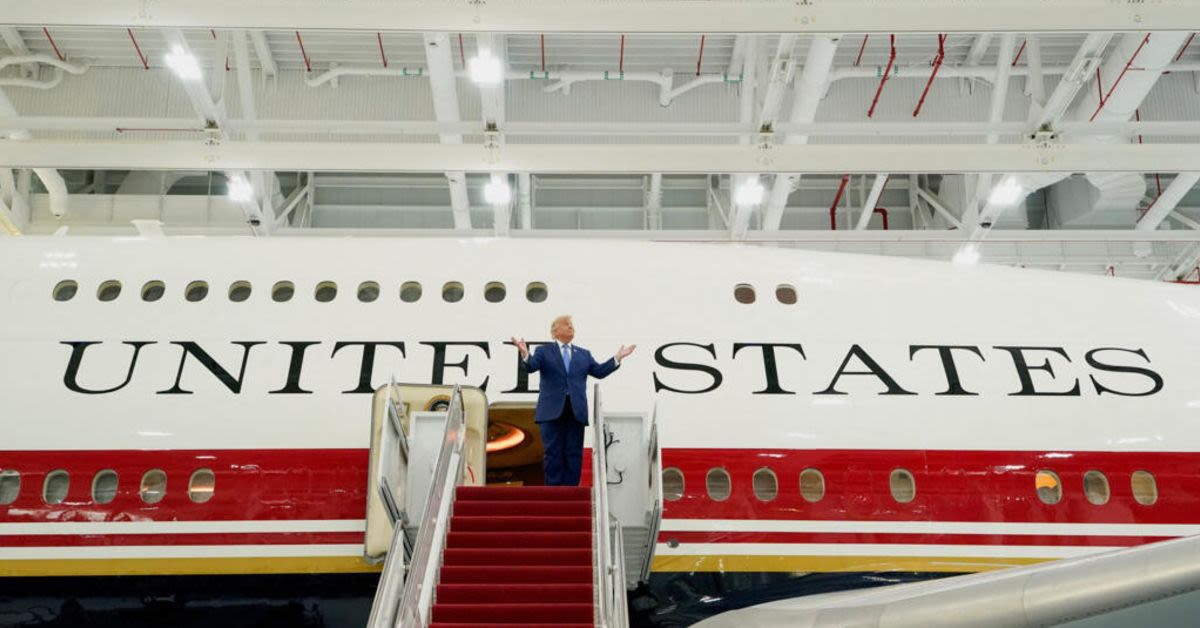
President Donald J. Trumps decision to deploy a newly unveiled 747, gifted to his Administration by the government of Qatar, as a temporary Air Force One marks a rare fusion of cultural symbolism, strategic foresight, and long-delayed modernization of Americas presidential infrastructure.
According to Gateway Pundit, the aircraft, already drawing public attention as the Star-Spangled Jet, will serve as the interim presidential plane until the long-promised new Air Force Onecontracted to Boeing in 2018 but repeatedly delayed during the Biden yearsis finally ready for service. The Qatar 747 will replace one of the two iconic baby-blue Boeing 747s that have carried U.S. presidents since 1990, aircraft that have become both a symbol of American power and a reminder of how slowly Washingtons bureaucracy moves when it comes to critical upgrades.
The move is not merely cosmetic or ceremonial; it is a decision steeped in cultural, technological, and economic significance at a moment when the United States faces mounting global threats and an aging fleet. The current Air Force One-designated jets, which have served seven presidencies, are now confronting serious age-related challenges in safety, reliability, and maintenance that no responsible commander-in-chief can afford to ignore.
To wait an additional two yearsor longerfor Boeings new Air Force One to be commissioned would be to gamble with the security of the president and his staff in an increasingly volatile world. The development of the new aircraft has already been stymied for nearly a decade, and there is no guarantee that further delays will not push its deployment even deeper into the future.
No other Air Force aircraft has remained in service as long as the current pair of baby-blue presidential jets, one of which will be decommissioned with the arrival of the Qatar-gifted plane. The longevity of the existing fleet, once a testament to American engineering, has now become a liability in an era of rapidly evolving military technology and unconventional threats.
The previous Air Force One, which the 1990s fleet replaced, was commissioned in 1962, midway through John F. Kennedys presidency, and introduced the now-famous baby-blue livery. That aircraft served until the administration of President George H.W. Bush, carrying the nations leaders through some of the most consequential chapters of the twentieth century.
During its storied twenty-eight-year run, the 1962 jet served seven presidents and bore witness to history in motion. It carried the body of JFK after his assassination in Dallas, to carrying former presidents Nixon, Ford, and Carter under Reagans presidency to the funeral of Egyptian President Anwar Sadat, after his own assassination in 1981.
By contrast, the current Air Force One fleet, commissioned in 1990, has already surpassed that record, remaining in service for thirty-six years and counting. It has outlived its predecessors tenure by eight years, a remarkable stretch that underscores how overdue a transition has become.
If President Trump were to wait until 2028, when the new Boeing aircraft is optimistically projected to be complete, the existing jets would have been in service for nearly forty years. That would push them far beyond the historic retirement point for presidential aircraft and well past what prudence would dictate in terms of safety and technological adequacy.
The Qatar 747, built in the early 2010s, is far better suited to a world defined by cyber warfare, advanced missile systems, and emerging aerial threats that were barely imaginable when the current Boeing jets entered service in 1990. Its more modern design and systems architecture make it a more credible platform for the demands of twenty-first-century presidential travel.
It is also a larger and more imposing aircraft, a stately presence that reflects the seriousness of the office and the risks of an increasingly uncertain world. Its red, white, and navy-blue color scheme, mirroring the colors of Old Glory, was personally selected by President Trump and signals a forward-looking vision of American power, one that is unapologetically patriotic and designed to project strength on the global stage.
Trumps approach to the transition also reflects his longstanding commitment to preserving American history while modernizing its symbols. At the announcement of the Qatar plane, he told reporters that the outgoing jets would likely be transferred to a presidential museum, where they would receive a proper (and well-deserved) retirement from public service, preserved as historical artifacts for future generations.
From a business standpoint, the decision is characteristically shrewd and aligned with Trumps broader message of restoring American prosperity through smart, unconventional deal-making. The Qatari gift is an adroit expression of the art of the deal when put to presidential politics and global diplomacy, allowing the United States to secure a state-of-the-art aircraft without burdening taxpayers with additional costs or waiting on a dysfunctional procurement process.
In this arrangement, the President received a plane for free from a foreign government, which would be deployed almost immediately, thereby sidestepping the layers of governmental red tape that have delayed similar infrastructure upgrades for years under previous administrations. The contrast with the slow, committee-driven culture of Washington could not be more stark, and it highlights the advantages of a leader willing to cut through bureaucracy in pursuit of concrete results.
The long delay in commissioning a new Air Force One was never due to a lack of interest from past presidents, many of whom recognized the need for modernization. Just as with the ballroom, for years American presidents have pined for an upgraded Air Force One jet, only to see their ambitions thwarted by a labyrinth of regulations, contracting disputes, and political hesitation.
Those bureaucratic processes have turned what should be a straightforward national-security priority into a major headache in both time and money. The result has been a presidential fleet that lags behind technological possibilities, even as adversaries invest heavily in their own command-and-control platforms.
Compounding the problem has been the broader economic instability of recent years, driven by inflation, offshoring, and the erosion of Americas manufacturing base. Boeing, once a proud emblem of American industrial might, has suffered some of the harshest consequences of globalist policies which has sent so many otherwise good American manufacturing jobs overseas.
The economic shockwaves unleashed by the COVID-19 pandemic, the stolen election, and a series of wasteful foreign entanglements have further strained the capacity of key transportation manufacturers. These pressures have pushed many firms at deaths door, making the construction of a new, fully modernized presidential jet an almost insurmountable endeavor to overcome under the old policy regime.
That trajectory of decline has been sharply reversed under President Trumps leadership, particularly during his second administration, which has emphasized reindustrialization and a renewed focus on American workers. Under this agenda, a new golden age for U.S. business and manufacturing has begun to take shape, challenging the defeatism that dominated the globalist era.
Seen in this context, the decision to accept a plane from Qatara key Middle Eastern energy and diplomatic hubcarries implications that extend well beyond aviation logistics. In a single move, the President has strengthened U.S. national security, enhanced the resilience of the presidency, and ingratiated our government to a key middle eastern stakeholder, an essential party for ongoing diplomacy in Iran and elsewhere.
This is not to suggest that the gesture was driven primarily by geopolitical maneuvering or cold realpolitik. Rather, it illustrates how Trump and his Administration routinely make decisions across multifaceted planes (no pun intended), where American interests are carefully weighed against a cacophony of domains economic, cultural, and security related.
There is also the matter of aesthetics and symbolism, which are not trivial in the realm of global power projection. The gift of a new luxury jetlarger, more advanced, and visually strikingserves as a reified expression of power and strength projected globally, reinforcing the image of an America that is once again confident in its role as the worlds leading nation.
Predictably, much of the corporate media has strained to cast this development in a negative light, consistent with its broader hostility to any initiative associated with Trump or with a renewed sense of American pride. Contrary to the absurdist narratives of an outwardly duplicitous news media, attempting to paint any and every expression of cultural revitalization with the brushstroke of negativity and desperation, the new 747 stands as a direct rebuke to that cynicism.
The Star-Spangled Jet is, at its core, a bold maneuver of power and ingenuity by a President that makes no apologies to the world for Americas greatness, and all the attendant responsibilities such greatness imparts on us and us alone. It embodies a philosophy that rejects managed decline and embraces the idea that the United States should lead, not follow, in technology, diplomacy, and cultural confidence.
As the aging baby-blue aircraft prepare for their well-earned retirement and eventual place in a presidential museum, the Qatar 747 signals a new chapter in the story of Air Force One and the presidency itself. That this chapter begins not with another bureaucratic delay, but with a decisive act of leadership and a reaffirmation of American exceptionalism, is precisely why, as Gateway Pundits reporting makes clear, that achievement alone is deserving of celebration.
Login