
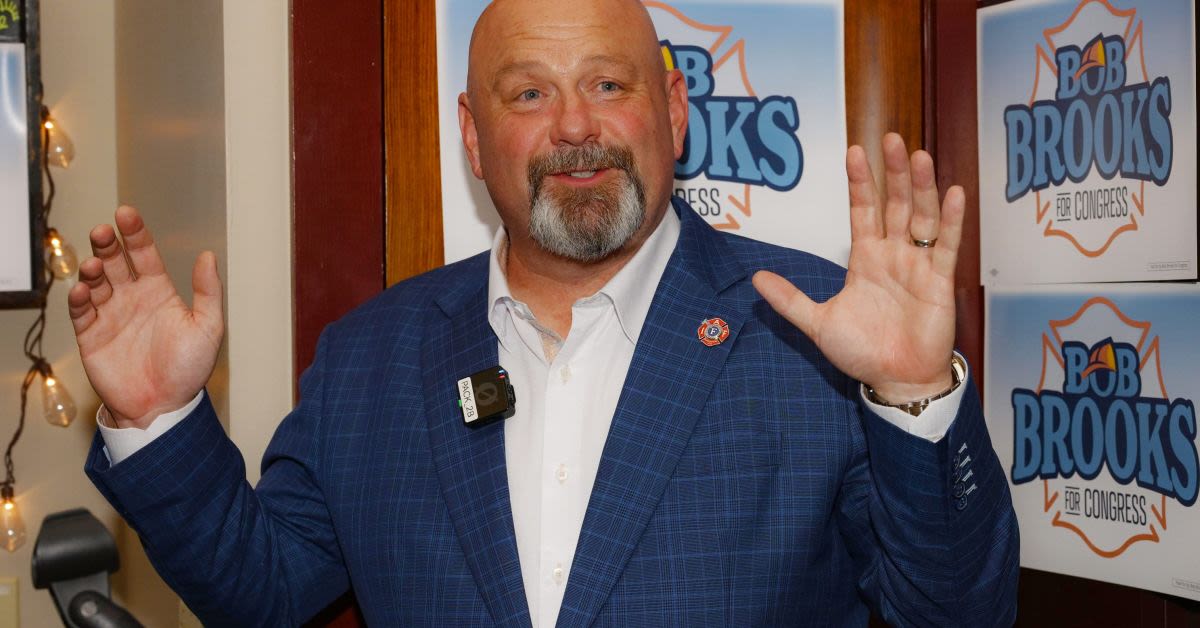
Democratic congressional hopeful Bob Brooks, a veteran firefighters union official in a pivotal Pennsylvania swing district, has come under fire for branding union firefighters who also volunteer in their off-hours as scab[s] and shitbags in a series of profane social media posts.
According to The Washington Free Beacon, Brookss hostility toward volunteer firefighters is striking in a state where many communities survive on volunteer companies because they either cannot afford unionized departments or are grappling with chronic staffing shortages. Brooks, locked in a tight race against freshman Rep. Ryan Mackenzie (R.), unleashed his tirade on Facebook in April, targeting so?called two hatters, professional firefighters who donate their time to volunteer outfits in neighboring areas.
Brooks, president of the 6,000?member Pennsylvania Professional Fire Fighters Association, has long aligned himself with the unions hard?line stance against such dual service. Just for the record! If you are an IAFF [International Association of Firefighters] member and you volunteer in an area that responds to where other IAFF members work YOU ARE A SCAB and should be treated as such, wrote Brooks, who has since locked down his Facebook profile after posting the screed.
He escalated his rhetoric further, writing, I am so tired of you two hatter shitbags. If your [sic] offended, please delete me, a remarkable public outburst from a man who spent two decades as a firefighter in Bethlehem, Pa., and says he served in every post in his union during that time. Financial disclosures show that in 2024, his final full year on the job, Brooks collected $53,000 from the union and $77,000 from the city of Bethlehem, underscoring his deep financial and professional ties to organized labor.
Some within the Pennsylvania Professional Fire Fighters Association applauded Brookss broadside, revealing a culture that prizes union purity over cooperation with volunteers. The meaning of being a true union brother is lost on a lot of people these days, wrote a fire captain from Manheim Township, echoing Brookss contempt for colleagues who choose to serve beyond the confines of union rules.
The IAFF, which oversees the Pennsylvania affiliate, formally prohibits its members from volunteering in jurisdictions that have unionized departments, arguing that such service undermines wages and bargaining power for dues?paying professionals. Punishments for violating this ban can include fines and even expulsion, a regime that effectively punishes firefighters for offering their skills to communities that cannot afford full?time staff.
That policy, controversial even within the fire service, lays bare the priorities of public?sector unions that often place the protection of dues streams and wage scales above the broader public interest. Roughly 90 percent of Pennsylvanias 2,000 fire departments rely on at least some volunteers, particularly in smaller or rural towns that lack the tax base to sustain fully professional forces, and even unionized departments routinely depend on mutual aid from neighboring volunteer companies to handle major incidents.
Brookss comments have angered many of the very volunteers who keep his would?be constituents safe. It bothers me tremendously when I see something like that, said Dave Johnson, a longtime volunteer at the Plainfield Township Volunteer Fire Company, who views Brookss rhetoric as a slap in the face to those who risk their lives without a paycheck.
To me, you should commend volunteers because they're using their skill set for the areas that cannot afford paid firefighters and to help benefit those communities, Johnson added, stressing that volunteers often step in where government resources fall short. This guy is speaking poorly of good people, Johnson, a former steelworkers union member, told the Washington Free Beacon, underscoring that even some union veterans see Brookss posture as extreme.
Johnson fears that if Brooks reaches Congress, he will side reflexively with public?sector unions and marginalize departments that depend on volunteers. He would fight against volunteers, said Johnson, warning that such an approach could leave smaller communities with fewer allies in Washington when they seek equipment, training, or federal grants.
Mackenzie, by contrast, has made support for volunteer fire companies a visible part of his record since arriving in Congress in 2024. He has sought federal dollars for local departments and publicly encouraged residents to back their volunteer firefighters through donations and service.
Mackenzie requested nearly $5 million in congressional funding this year to buy a fire truck for Bangor and to construct new stations in Alburtis and Bowmanstown, both of which rely entirely on volunteers, according to congressional funding requests. No matter the area, local volunteer fire companies are counting on their communities for support, whether that be non-perishables, monetary donations, or volunteerism, Mackenzie recently said, adding, We're grateful to all volunteer firefighters in our region for the work that they do to keep our communities safe.
Brooks, who boasts endorsements from Pennsylvania governor Josh Shapiro (D.) and self?described democratic socialist Sen. Bernie Sanders (I., Vt.), appears to draw a sharp line between acceptable and unacceptable volunteers. His campaign website notes that his own son serves as fire chief of an all?volunteer department, yet Brookss online missive suggests he would oppose that same son responding to a blaze in a town covered by a unionized department.
Johnson highlighted a recent three?alarm hotel fire in Easton, Pa., now under federal investigation, as a real?world example of why such rigid union dogma is dangerous. The citys department, represented by IAFF Local 713, had to summon volunteers from surrounding communities to extinguish the blaze, a mutual?aid response that Brookss rhetoric would seemingly discourage or condemn.
For residents facing an emergency, Johnson argued, ideological purity tests and union turf wars are the last thing on their minds. Who cares if they're paid or not paid, he told the Free Beacon, insisting that what matters is having enough trained firefighters on scene when lives and property are at risk.
Brooks did not respond to a request for comment, and his campaign likewise declined to address the controversy, leaving voters to weigh his union?first posture against the practical realities of public safety in a state built on volunteer service. As the 2026 elections approach, the contrast between a Democrat closely aligned with powerful public?sector unions and a Republican incumbent who has championed volunteer departments offers voters a clear choice about whose interests should come first when the alarm bell rings.
Login