
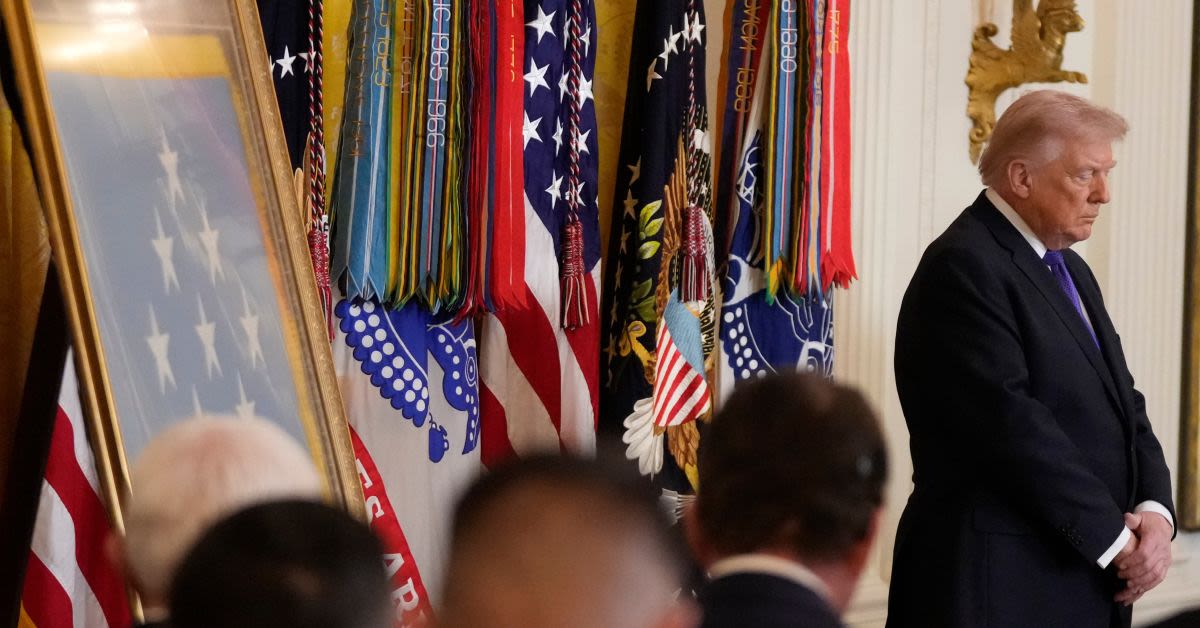
In a solemn White House ceremony, President Donald Trump conferred the Medal of Honor upon three U.S. military veterans whose battlefield heroism in Vietnam and Afghanistan transcended the already demanding standards of American combat valor.
The event marked the culmination of a legislative effort earlier this year, when Congress, through the National Defense Authorization Act, approved specific waivers to upgrade the mens earlier combat decorations by setting aside the usual five-year statutory deadline. According to One America News, the honorees were retired Marine Corps Major James Capers Jr., retired Army Major Nicholas Dockery, and the late Marine Corps Colonel John W. Ripley, whose family accepted the nations highest award for valor on his behalf.
Retired Marine Corps Major James Capers Jr., now 88, was recognized as a trailblazer in Marine Special Operations and for his extraordinary leadership during a four-day mission in South Vietnam from March 31 to April 3, 1967. Then a second lieutenant with the 3d Force Reconnaissance Company, Capers commanded a nine-man team tasked with locating a North Vietnamese regimental base camp deep in hostile territory.
Despite repeatedly encountering enemy formations that significantly outnumbered his small reconnaissance element, Capers relentlessly pressed the attack and directed devastating supporting fire. His actions disrupted and ultimately thwarted an impending assault on a nearby Marine battalion, preventing what could have been a catastrophic blow to American forces.
On the final day of the mission, his patrol was struck by a brutal ambush triggered by a claymore mine, leaving Capers grievously wounded and suffering massive blood loss. Even after receiving morphine for agonizing pain, he continued to organize his teams defensive perimeter and coordinate supporting fires with calm precision.
Demonstrating the ethos of never leaving anyone behind, Capers refused medical evacuation until every member of his team had been safely loaded onto the extraction helicopter. He also insisted that the body of their fallen military working dog be brought out, underscoring a warriors loyalty that extends even to the four-legged partners who share the dangers of combat.
The late Marine Corps Colonel John W. Ripley was honored posthumously for a feat of battlefield engineering and courage that has long occupied a near-mythic place in Marine Corps history. The Department of War has described his actions as a legendary feat of bravery that has been revered within military lore for decades, carried out at the height of North Vietnams massive Easter Offensive on April 2, 1972.
Then-Captain Ripley was serving as Senior Marine Advisor to the Third Vietnamese Marine Corps Infantry Battalion when an enemy force of 20,000 troops and 200 tanks surged toward the village of Dong Ha. Operating under explicit orders to hold and die, he quickly recognized that the enemys mechanized advance hinged on seizing a key bridge spanning the Cua Viet River.
For more than three hours, Ripley dangled by his hands beneath that bridge, painstakingly placing over 500 pounds of explosives along the steel I-beam girders while exposed to relentless sniper and machine-gun fire. His grueling effort, carried out under constant threat of death, showcased a level of physical endurance and moral resolve that military professionals still study today.
Shaking off extreme physical exhaustion, Ripley succeeded in detonating the charges just minutes before the enemy armor could cross, completely destroying the bridge and halting the advance. By blowing the span, he sav[ed] an untold number of lives, buying critical time for friendly forces and dealing a severe blow to communist ambitions in the region.
Colonel Ripley died in 2008, but his example continues to shape the warrior ethos of Marines and soldiers who came after him. His Medal of Honor now formalizes a legacy that had already become a touchstone for those who believe in duty, sacrifice, and the defense of freedom against totalitarian aggression.
Representing the post-9/11 generation of American warfighters, retired Army Major Nicholas Dockery received the Medal of Honor for conspicuous gallantry during a ferocious engagement in Kapisa Province, Afghanistan, on October 2, 2012. At the time, he was a second lieutenant and rifle platoon leader with the 2d Battalion, 12th Infantry Regiment, 4th Infantry Division, operating in constricted urban terrain that favored the enemy.
Dockery and his platoon were ambushed by a heavily armed Taliban force that exploited the tight confines of the city to channel and trap U.S. troops. Over the course of a four-hour firefight, Dockery repeatedly crossed open ground under intense machine-gun fire to reinforce isolated positions and prevent his formation from being split and destroyed in detail.
When an enemy fragmentation grenade landed near his element, Dockery instinctively threw himself toward the blast, using his own body to shield a fellow soldier. That split-second decision, taken at grave personal risk, embodied the warriors creed of placing the lives of comrades above ones own safety.
Moments later, realizing that a noncommissioned officer was missing, Dockery fought his way into a nearby courtyard and single-handedly rescued the unconscious soldier as two Taliban fighters attempted to drag him away. After providing lifesaving medical aid, he climbed to a rooftop to coordinate rotary-wing air support, directing precision strikes that suppressed further enemy counterattacks while his platoon evacuated the wounded.
The White House announced that all three men will be formally enshrined in American military history when they are inducted into the Pentagons Hall of Heroes on Friday morning. Their stories, spanning from the jungles of Vietnam to the streets of Afghanistan, stand as a powerful rebuke to those who downplay American exceptionalism and a reminder that genuine courage, duty, and sacrifice remain at the heart of the nations defense.
Login