
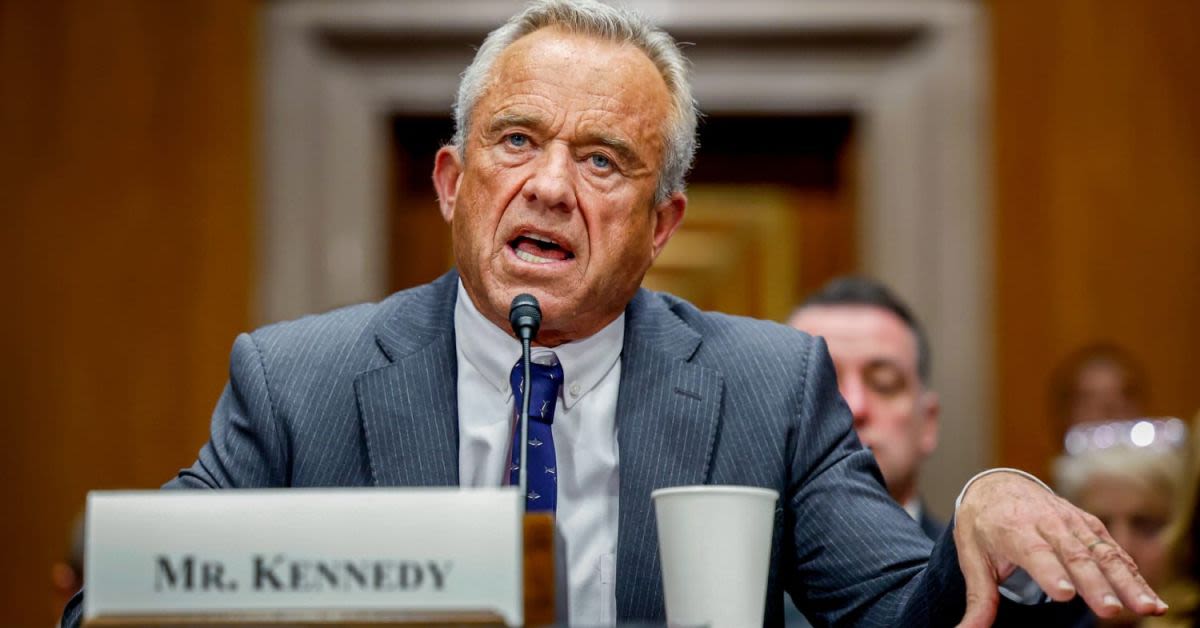
Health and Human Services Secretary Robert F. Kennedy Jr. is pushing back hard against a New York Times portrayal of his leadership as disengaged, calling the report a politically motivated smear built on anonymous gripes and selective sourcing.
According to WND, New York Times reporter Sheryl Gay Stolberg published a lengthy critique of Kennedys tenure at the Department of Health and Human Services, headlined, Kennedy Shows Minimal Engagement in Vast Health Portfolio. The piece, framed as an examination of his management style and priorities, leaned heavily on unnamed or disgruntled former staffers, many of whom were reportedly fired or left under a cloud of poor performance. From the outset, the article was cast by critics as a hatchet job, a familiar pattern in legacy media coverage of conservative or reform-minded officials who challenge entrenched bureaucracies and progressive orthodoxies.
Kennedy, who has emerged as one of the most assertive and hands-on HHS secretaries in recent memory, did not let the attack go unanswered. Early Thursday morning, he issued a blistering, point-by-point rebuttal on X, the platform formerly known as Twitter, that conservatives quickly hailed as a master class in confronting media bias and defending an aggressive reform agenda.
Sheryl. Your article exemplifies the biased reporting we have come to expect from you and . It was unfair, inimical, and inaccurate, Kennedy wrote, opening his response with a direct rebuke of Stolbergs methods and motives. He argued that the entire premise of her story collapses under the weight of publicly available evidence, noting, All one needs to refute your argument is to glance at my publicly available calendar and to review my unprecedented list of accomplishments on a wide range of issues, all of which I drove. You evidently never undertook these foundational due diligences. Why let facts obscure a good story?
The Times piece, as summarized by critics, attempted to paint Kennedy as detached from major global health crises, including the Ebola outbreak in Africa, and suggested he was often absent from key internal meetings. Stolberg leaned on former employeesmany of them anonymous, others known to have been dismissedto claim that Kennedy was inattentive and aloof, a narrative that conveniently dovetails with the broader left-wing effort to undermine conservative governance by portraying reformers as reckless or incompetent.
Kennedy countered that this narrative is not only false but deliberately constructed. You fault me for missing a couple of monthly counselor meetings. However, I meet one-on-one with my counselors every day to decide policy and strategy, he explained, making clear that the formal group sessions Stolberg highlighted are hardly the core of his decision-making process. We schedule the monthly meetings to give the divisions a chance to keep each other informed about HHS-wide policies with which Im already intimately familiar. Had you read my calendar, you would have seen that I have back-to-back meetings all day, every day, with both career and political staff, with my counselors and with outside stakeholders, interspersed with press conferences and other policy announcements.
Far from being disengaged, Kennedy described a work schedule that would be grueling by any standard, particularly for a Cabinet-level official overseeing one of the largest and most complex departments in the federal government. I am knowledgeable and active on every issue in every division of my department, and I always make the final decisions, he wrote, underscoring that he is not a figurehead but the driving force behind HHS policy. I meet with the principals at FDA, NIH, CDC, and my senior counselor every morning, something, Im told, is unprecedented in HHS history. I try to get out of the office between 4:30 and 6:00 PM, so that I can spend three hours, in quiet, responding to emails. I normally work until 11 PM every night, mostly on phone calls to staff.
From a conservative standpoint, this description of Kennedys daily routine aligns with what many on the right have long demanded from federal leadership: direct accountability, personal involvement in policy, and a willingness to challenge the complacency of the permanent bureaucracy. It also stands in stark contrast to the picture painted by Stolberg, who, Kennedy says, cherry-picked voices from the margins of his department to support a prewritten thesis rather than conducting a fair-minded investigation.
In order to prove your preconceived case for my disengagement, you quote anonymous employees, some of whom I fired or who quit to avoid being fired, Kennedy wrote, calling out the Times reliance on sources with obvious axes to grind. You also deceptively quote HHS employees without identifying whether they were among those I fired, thereby depriving your readers of the opportunity to make an independent judgment about their credibility. This tacticelevating disgruntled ex-staffers while obscuring their disciplinary historiesis a familiar one in establishment media coverage of conservative administrations, and Kennedys critique will resonate with readers who have watched similar campaigns against other reformers.
Kennedy framed his tenure at HHS as a deliberate effort to confront and correct a broken agency that has presided over what he calls the worst decline in public health in American history. I came into this job to change the culture of a broken agency that has presided over the worst decline in public health in American history. Of course I fired peoplelots of them! he wrote, unapologetic about removing those who resisted accountability or reform. He noted that it is an easy task for even the laziest journalist, to comb that flotsam and jetsam for malevolence toward the Trump administration, adding that of course, this species of journalist will always be able to find disgruntled individuals among the 70,000 employees of the Department from whom to cherry pick facts to flesh out a preordained hit piece.
All that is required for this brand of journalism is the ethical elasticity that you seem to have in spades, Kennedy continued, accusing Stolberg of starting with a conclusion and then working backward to justify it. You had a preconceived thesis, and you set out to prove it. This is a widely accepted technique in journalism today, but I grew up in an era when it would not have been tolerated by the New York Times. For conservatives who have watched the papers steady drift from reporting to activism, Kennedys lament about the Times lost standards will sound all too familiar.
Beyond defending his own record, Kennedy used his response to offer a broader indictment of what he sees as the collapse of journalistic integrity in the legacy press. Ultimately, God puts us all on this earth to search for existential truths, he wrote, grounding his mission in a moral and even spiritual framework that stands at odds with the technocratic, ideology-driven approach favored by the left. Ive tried to instill this mission at HHS by implementing gold standard research to end the regime of politicized science that COVID exposed to the American public.
There was a time that journalists were proud to be the fearless and uncompromising champions of truth. Standards have devolved, and journalism is dead, Kennedy declared, in a sweeping condemnation of the professions current state. The Times now employs propagandists. Your capitulation to partisanship further compounds your journalistic challenges; since we all are aware of your predictable bias, we at HHS are unwilling to talk to you about the topics that are important. The fact that you have minimal access to decision makers leaves you covering trivia and relying on your own capacity for invention. That refusal to reward biased coverage with access is a stance many conservatives have urged Republican officials to adopt for years.
Kennedy also highlighted reforms that, he says, the Times has deliberately ignored because they do not fit its preferred narrative. Btw. When I took this job, the building was empty. About 90% of the employees were not coming to work, he wrote, describing a demoralized and absentee workforce that had grown comfortable with remote non-accountability. I changed that, but your newspaper never covers my reforms. Nor did you cover the fact that my predecessor almost never showed up for work here during his four years in office. When we came in, there were still artifacts from the first Trump administration in many of our office drawers because no one showed up for work during the Biden years. Just as Rochelle Walensky spent her entire term as CDC Director in Cambridge, Xavier Becerra reportedly spent most of his term as HHS Secretary in California. (I live in California, but Ive only been there once in fifteen months).
In one of the most damning sections of his response, Kennedy contrasted his own hands-on approach with what he described as the catastrophic failures of his Democratic predecessor, Xavier Becerra. His only notable accomplishments here were losing 300,000 children, referred to HHS for custody and care, to human traffickers and drug runners, encouraging transgender surgeries, and disabling the entire program-integrity apparatus, allowing hundreds of billions of dollars of theft from my agency, Kennedy charged, outlining a record that, if fully investigated, would amount to a scandal of historic proportions. I have set out to find the children Becerra lost. He is now the front-runner for the governor of California. These are not invented stories; they are genuine scandals that the Times will never cover, presumably, because the malefactors are Democrats.
That passage encapsulates a core conservative critique of the modern press: Democratic failures, even when they involve vulnerable children, massive fraud, or radical social experiments, are downplayed or ignored, while Republican or reformist officials are subjected to relentless, personalized attacks. Kennedys willingness to call out the medias double standard by nameand to tie it directly to the suffering of trafficked children and the erosion of program integrityunderscores why he has become such a lightning rod for the left.
Stolberg also faulted Kennedy for spending what she implied was excessive time with Native American communities in Alaska, a charge he dismissed as both ignorant and revealing. Finally, you criticize me for spending time with the Indian tribes in Alaska. I consider that part of my job, he wrote, pointing out that the Indian Health Service falls squarely under his authority. I run the Indian Health Services, and Ive had unprecedented success in transforming IHS from a backwater to a top priority for this department. Ive made more trips to Indian country and to Indian health clinics and hospitals than any HHS secretary in history, and Ive brought Indians into high positions on the sixth floor for the first time in agency history. This is another success story that the Times will never cover.
For a conservative audience, Kennedys emphasis on personal responsibility, institutional reform, and attention to neglected communities fits comfortably within a vision of limited but effective governmentone that serves citizens rather than ideological agendas. His insistence on in-person work, his crackdown on waste and abuse, and his focus on depoliticizing science all run counter to the bureaucratic inertia and progressive social engineering that flourished under his predecessors, which may explain why he has become such a target for the left-leaning press.
If the publishers at The New York Times had integrity they would be humiliated by this nasty effort to damage the sitting HHS Secretary by Goldberg, the WND piece observed, echoing the frustration of many readers who see the papers coverage as less about informing the public and more about protecting a political class. Kennedys response, far from the defensive spin politicians often resort to, reads like a prosecutorial brief against a media institution that has abandoned its own professed standards.
As the clash between Kennedy and the Times continues, the broader stakes are hard to miss. On one side stands a secretary who says he is working late into the night to restore accountability, rescue trafficked children, and rebuild a demoralized agency hollowed out by absentee leadership and politicized science. On the other stands a legacy outlet that, rather than scrutinizing the failures of the previous administration or the scandals of the progressive establishment, has chosen to train its fire on the official attempting to clean up the messrelying on anonymous malcontents and selective anecdotes while ignoring the public record that Kennedy insists is hiding in plain sight.
Login