
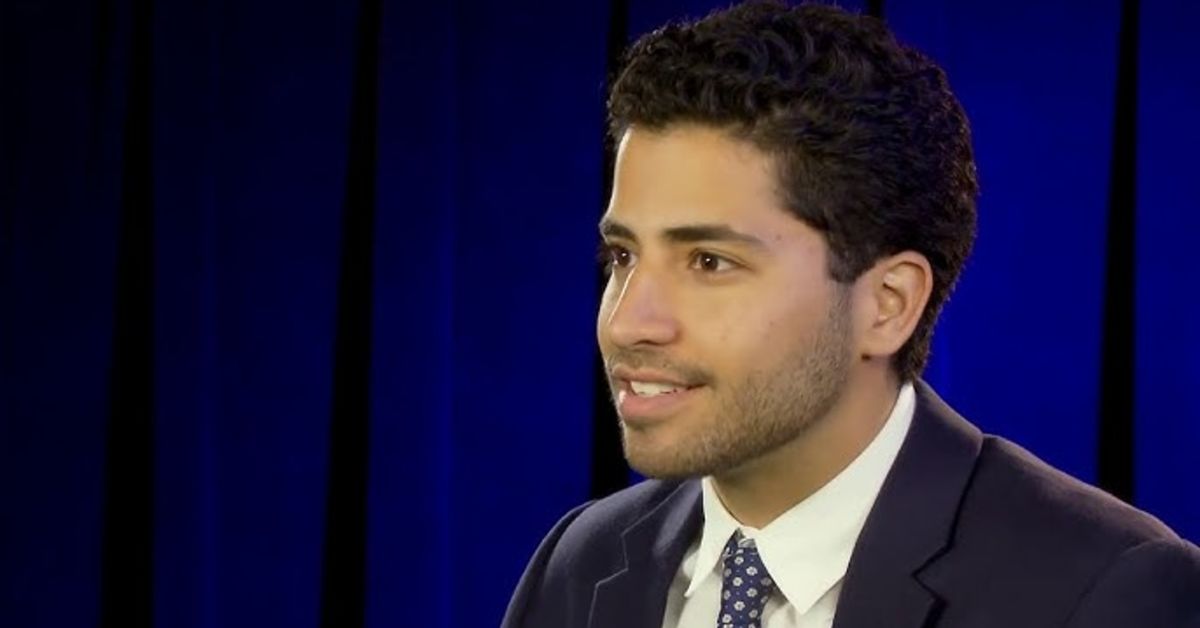
Manny Rutinel, a progressive Democrat running in one of Colorados most competitive congressional districts, is facing serious questions over whether he illegally used the state capitol as a backdrop for campaign fundraising.
According to the Washington Free Beacon, the controversy centers on an April 9 video Rutinel filmed inside the Colorado state capitol, where he serves as a state representative, confronting his likely Republican opponent, Rep. Gabe Evans, over a sprawling spending package known as the One Big Beautiful Bill and its associated Medicaid reductions. The clip, posted to social media, shows Rutinel pressing Evans on his vote before the audio abruptly shifts to the 1990s hit Jump Around by House of Pain, then cuts to an image of Rutinel on the campaign trail with the bold text, "Im coming for his job. His days in Congress are numbered." The post ends with a direct call to action, urging viewers to "join the fight (link in bio)."
Rutinel later repurposed a screenshot from that same exchange in at least two campaign fundraising emails, sent April 17 and April 21, that linked directly to his ActBlue donation page. The first email, bearing the subject line "I confronted my MAGA congressman," opened with Rutinel declaring, "I'm Manny Rutinel, and I decided to run for Congress to unseat Gabe Evans because we have the power to stop the damage of the Trump agenda right here, right now," before warning supporters, "But this is one of the closest seats in the entire country, so I can't flip it alone." A second appeal, titled "Gabe Evans: I'm coming for your job," used the same imagery from the capitol confrontation to solicit contributions.
The problem for Rutinel is that Colorado law explicitly bars elected officials from using state resourcesincluding their privileged access to the capitol buildingfor campaign purposes. The General Assemblys own legal office has described such conduct as "improper and unethical" and has urged "that members and employees stay comfortably clear of the line separating official duties from political activity." That line appears to have been crossed when a video shot in the course of official business was later weaponized for partisan fundraising.
Evans, anticipating potential misuse, recorded the encounter as well, and his versionobtained by the Washington Free Beaconincludes key moments Rutinel left on the cutting-room floor. At the outset of the exchange, an off-camera voice reminds Rutinel that campaigning is not allowed inside the capitol, prompting Rutinel to insist, "I'm not campaigning." As Evans walks away at the end, he reiterates, "No campaigning on state property," to which Rutinel again replies, "I'm not campaigning."
Campaign finance experts are not buying that defense. Tammy Klein, chief operating officer of the compliance firm SWS Polifi, said Rutinels conduct was "definitely illegal," noting that the use of footage captured while acting as a legislator for explicit fundraising purposes crosses a bright legal line. "He was there in his official capacity, but yet he used material to produce something for fundraising," Klein told the Free Beacon, adding, "You cannot use any government-funded material or be campaigning on government property."
Rutinels campaign has declined to address Kleins legal assessment directly. Instead, a spokesperson framed the confrontation as a matter of public accountability, saying, "Representative Rutinel believes it's important for Gabe Evans to explain to Coloradans why he voted to take healthcare away from 10 million Americans, so when he saw Evans he asked him to explain his vote to his constituents." That explanation sidesteps the core issue: whether a sitting lawmaker can turn an official venue into a campaign stage and then monetize the footage.
The stakes are high in Colorados Eighth Congressional District, a newly drawn swing seat that both parties view as pivotal in the battle for control of the House. Evans secured his 2024 victory by fewer than 2,500 votes, underscoring the districts razor-thin margins and making any ethical misstep by his challenger politically consequential. Rutinel currently enjoys a cash advantage in the Democratic primary over former state representative Shannon Bird, with nearly $1.8 million on hand to Birds $1.1 million as of March 31, but an internal Bird campaign poll last month showed her edging him by 1 percentage point, with a striking 45 percent of voters still undecided.
Rutinel has tried to cast himself as a defender of Medicaid, attacking Evans for supporting the One Big Beautiful Bill and its Medicaid cuts. Yet his own record in Denver complicates that narrative, as he recently voted for a budget measure that imposed a 2 percent cut on Medicaid health care providers to help close Colorados $1.5 billion deficit. That same budget, however, preserved the controversial Cover All Coloradans program, which offers taxpayer-funded health care to "pregnant persons" and children who would otherwise qualify for Medicaid but are in the country illegally, though with reduced benefits and enrollment caps.
That program, backed by both Rutinel and Bird, has exploded in cost since its inception. When the legislature created Cover All Coloradans in 2022, it was projected to cost under $15 million, but the price tag has since soared to nearly $105 million this fiscal yearroughly seven times the original estimate. While Rutinel criticizes Evans for tightening eligibility and verification through the One Big Beautiful Bill, he has supported a program that significantly expands benefits to noncitizens at a time when the state is grappling with a massive budget shortfall.
The One Big Beautiful Bill, by contrast, tightened verification of citizenship and immigration status for benefit eligibility, a move more in line with conservative priorities of fiscal restraint and enforcement of existing law. For many voters in the Eighth Districthome to working-class families already squeezed by inflation and rising taxesthe idea of subsidizing health care for illegal immigrants while cutting provider payments for citizens is likely to be a hard sell. Rutinels voting record thus risks alienating moderates and independents who may be open to a Democrat but wary of progressive spending priorities.
Rutinels legal and ethical troubles are not confined to campaign finance. A former environmental lawyer with the activist group Earthjustice, he was arrested in November 2019 alongside dozens of demonstrators who stormed the field during a Yale University football game to protest fossil fuels. His campaign now claims he attended the event merely as a legal observer, but the episode underscores his alignment with the Green New Deal-style activism that is deeply unpopular in energy-producing regions.
That background is particularly sensitive in Colorados Eighth District, which encompasses a major oil and natural gas field and helps make Colorado the fourth-largest oil-producing state in the nation. Voters whose livelihoods depend on traditional energy may view Rutinels past activism as a direct threat to their jobs and local tax base. His history of environmental extremism stands in sharp contrast to Evanss more industry-friendly approach, giving Republicans a clear line of attack in a district where energy policy is not an abstraction but a paycheck.
Rutinel has also attempted to soften his image on another front: his long-standing vegan activism. As a Law, Ethics & Animals Program fellow at Yale Law School, he denounced the meat industry as "horrific" and "exploitive [sic]" and even petitioned fast-food chain Popeyes to introduce plant-based menu options, positions that play well on elite campuses but not necessarily in farm and ranch country. He later founded the nonprofit Climate Refarm, which, as the Free Beacon reported, lobbied schools to switch to plant-based meals and pushed for tax hikes on meat, dairy, and eggs.
Now, running in a district with a significant animal agriculture sector, Rutinel insists he was only targeting the industrys "bad apples." That rhetorical retreat reflects a broader pattern: aggressive left-wing activism in safe, progressive environments, followed by strategic moderation when facing a more centrist or conservative electorate. For many rural and suburban voters, especially those tied to agriculture and energy, such reversals may look less like nuance and more like political opportunism.
Republicans, unsurprisingly, see a clear narrative emerging. "From getting arrested for a deranged Green New Deal protest to dressing up as a cow and hoping the world went vegan, Manny Rutinel's entire existence has been one embarrassing episode after the next," Republican National Committee spokesman Zach Kraft said, encapsulating the GOPs portrayal of Rutinel as an out-of-touch ideologue. With ethics questions swirling around his use of the state capitol for campaign purposes, a record of supporting costly benefits for illegal immigrants while cutting Medicaid providers, and a history of radical activism at odds with the districts economic base, Rutinel faces an uphill battle convincing swing voters that he represents their values rather than the priorities of the progressive left.
Login