
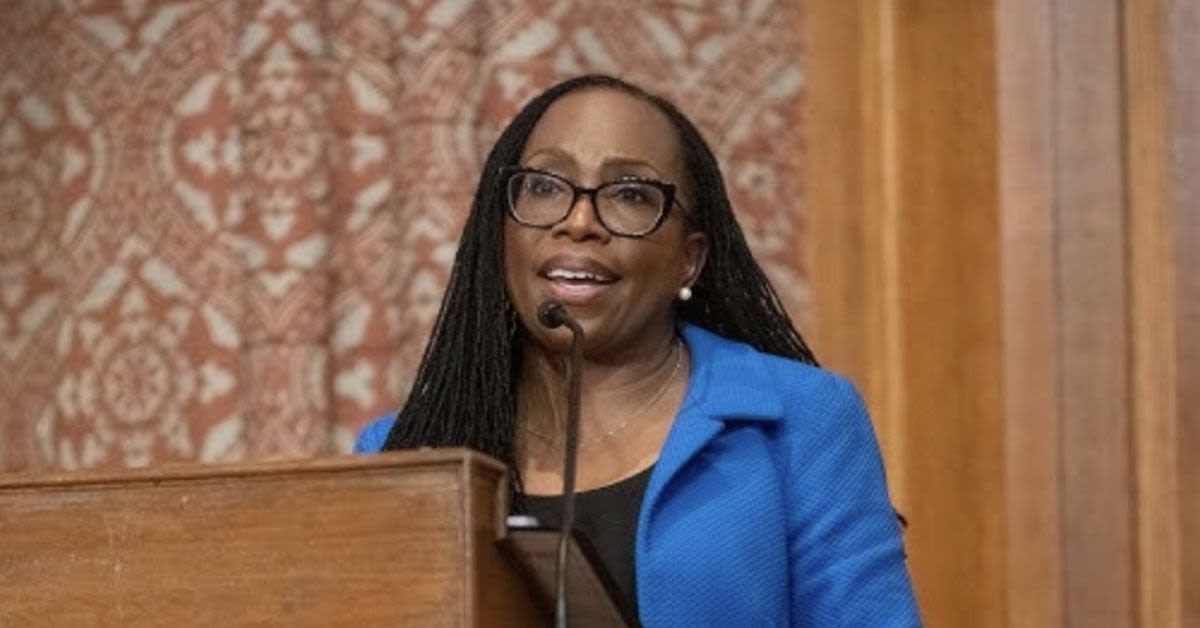
President Joe Bidens lone appointment to the U.S. Supreme Court, Justice Ketanji Brown Jackson, is rapidly emerging as the most openly ideological and activist member of the high court, raising fresh concerns about judicial overreach and partisan lawfare from the bench.
During her confirmation hearings, Jackson signaled her alignment with the most radical elements of the contemporary left, particularly on gender ideology, when she famously claimed she was unable to define the word woman. That moment, which most Americans recognized as both evasive and revealing, placed her squarely in the camp of activists who insist that a man who says he is a woman IS a woman, a position that undergirds the broader push for body-altering transgender procedures and policies that erase biological distinctions.
Her record since joining the court has only reinforced those concerns, as she has pressed for expansive interpretations of birthright citizenship for children of illegal aliens and supported the use of race as a central factor in drawing congressional districts. According to WND, she has also repeatedly suggested that her own policy preferences and political instincts should guide her judicial work, boasting in effect of her authority to tell the public what she thinks rather than what the Constitution demands.
Her conduct off the bench has drawn scrutiny as well, as she has used her public profile to participate in a Broadway production and to issue unusually sharp and untoward condemnations of her colleagues, behavior that many court watchers see as undermining the dignity and neutrality expected of a justice. Now, a report at the Federalist reveals a far more troubling development: Jackson has openly floated the idea that lower federal courts might, in some circumstances, disregard or sidestep the Supreme Courts own rulings.
The episode unfolded during a recent appearance at the American Law Institute, where Jackson shared the stage with U.S. District Judge Richard Gergel of South Carolina. Gergel raised concerns about the Supreme Courts emergency docket, noting that the justices sometimes issue brief, rapid decisions that appear to upend long-standing precedent, a practice that has become more visible as the court has taken up high-stakes disputes on an expedited basis.
Gergel described his frustration in unusually candid terms, telling Jackson, I have found, as a district judge, it mystifying at times, where an emergency docket decision of maybe just two or three pages, appears to countermand longstanding Supreme Court precedent. Are we to apply the brief, the short stay decision, or denial of stay? Or are we to follow 50 years of precedent? Its a perplexing thing to do. Rather than firmly reaffirming the basic constitutional principle that lower courts are bound by the Supreme Courts directives, Jackson instead validated the idea of resistance from below.
She responded that it is absolutely a legitimate question whether lower court judges should follow the Supreme Courts emergency orders or instead cling to older precedents that may point in a different direction. Jackson went on to frame the issue as a practical dilemma for trial judges, remarking, I mean, what is a lower court judge to do after the Supreme Court has intervened early on to tell everyone whos likely to win the case?
Jackson further complained that the Supreme Court has, at times, stayed lower court rulings even after a district judge has made findings of fact or conducted extensive hearings, a result she clearly opposes. The Federalist characterized her remarks bluntly, stating, Jacksons comments are especially insane given that there is nothing new about lower courts being bound by the Supreme Courts guidance (including an emergency order). But this wasnt the only time Jackson was seemingly unaware how the court she sits on works.
The controversy appears to stem in part from Jacksons reaction to a recent Louisiana redistricting case, in which the Supreme Court held that Section 2 of the Voting Rights Act, properly understood, enforces the Constitutions ban on intentional racial discrimination but cannot be twisted into a mandate to force states to engage in race-based discrimination by creating majority-minority districts. That ruling, which rejected the race-driven mapmaking favored by Democrats, was an 8-1 decision, underscoring how far Jackson stands from the mainstream even within the current court.
Because election deadlines were approaching, the justices allowed the decision to take effect immediately rather than waiting the customary 30 days, a procedural step well within the courts authority. Jackson reacted with fury, accusing her colleagues of meddling in the political process and declaring, Not content to have decided the law, [the Supreme Court] now takes steps to influence its implementation. The Court unshackles itself from both constraints today and dives into the fray. And just like that, those principles give way to power.
Her colleagues on the right were not persuaded, and they did not mince words in their response. Justices Samuel Alito, Clarence Thomas, and Neil Gorsuch pointed out that under Jacksons preferred approach, the Supreme Court would effectively be ordering Louisiana to conduct elections under a districting plan that had already been found unconstitutional, a result that would elevate partisan advantage over constitutional fidelity.
They described Jacksons accusations as baseless and insulting, a rare public rebuke of a sitting colleague. The conservative justices also highlighted the ideological nature of her objections, noting, Its hard to ignore that Jackson is treating standard functions of the court as possibly illegitimate whenever they happen to produce an outcome she dislikes.
Jackson has also warned that the court must be careful when issuing rulings that touch on politics, a curious admonition given that her sharpest dissents have come precisely when the courts decisions cut against her own partisan preferences. Her extremism has been so pronounced that even the courts other two liberals, Justices Sonia Sotomayor and Elena Kagan, have frequently declined to join her most strident opinions, leaving her isolated on the far left flank of the bench.
In her public and written statements, Jackson has accused other justices of being overly sympathetic to corporate interests while simultaneously insisting that she wants Americans to see the court as neutral. At the same time, she has been widely viewed as a leading intellectual ally of Democrat proposals to pack the Supreme Court by adding four new justicespresumably all progressive ideologueswho could instantly erase the current six-justice conservative majority and deliver reliable victories for the lefts policy agenda.
Jackson has repeatedly asserted that her own Democrat-aligned positions are simply what the Constitution requires, a claim that conservatives see as an attempt to cloak partisan outcomes in the language of original authority. Justice Alito, in analyzing her writings on the Louisiana case, went so far as to say that Jackson was effectively working on behalf of those who would find it politically advantageous to have the election occur under the unconstitutional map.
Legal analysts critical of Jackson have described her opinions as often poorly argued and lack coherent legal reasoning, and have noted that she frequently issues dissents that read more like an unhinged solo screed than a disciplined judicial analysis. For a justice who campaigned rhetorically on neutrality and restraint, her record so far suggests a jurist determined to push the courtand the countrytoward a more aggressively progressive posture, even if that means encouraging lower courts to question the authority of the very institution on which she serves.
Login