
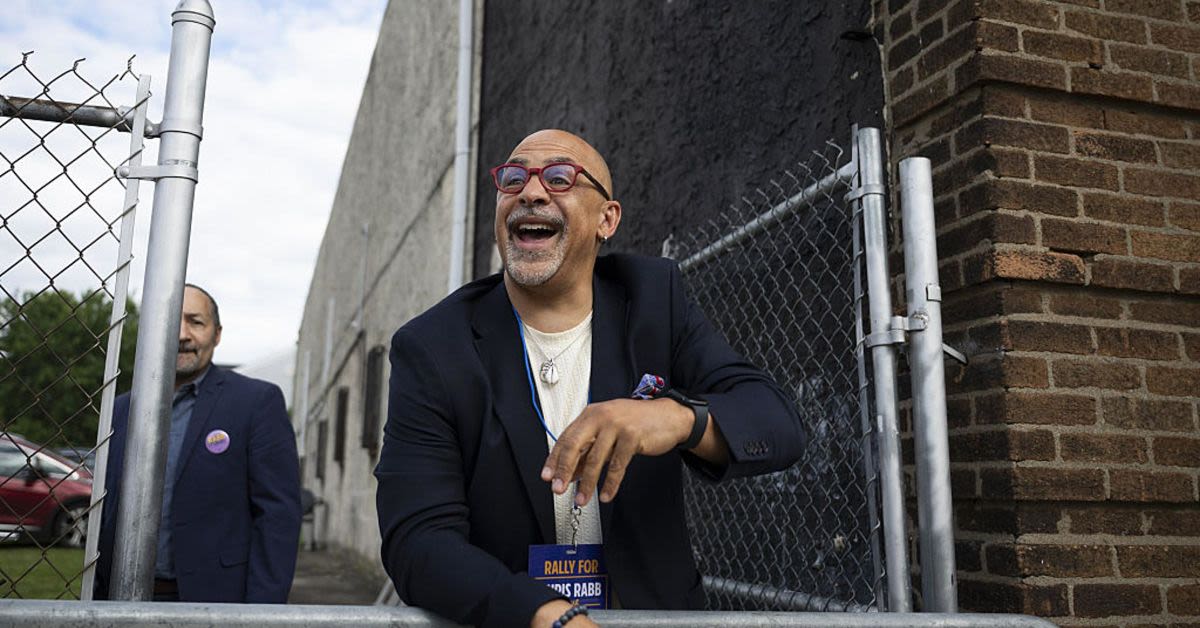
The Democratic Partys increasingly open embrace of socialism was put on vivid display in Pennsylvania this spring, as state Rep. Chris Rabb rode an unapologetically hard-left platform to victory in the primary for the 3rd Congressional District.
In the May 19 primary, Rabb handily defeated the preferred candidate of the party establishment, state Sen. Sharif Street, a former state Democratic Party chair and a well-connected cog in the Philadelphia political machine. According to RedState, the outcome underscores how far the Democratic base in deep-blue districts has shifted, rewarding candidates who run not as moderates, but as self-described democratic socialists.
Throughout the campaign, Rabb made little effort to conceal his contempt for his own partys leadership and its traditional power brokers. He attacked the Democratic Party, denounced the status quo, and eagerly aligned himself with the farthest-left elements of the progressive movement.
Rabb secured endorsements from the Philadelphia Democratic Socialists of America and Our Revolution, the group launched by supporters of Sen. Bernie Sanders. He also received public praise from socialist icons such as Rep. Alexandria Ocasio-Cortez of New Yorks 14th District and lauded New York City socialist lawmaker Zohran Mamdani, all while proudly running as a democratic socialist himself.
Despite his radical branding, or perhaps because of it in this heavily Democratic district, Rabb cruised to victory and is now effectively guaranteed a seat in Congress. The Republican Party did not even bother to field a candidate or hold a primary in the district, virtually assuring that Rabb will arrive in Washington, D.C., next January without serious opposition.
Once sworn in, Rabb is expected to slot neatly into the ranks of the Squad and its ideological orbit, amplifying the partys most extreme voices. He will almost certainly continue to attack his own partys leadership from the left, generating headlines with provocative rhetoric that will raise his national profile and expand his influence among progressive activists.
Far less likely to receive sustained media scrutiny, however, are the actual policies Rabb is championing under the banner of democratic socialism. Even less attention will be paid to the real-world consequencesshort-term and long-term, intended and unintendedof implementing such an agenda, despite more than a century of historical evidence about how similar experiments have fared.
On his campaign website, Rabb vows to fight the broken system that only works for the wealthy and to guarantee families can access all the essentials we need to thrive. These are familiar populist slogans on the left, but behind the rhetoric lies a sweeping program to expand federal power and dependency on government.
To create what he calls an affordable and accessible society for all, Rabb proposes a vast array of Universal Basic Guarantees: Medicare for All, Housing, Food and Water, Free Transit, High-Speed Internet, Childcare, Income, Jobs. In other words, he envisions the federal government as the primary provider of nearly every major necessity of life, from health care and housing to employment and income.
Yet even Rabb implicitly concedes that this massive entitlement architecture is only one piece of his broader transformation. He argues that such guarantees alone cannot fix the broken system or fully secure the essentials, and therefore must be paired with an aggressive expansion of federal public works and climate policy.
To that end, Rabb calls for federal public works programs for critical national efforts like infrastructure upgrades, green energy conversion, nature conservation, and more. This is a deliberate echo of New Deal-era programs, but on a scale and with an ideological edge that would make the federal government the central planner of vast swaths of the economy.
This leads directly into another of Rabbs core pillars: the so-called climate crisis. As we continue to face the increasing impacts of climate change, we need action now, he declares, adopting the alarmist framing that has become standard among progressive activists and many Democratic politicians.
Decarbonizing our economy is not just good for the environment and our health and safety, it will also strengthen economic opportunity for so many of our most vulnerable communities. In line with that claim, Rabb endorses The Green New Deal, Green Union Jobs, a Civil Climate Corps, No Hyperscale Data Centers, and a Just Transition to 100% Renewable Energy.
Rabbs stated goal is nothing less than a fully decarbonized society. He is not merely advocating incremental emissions reductions or technological innovation, but a wholesale restructuring of the American energy system and, by extension, the entire economy that depends on it.
His radicalism does not stop with economic and climate policy. Rabb also supports packing the Supreme Court, a move that would allow Democrats to install additional justices to rubber-stamp their most constitutionally dubious programs and sidestep the arduous constitutional amendment process.
Taken together, Rabbs agenda would fundamentally alter the relationship between the individual and the federal government. His universal basic guarantees invert the Founders design of a national government with limited, enumerated powers, replacing it with a centralized state that claims authority to provideand thus controlnearly every aspect of citizens lives.
Such a transformation would shift the federal government from a rights-protecting institution to a rights-granting one, with all the dangers that entails. When the state becomes the source of rights rather than their guardian, those rights can be reshaped, restricted, or revoked at the whim of political majorities and bureaucratic elites.
The sheer cost of Rabbs program is effectively incalculable and plainly unaffordable, even before considering the economic distortions it would create. Yet the arithmetic, as staggering as it would be, is only part of the problem.
If Washington were to provide universal basic guarantees of income, housing, health care, and more, the incentive to work and innovate would inevitably plummet. A dynamic, productive economy cannot be sustained when government promises cradle-to-grave security regardless of effort, productivity, or personal responsibility.
Rabbs enthusiasm for a new wave of public works programs carries its own set of risks. Every dollar spent by the federal government must first be taken from the private sector, where individuals and businessesguided by prices, profit, and competitionhave historically allocated resources far more efficiently than any command-and-control bureaucracy.
The New Deals vast public works initiatives, often romanticized by the left, never delivered the economic miracle Franklin D. Roosevelt promised. Make work programs misallocated labor and capital, and it was ultimately private-sector mobilization during World War II and postwar free-enterprise growthnot federal jobs schemesthat restored American prosperity.
Most troubling of all is Rabbs climate alarmism and his demand for the total decarbonization of society. Decades of data do not support the hysterical narrative of ever-worsening increasing impacts of climate change that he and his allies invoke to justify unprecedented government control.
Whipping up fear among children and young adults that the world is on the brink of collapse due to climate change, purely for political leverage, is nothing short of grotesque. Yet this is precisely the tactic that has propelled the Green New Deal to the center of the democratic socialist agenda since 2018, a program Rabb now eagerly embraces as an FDR-style reboot for the 21st century.
The Green New Deal is the crown jewel of democratic socialism, a single legislative vehicle designed to lock in much of Rabbs universal basic guarantees while forcing a rapid, government-mandated transition away from fossil fuels. It would address his obsession with decarbonization by effectively banning conventional energy and imposing a top-down green regime on the entire country.
Such a scheme would devastate the reliability of the U.S. power grid, cripple transportation networks, and expose millions to life-threatening blackouts when electricity becomes a luxury rather than a dependable necessity. The Department of Energy itself acknowledges that Petrochemicals derived from oil and natural gas make the manufacturing of over 6,000 everyday products and high-tech devices possible, underscoring how deeply modern life depends on fossil fuels.
From health care and food production to construction, communications, and transportation, every critical sector of modern society relies on affordable, reliable energy. Without fossil fuels, there is no modern society, and any attempt to pretend otherwise risks plunging Americans into a lower standard of living and greater vulnerability.
Rabb tells voters he will build an affordable and accessible society for all, promising comfort, security, and justice through an ever-expanding federal state. Yet the policies he champions would almost certainly produce the opposite: higher costs, reduced freedom, weaker economic growth, and a fragile energy system that endangers lives.
As Chris Rabb prepares to take his democratic socialist vision to Congress, he will not be alone. From Seattle to New York City, democratic socialism is advancing, and it is likely that even more such candidates will enter Congress after the 2026 midterm elections, with early polling suggesting they are already eyeing 2028 as their next great opportunity.
Login