
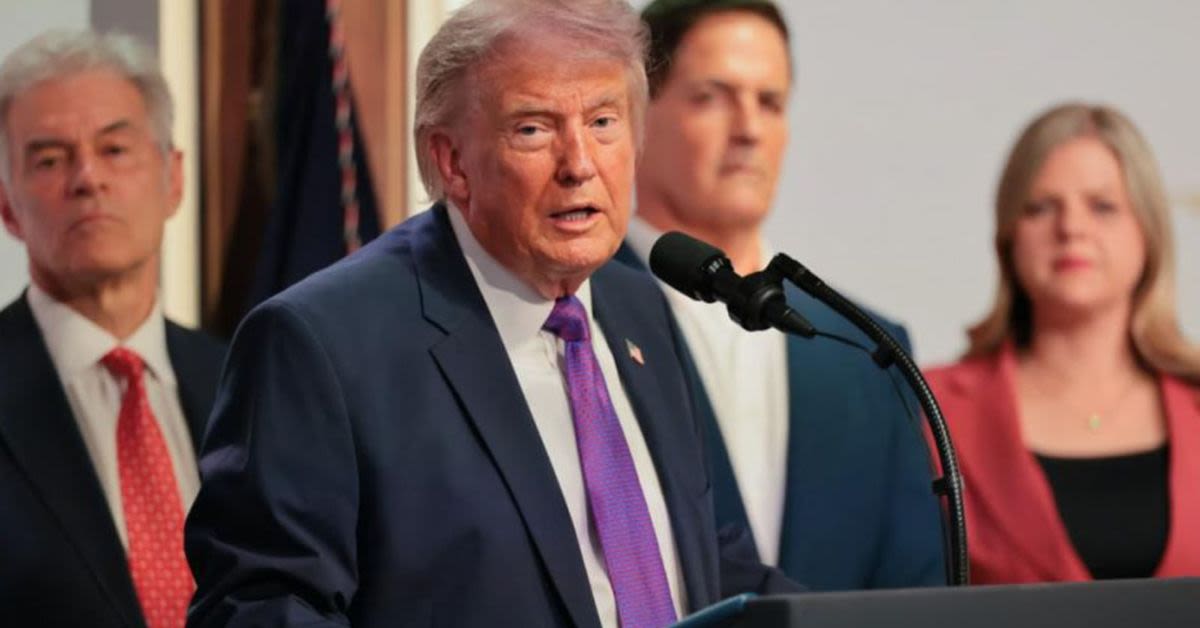
President Donald Trump has sharpened the terms of his nuclear negotiations with Tehran, declaring that Irans cache of highly enriched uranium must be surrendered to the United States or destroyed under strict international supervision.
According to RedState, President Trump used a Truth Social post to spell out a non-negotiable condition of any agreement with the Islamic Republic. The Enriched Uranium (Nuclear Dust!) will either be immediately turned over to the United States to be brought home and destroyed or, preferably, in conjunction and coordination with the Islamic Republic of Iran, destroyed in place or, at another acceptable location, with the Atomic Energy Commission, or its equivalent, being witness to this process and event, the president said in a post on Truth Social.
That statement signals a tightening of the deals technical requirements and a clear rejection of half-measures that have plagued past diplomatic efforts. It reflects a conservative insistence on verifiable disarmament rather than trusting Tehrans promises or relying on opaque international arrangements.
Iranian officials had previously floated the idea of transferring the enriched uranium to a third country, a proposal that might appeal to globalists but raises obvious security concerns. The risk that such a country could quietly return the material to Iranor even divert it for its own malign purposesunderscores why the Trump administration is insisting on direct U.S. control or supervised destruction.
Even as these negotiations unfold, Tehran has continued its familiar pattern of brinkmanship and legalistic maneuvering. As earlier reporting noted, Iranian officials attempted to walk back their talk of tolls on the Strait of Hormuz, dressing up what amounts to extortion in more palatable legal language, while President Masoud Pezeshkian escalated tensions with inflammatory rhetoric.
On the ground, that rhetoric has been accompanied by suspicious activity along Irans southern coast. Explosions were reported in Bandar Abbas and in the coastal areas of Sirik and Jask, locations where the regime has previously attempted to menace U.S. warships and disrupt vital shipping lanes.
U.S. Central Command has now confirmed that American forces responded with limited, targeted action. U.S. forces conducted self-defense strikes in southern Iran today to protect our troops from threats posed by Iranian forces, Capt. Tim Hawkins, a CENTCOM spokesperson, said.
Targets included missile launch sites and Iranian boats attempting to emplace mines. U.S. Central Command continues to defend our forces while using restraint during the ongoing ceasefire, Hawkins said. A senior U.S. official added that two Iranian boats were observed laying mines in the Strait of Hormuz, and that U.S. forces also acted after a missile site targeted American warplanes.
The strikes reportedly destroyed Islamic Revolutionary Guard Corps boats and hit a surface-to-air missile site in Bandar Abbas, directly degrading Irans capacity to threaten U.S. assets and international shipping. CENTCOM emphasized that the operations have concluded for now and do not signal an end to the ceasefire, underscoring that Washington is prepared to use force when necessary while still pursuing a negotiated outcome that removes Irans enriched uranium from the battlefield of Middle Eastern power politics.
Login