
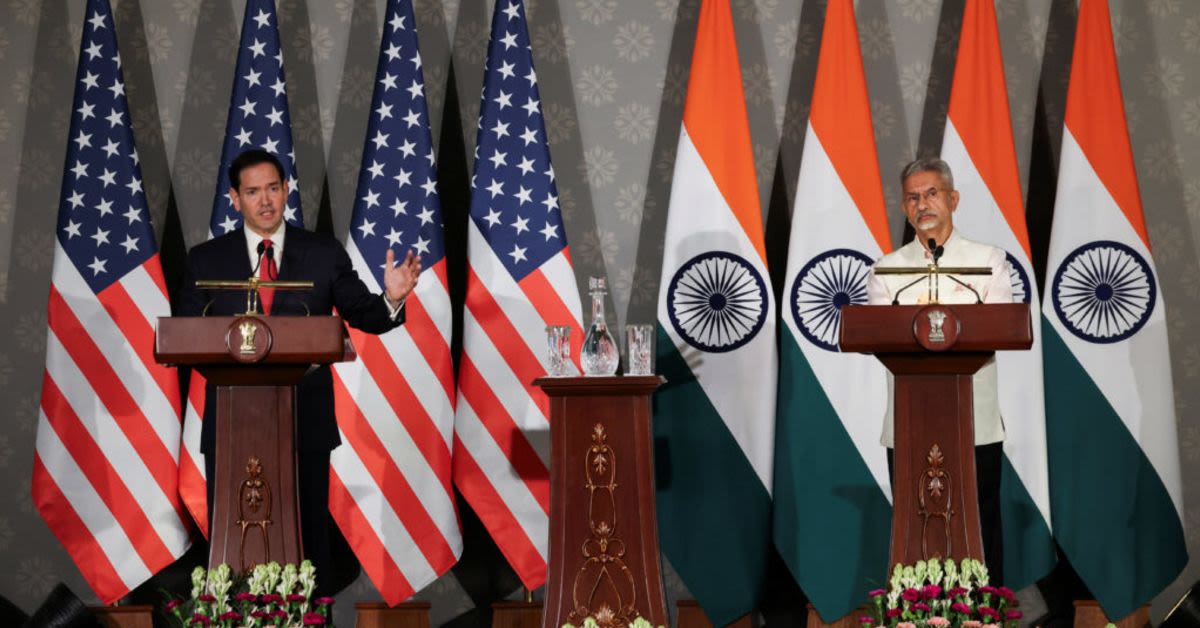
Secretary of State Marco Rubio used a visit to New Delhi to defend President Donald Trumps immigration overhaul, insisting the reforms are driven by national interest and border security, not hostility toward India or its highly skilled workers.
Speaking alongside Indian officials as reported by Fox News, Rubio confronted growing unease in New Delhis political class and media over U.S. visa changes that could slow the flow of Indian professionals to America. He argued that while India may feel the impact more acutely because of its large pool of high-skilled migrants, the Trump administrations approach is not aimed at any single country.
"What I want to leave clear is that the changes, while they may be having a disproportionate impact on a place like India that provides so many high-skilled workers to the U.S. economy, it is not a system that is targeted at India," Rubio said during a Sunday news conference in New Delhi, India. "It is one thats being applied globally."
Indias foreign minister Subrahmanyam Jaishankar, however, made clear that New Delhi is not entirely reassured. "I apprised Secretary Rubio of challenges that legitimate travelers face in respect of visa issuance," Jaishankar said.
The Indian minister underscored that while both nations cooperate against illegal migration, New Delhi expects Washington not to punish lawful travelers in the process. "While we cooperate to deal with illegal and irregular mobility, our expectation is that legal mobility would not be adversely impacted as a consequence. After all, this is very relevant to our business, technology, and research cooperation," he said.
Rubio himself the son of Cuban immigrants emphasized that the United States continues to see India as a "strategic ally" and a crucial economic partner, even as it tightens and modernizes its immigration rules. He framed the Trump-era reforms squarely within an America First doctrine that prioritizes U.S. sovereignty and national interest over foreign pressure.
"Everything that you do as a country needs to be in your national interest, and that includes your immigration policy," Rubio continued.
"The United States, I believe, is the most welcoming country in the world on immigration."
He pointed to the sheer scale of legal immigration as evidence that Washington remains open to newcomers who follow the rules and contribute. "Every single year, a million people, roughly, become permanent residents of the United States and contribute greatly," he said.
Rubio acknowledged the "contribution that Indians have made to the U.S. economy," highlighting the billions in investment and innovation that Indian firms and professionals bring. "Modernization" was the keynote to Rubio's reply to concerns about the "contribution that Indians have made to the U.S. economy," noting "over $20 billion have been invested in the U.S. economy by Indian companies."
He insisted that the current tightening is part of a comprehensive overhaul of a broken system, not a targeted strike on Indian nationals.
"The changes that are happening now or the modernization of our migration system into the United States is not focused its not India-specific; it is global," Rubio stressed.
"Its being applied across the world. We are in a period of modernization, and Ill be frank and honest with you, because its important to talk about this: Weve had a migratory crisis in the United States," he said.
"This is not because of India, but broadly, we had over 20 million people illegally enter the United States over the last few years, and weve had to address that challenge." The reforms were "long overdue," he added.
"It has to be a process thats adjusted in every era to the realities of the modern times in which you live, and we are, and its long overdue," Rubio added. "So the United States is currently undergoing a process of reforming the system by which we choose how many people come into our country, who comes in, when they come in, et cetera."
From a conservative standpoint, Rubios remarks reflect a familiar argument: a sovereign nation has both the right and the duty to decide who enters, on what terms, and in what numbers. He urged India and other partners to recognize that a secure, orderly system ultimately benefits both the host country and lawful migrants who play by the rules.
"Anytime you undertake a reform, anytime you undertake a change in the system by which you admit people, or frankly, anytime you undertake a reform in any system not just on immigration there are going to be theres going to be a period of transition thats going to create some friction points and some difficulties and so forth," he said. "Ultimately, we think when this process is in place, once this process has been modernized and thats really what it is we are modernizing the U.S. immigration system for the 21st century so that it is an immigration system thats not just good for America but its also good for the people that are coming."
The secretary argued that both the United States and India stand to gain from a more efficient, rules-based immigration framework that rewards merit and discourages abuse. "Were going to wind up with a system thats more efficient and even better than the previous system, and in some ways may prove to be even more beneficial than the previous system was to people from India that seek to enter the United States to work and innovate," he concluded.
"But obviously, theres going to be a period of adjustment along the way. Were in a period of transition, and like any period of transition theres going to be some bumps on that road."
"But we think ultimately our destination is going to be a better system, a more efficient system, one that works better than the one that we had in place previously, and more sustainable, by the way," Rubio said.
That emphasis on sustainability echoes long-standing conservative concerns that uncontrolled migration strains public services, depresses wages, and undermines the rule of law.
Rubio also confronted accusations of anti-India racism in the United States, dismissing such claims as the product of fringe voices rather than mainstream American sentiment. He urged Indian audiences not to confuse online vitriol or isolated remarks with the broader character of the American people.
"Ill take that very seriously about the comments," Rubio said.
"Look, Im sure that there are people that have made comments online and other places, because every country in the world has stupid people. Im sure there are stupid people here."
"There are stupid people in the United States that make dumb comments all the time. I dont know what else to tell you other than the United States is a very welcoming country," Rubio said. "Our nation has been enriched by people who come to our country, have come from our country from all over the world, have become Americans, have assimilated into our way of life, and have contributed greatly."
For the Trump administration and its allies, that is the core of the message: a firm border, a modernized system, and a preference for legal, merit-based immigration are not signs of xenophobia but of a confident nation determined to protect its citizens while still opening its doors to those who respect its laws and values. Rubios comments in New Delhi signal that Washington will not retreat from its reform agenda, even under diplomatic pressure, but will continue to court partners like India within a framework that puts American sovereignty and security first.
Login