
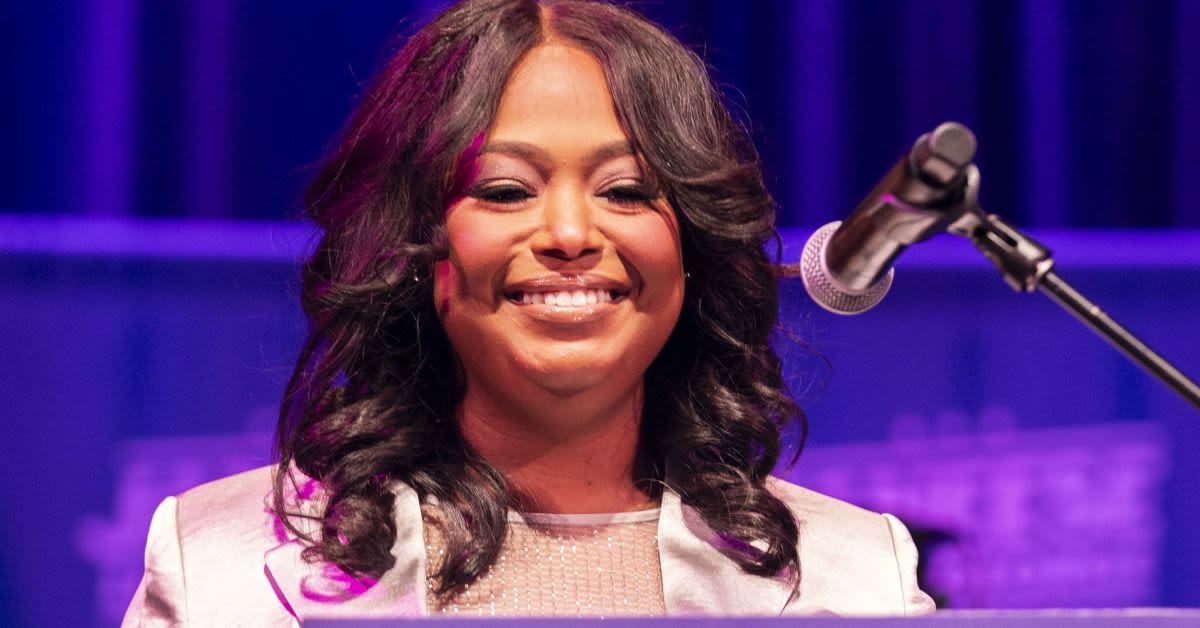
Janeese Lewis George, a self-described progressive and proud member of the Democratic Socialists of America, is now the frontrunner to become mayor of the nations capital even as she champions policies that critics say would further erode public safety in a city already struggling with crime and disorder.
According to Hot Air, Lewis George, a Washington, D.C., native and Howard Law graduate, first won office in 2020, capturing the Ward 4 council seat that runs from Petworth up through Takoma and Chevy Chase. From the outset, she has positioned herself on the far left flank of the citys politics, earning the moniker D.C.s version of Zohran Mamdani for her DSA affiliation and aggressive opposition to traditional law-and-order measures.
Her record on the council reflects that ideological bent, particularly in her hostility to federal involvement in local crime control and immigration enforcement. She has rallied against the federal takeover, joined Free DC protests, and denounced ICE enforcement (she took a video of an apparent detainment in August).
Lewis George originally built her political brand in the wake of the George Floyd protests, running for the Ward 4 seat on a platform steeped in Black Lives Matter rhetoric and calls to defund the police. In a 2020 interview with NPRs Steve Inskeep, she met the reporter at the Black Lives Matter mural standing on the letter B, and offered a telling assessment of the symbolic display.
LEWIS GEORGE: I think it's awesome. Do I think it solves the problems we have in our city? Absolutely not. Before entering politics, she had served as a prosecutor, a role she now portrays as having opened her eyes to what she views as systemic racism in the justice system.
When Inskeep asked, Did you have a moment while working as a prosecutor when you said, I am working in a racist system? she did not hesitate. LEWIS GEORGE: Absolutely. All the time.
That experience, she claimed, shaped her push to divert police funding into social programs and so?called violence interruption efforts. As Inskeep summarized, That informed her proposals to divert some of the police budget to community improvements and violence reduction programs, a strategy that has become a hallmark of progressive criminal-justice reformers nationwide.
Lewis George elaborated on her philosophy in that same interview, criticizing what she described as an overreliance on traditional policing. LEWIS GEORGE: You know, I've seen, you know, how much we just lean on doing the same thing and expecting a different result, which is like - let's just put more officers there, and that'll the problem, which is not the only solution. You've got to put more resources into the community to do that.
Her skepticism of enforcement has extended to direct opposition to federal efforts to restore order in the District. Nine months after President Donald Trump declared an emergency and deployed federal agents to help tamp down violent crime in Washington, Lewis George publicly opposed the move, framing it as an illegitimate takeover rather than a necessary response to spiraling lawlessness.
She has taken a similarly hard line against one of the citys most basic public-safety tools: a juvenile curfew aimed at keeping teenagers off the streets late at night. Even as D.C. has seen repeated teen takeover incidentslarge, often chaotic gatherings that have devolved into fights, robberies, and gunfireLewis George has remained a consistent no vote on curfew measures.
Just last month, the D.C. Council voted 85 to make the youth curfew permanent, a move supported by those who argue police need a lawful mechanism to disperse unruly crowds before violence erupts. Council member Janeese Lewis George was among the no votes, saying that studies from other cities show that curfews do not result in fewer instances in youth-involved crime, public disturbances or high-risk behaviors.
Those curfews did not emerge in a vacuum; they were a direct response to scenes that have become disturbingly familiar in the capitals upscale neighborhoods. One viral incident in the Navy Yard area was described this way: BREAKING POINT: Hundreds of teens flooded Washington, D.C.s upscale Navy Yard neighborhood, sparking fights, robberies and gunfire in what officials described as a juvenile takeover. Former Biden White House advisor Yemisi Egbewole warned that blue cities need to wake up,
The Navy Yard has seen multiple such episodes in recent months, with social media filled with clips of police trying to break up massive youth crowds. Another example from last month: NOW: Navy Yard teen takeover dispersal, one post noted, underscoring how routine these disruptions have become.
The chaos has not been limited to the streets; businesses and families have been caught in the crossfire as well. Just a few days ago we had another example: ?? WTF?! A group of thug teens just went RAMPANT on a violent brawl at the Washington DC Navy Yard's Chipotle And there were terrified kids inside US Attorney Judge Jeanine can now prosecute the PARENTS for any of these youth. Bring on the FAFO! ??? @Katelyn_Caralle.
Supporters of the curfew argue that such measures give law enforcement a lawful pretext to intervene early, dispersing crowds before they escalate into full?blown riots or violent confrontations. So the point of the curfew is to give police the ability to disperse these crowds of rowdy, sometimes violent teens without having to declare a riot, one critic of Lewis Georges stance observed, warning that her election as mayor would almost certainly mean an effort to get rid of the curfew.
Lewis George, however, has doubled down on her opposition, framing the curfew not as a protective measure but as a threat to the very youth it is designed to safeguard. During a mayoral debate Monday night, she went so far as to label the policy dangerous, insisting that the city should instead expand our youth programming through youth centers and apprenticeships.
During the D.C. mayoral debate Monday night, City Council member and candidate Janeese Lewis George condemned curfews for youth in the city, calling the policy dangerous. Instead, Lewis George, who is a member of the Democratic Socialists of America and was dubbed by Axios D.C.'s version of Zohran Mamdani, said the city should expand our youth programming through youth centers and apprenticeships.
In her telling, the real menace to D.C.s young people is not the violent peer behavior playing out on city streets, but the presence of federal law enforcement. Meanwhile, she suggested the real threat to D.C.s youth is the federal troops and masked ICE agents patrolling the city, a framing that aligns neatly with the broader left?wing narrative that casts federal agents as oppressors rather than protectors.
Her remarks at the debate were explicit on this point. Right now, using the curfew as a tool for our young people is dangerous. It is dangerous because we have federal troops who are in our city, masked ICE agents who are in our city, and these are the people enforcing this law and our young people, and these are not individuals who are trained in de-escalation, they are not accountable to D.C. residents, she said.
Critics argue that this rhetoric ignores the lived reality of residents who must navigate streets increasingly dominated by disorder and intimidation. I don't think anyone is dumb enough to really believe those mobs of teens are going to disappear because of youth centers and apprenticeships, one commentator remarked, accusing Lewis George of leaning into the idea that the real threat is federal agents sent in by the Trump administration because running against Trump is a political winner even if the actual policy of ditching the curfew is an obvious loser.
Public-safety experts have also pushed back on her framing, warning that her approach inverts cause and effect. Charles Fain Lehman, a senior fellow at the Manhattan Institute, told Fox News Digital that Lewis George has it exactly backwards, arguing that the problem is not a lack of services but a lack of consistent enforcement.
Public acting out is not the result of insufficient services or alternative opportunities. Its what happens when the system fails to consistently and clearly enforce rules about public conduct, he said, adding, Its exactly backwards to say that what they need is more lenience. That critique reflects a broader conservative concern that progressive officials are dismantling the basic norms and consequences that keep public spaces safe and livable.
Despite these concerns, Lewis Georges political strategy appears to be paying dividends in a deep?blue city where progressive branding and anti?Trump messaging still resonate with many Democratic voters. Despite that, her strategy seems to be working. A poll out this week shows Lewis George in the lead but challenger Kenyan McDuffie isn't far behind and might have an edge in DC's new ranked choice voting.
The first citywide public poll of the race shows her with a narrow but significant advantage. Councilmember Janeese Lewis George holds a five-point lead over Kenyan McDuffie in Washington's Democratic mayoral primary, according to the first citywide public poll of the race. The City Cast survey found Lewis George is the first choice of 39% of Democratic voters, compared to 34% for McDuffie...
However, the introduction of ranked-choice voting could complicate her path to victory. But for the first time, D.C. voters will rank up to five candidates in order of preference and that could shake things up. Among voters who did not choose Lewis George or McDuffie as their top pick, more named McDuffie as their second choice, meaning he could close the gap once those votes are counted.
McDuffie, himself no conservative, has nonetheless made public safety the centerpiece of his campaign, drawing a contrast with Lewis Georges softer approach to enforcement. McDuffie is also pretty far left but during his campaign for mayor he's made public safety his top issue. He supports the curfew and hiring more police officers.
For voters who prioritize safety and order, there are additional red flags in Lewis Georges orbit beyond her own record. Her political director, Makia Green, is an outspoken advocate of police abolition, proudly aligning herself with radical activist Angela Davis, whose views on law enforcement have long been controversial.
There are other reasons Lewis George may not be an ideal candidate for anyone concerned with public safety, starting with her political director Makia Green who is a big fan of defunding the police. Here she is just yesterday calling herself a police abolitionist and comparing herself to Angela Davis.
Greens own words leave little doubt about her ideological commitments. Im an abolitionist like Angela Davis. There are plenty of substantive critiques people could make of my politics. Inventing electoral allegiances I do not hold is just lazy.
The invocation of Davis is telling, given the latters long history of hostility toward traditional policing and support for radical restructuring of the criminal-justice system. Angela Davis's view of police was, shall we say, nuanced. In fairness, Davis supports law enforcement in certain contexts, one commentator quipped, underscoring the extremity of the comparison.
Nor is Green the only controversial figure in Lewis Georges inner circle. Her self?described mentor in D.C. politics, Council member Trayon White Sr. of Ward 8, is currently under federal indictment for bribery, with prosecutors alleging a years?long pattern of corrupt behavior.
D.C. Council member Trayon White Sr. (D-Ward 8) faces trial in September for bribery. He has pleaded not guilty to charges that he agreed to accept $156,000 in kickbacks for helping renew lucrative city contracts. Yet prosecutors have evidence that he began taking payoffs in 2019, and the FBI caught him on tape in 2024 pocketing $35,000 in cash during four meetings in his car with an informant.
Despite those serious allegations, Lewis George recently appeared at Whites 42nd birthday party, offering warm public praise that underscored their close political alliance. Council member Janeese Lewis George (D-Ward 4), who is leading in the polls to become mayor of the nations capital, went to Whites 42nd birthday party on Sunday. In a video posted on Facebook that was later deleted, she had warm words for her indicted colleague.
Her remarks at the event left little doubt about the depth of that relationship. From the moment I got on the council, Trayon was one of the only people who would mentor me, said Lewis George. To underscore their close ties, she told him he deserved to be shown love for the love that you give to everybody else.
Whites record, however, extends beyond alleged corruption into the realm of open antisemitism and conspiracy theorizing. Whites presence in public office has been a national embarrassment long before his alleged criminality became known. In 2018, he accused Jews of controlling the government and manipulating the climate. White posted on social media that snow in March was part of a nefarious plot by the Rothschilds to take over the city. After initially defending the comments as not antisemitic, he apologized.
The fact that Lewis George has chosen such figures as her political director and mentor raises serious questions about the kind of administration she would run and the priorities she would pursue as mayor. Again, this isn't some rando, this is Lewis George's political director. Finally, Makia Green isn't the only sketchy figure Lewis George surrounds herself with. Her friend and mentor in DC politics is facing trial for bribery.
Her critics argue that she has taken a page from Zohran Mamdanis playbook, softening her public image with talk of affordability and youth programs while maintaining alliances with extremists and embracing policies that would weaken law enforcement. Lewis George seems to have learned from Mamdani that so long as she keeps smiling and talking about affordability, voters will let her slide on everything else.
For conservatives and many independents, the stakes in this race go beyond one citys mayoral contest and speak to a broader national divide over crime, accountability, and the role of government. As one editors note put it, The American people overwhelmingly support President Trumps law and order agenda, a sentiment that stands in stark contrast to the defund?the?police and anti?curfew positions embraced by Lewis George and her allies.
With D.C. residents facing rising disorder, teen takeovers, and a justice system increasingly reluctant to impose consequences, the question before voters is whether they want a mayor who will double down on leniency and ideological posturing or one who will prioritize safety, enforcement, and basic civic order. The poll numbers suggest Lewis Georges message is resonating with a significant share of the Democratic electorate, but the citys experiment with ranked-choice votingand the hard realities on its streetsmay yet test how far Washingtonians are willing to go down the path of progressive criminal-justice experimentation.
Login