
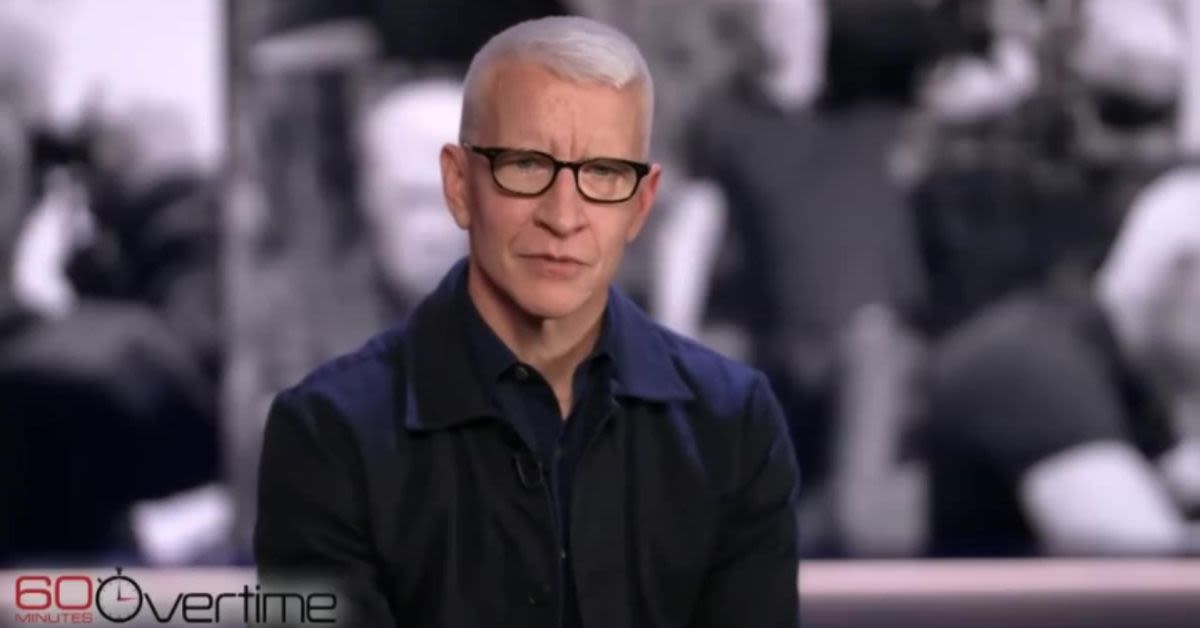
Anderson Coopers emotional farewell to 60 Minutes marked the end of more than two decades of work on the storied newsmagazine and underscored the tension between old-school journalism and a rapidly shifting media landscape.
The veteran CNN anchor, who has long straddled the worlds of cable news and broadcast reporting, delivered his final story for the CBS program during its season finale before struggling to get through his traditional closing line, Im Anderson Cooper. According to Mediaite, Cooper visibly choked up, pausing for several seconds, looking down to regain his composure, and then repeating the sign-off three times, honoring a ritual that has become synonymous with the shows brand of serious, personality-driven journalism.
In an extended retrospective segment, Cooper looked back on his more than 20 years as a correspondent, a tenure that began when he was still a rising figure in television news and ended with him as one of the most recognizable faces in the industry. At the start of the piece, when an interviewer reminded him that he had been with the program for two decades, Cooper responded with characteristic understatement: Wow, its been a hell of a ride.
Producers intercut his reflections with archival footage of his past assignments, featuring interviews with celebrities, lawmakers, and business titans, all framed by Coopers commentary on what the show had meant to him professionally and personally. The montage underscored how 60 Minutes, even as corporate media has grown more politicized and fragmented, has tried to maintain a reputation for in-depth, long-form reporting that stands in contrast to the soundbite culture dominating much of modern news.
This is crazy, Cooper remarked at one point. This is my last shoot for 60 Minutes. 60 Minutes has always been a place, at least for me, that you get to step into somebody elses shoes. You get to see things through their eyes and see what their struggles are and what they are facing and you learn from that.
He went on to explain that he first became a viewer of the program after his fathers death, drawn to its trusted and hard-hitting reporting and to the familiar voices of CBS correspondents whose work helped define serious television journalism for generations. Cooper recalled those names with evident affection, suggesting that for him, as for many Americans, the show represented a standard of credibility that is increasingly rare in an era of partisan spin and click-driven coverage.
Cooper also recounted his disbelief when he finally joined the program, saying he could not believe he had made it onto 60 Minutes after years of admiring it from afar. He remembered that, following the death of legendary correspondent Bob Simon, he was given Simons office and still keeps a bottle of scotch the late reporter left behind, noting that Simon repeatedly inspired him in the field and served as a model of the kind of reporter he aspired to be.
The retrospective included high-profile interviews with Prince Harry, actor Donald Sutherland, and singer Lady Gaga, underscoring the shows reach into both politics and culture. Yet Cooper stressed that the stories that lingered with him most were not the celebrity profiles but the pieces centered on ordinary people whose lives, struggles, and resilience rarely make front-page news.
Reflecting on his reporting trips across Africa over the years, Cooper said, Thats the great thing about 60 Minutes is that if you pitch a story of like, I think this is a really important story. Lets go and do it. Theyll say yes. He added that the programs willingness to invest time and resources in such reporting stands in contrast to much of the industry, where corporate priorities and ideological agendas often crowd out substantive coverage of the world beyond Americas borders.
The thing is, its never felt like work. Its felt like youre stepping into peoples lives, and youre invited into people homes, he continued. Youre invited into their struggles, youre invited into whatever it is that has brought them to be on 60 Minutes.
Cooper, who joined the CBS newsmagazine in 2006 while continuing to anchor at CNN, acknowledged that maintaining both roles had become increasingly difficult as demands on his time grew. The whole time Ive done pieces for 60 Minutes, my full-time job has been over at CNN and still is, and its been really challenging to do the kind of work you need to do to have a great piece, he said.
CNN doesnt like it if I take a lot of time off to work on a piece, so Ive worked mostly for 60 Minutes on weekends. My vacation time at CNN has been working on pieces, and Ive loved it, but its been tough.
He made clear that the decisive factor in stepping away was not only professional strain but his responsibilities as a father, a priority that resonates with many Americans who still place family above career. Ive got a 4-year-old and a just now 6-year-old, and I want to spend as much time with them as I can while they still want to spend time with me, Cooper said, referring to his sons Wyatt and Sebastian.
Breakers Lachlan Cartwright had previously reported that Cooper declined an offer to remain with the show earlier this year, signaling that his departure was not the result of a sudden break but a considered decision. His exit comes amid a turbulent period for CBS News, which has seen a wave of editorial departures and on-air reshuffling, including at 60 Minutes, following the arrival of Bari Weiss as the networks editor-in-chief after parent company Paramount merged with Skydance.
Against that backdrop of corporate consolidation and ideological repositioning, Cooper used his farewell to voice a hope that the programs core identity would endure. I hope 60 Minutes remains 60 Minutes. Theres very few things that have been around for as long as 60 Minutes has and maintain the quality that it has, he said, implicitly pushing back against the tendency of media conglomerates to dilute legacy brands in pursuit of short-term gains.
Things can always evolve and change and I think thats awesome and things should evolve and change, he continued. But I hope the core of what 60 Minutes is always remains.
In the closing moments of the segment, viewers saw a montage of sign-offs from Coopers predecessors before the camera returned to him, struggling through several attempts to deliver his own final line. After briefly choking up, he finally managed to say, Im Anderson Cooper, one last time, a simple statement that doubled as a quiet defense of a journalistic tradition rooted in trust, depth, and seriousness at a time when those values are increasingly under pressure.
Login