
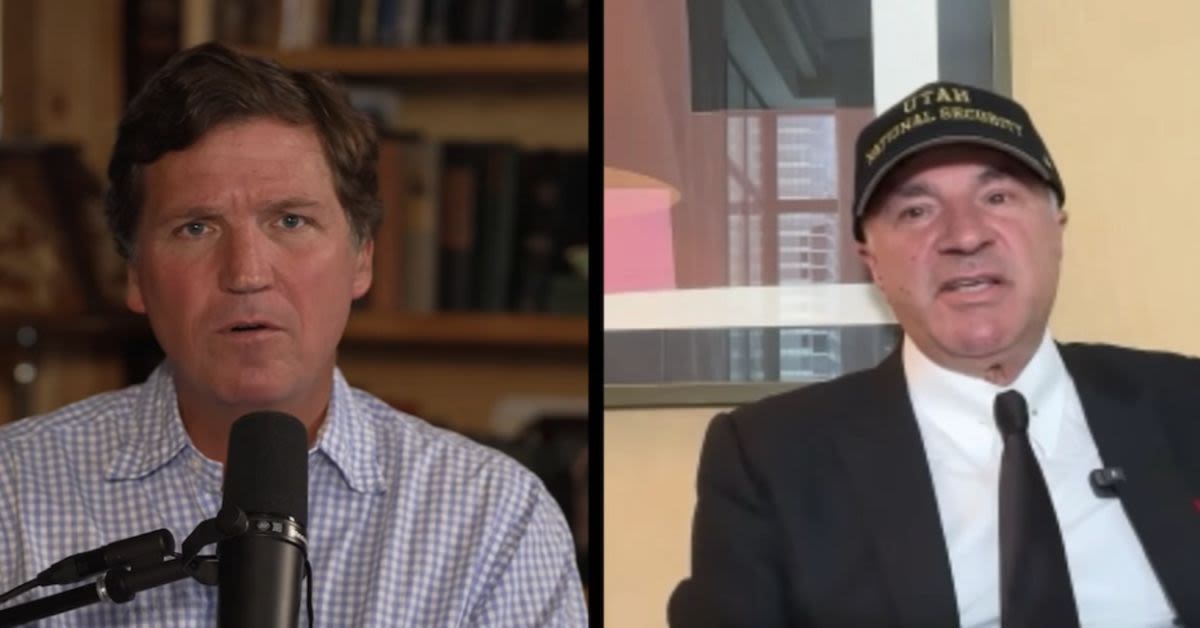
Tucker Carlson clashed with businessman and television personality Kevin OLeary over taxpayer-funded incentives for a massive artificial intelligence data center project, accusing the investor of gaming a system and leaning on corporate welfare rather than free-market discipline.
The exchange unfolded on Carlsons program during a wide-ranging discussion about artificial intelligence, its economic implications, and the political choices surrounding its rapid expansion, as reported by Mediaite. Carlson, who has repeatedly voiced skepticism about the unchecked growth of Big Tech and the concentration of power in the hands of a few corporate giants, pressed OLeary on why ordinary Americans should be compelled to subsidize a project whose primary beneficiaries will be some of the wealthiest companies on earth.
OLeary, a vocal supporter of President Donald Trump and a champion of large-scale private investment, defended the use of state-level tax incentives as a standard feature of American economic competition.
Carlson opened the segment by acknowledging the speed and scale of technological change, particularly in AI, and the understandable anxiety it creates among workers who fear being displaced. Things around the world are moving so fast right now, its impossible to keep up with all of the changes, he said, adding that AI is just a huge new thing and I think its understandable that people would be anxious about it. He admitted that even he does not fully grasp the technology, remarking, I dont think they understand it. I dont fully understand it, thats for sure.
The focal point of the conversation was OLearys ambitious plan to construct a colossal $100 billion AI data center in Utah, a project backed by state officials who argue it is necessary to maintain Americas competitive edge. Utahs governor has gone so far as to say there is an obligation to build the facility to keep pace in the global AI race, a framing that raises questions about whether government should be in the business of picking winners and losers in emerging industries.
OLeary has promised that the project will generate thousands of jobs, both in construction and long-term operations, while critics in the state have raised concerns about environmental impacts, including heavy water usage and the enormous energy demands of such a complex.
Carlson, reflecting a traditional conservative skepticism toward crony capitalism and corporate favoritism, zeroed in on the financial structure of the deal. The project was approved through the Utah Military Installation Development Authority (MIDA), a state entity that can grant significant tax advantages to attract large developments. Those incentives, which include initial tax breaks, became the central point of contention as Carlson questioned why a supposedly profitable private venture should require public subsidy.
Let me ask though about why taxpayers should have to pay for this if its a private business and your tenants are some of the richest companies in the world, Carlson pressed OLeary, cutting to the heart of the matter. Why would taxpayers be required, as they now are, to subsidize this? OLeary responded that such arrangements are not only common but essential in a competitive environment where states vie for major investments. They dont. They dont necessarily have to do that. They just wont win any contracts. Its a competition, he said, framing the issue as a race between states to lure capital and jobs.
Carlson was not satisfied with that explanation and pushed further on the principle at stake, asking bluntly, But why are you getting tax breaks is my question. OLeary replied that every large-scale investor seeks incentives when committing billions of dollars to a project, describing it as a standard negotiation. Everybody, you go back and you say, What incentives can you give us to invest $15 billion in the first 1.5 gigs? Thats what it takes. I have to go raise $15 billion. Thats just the first he said, emphasizing the enormous upfront capital required.
From Carlsons perspective, however, the issue was not the size of the investment but the fairness of forcing taxpayers to underwrite it. But anyone who starts a business, why should taxpayers have to pony up for that? he asked, drawing a contrast between politically connected mega-projects and ordinary entrepreneurs who receive no such help. OLeary insisted, They dont, but Carlson countered that the math does not support that claim, noting that any tax break granted to one entity must be offset elsewhere in the state budget.
Of course they do. If youre getting a tax break and theyre not, theyre making up the difference. Theres a state budget, Carlson argued, highlighting a core conservative concern: when government intervenes to favor one business, others are left to shoulder the burden. OLeary brushed off the objection by pointing to alternative locations eager to host the project, saying, Thats no problem. Thats no problem. I can build in Texas. I can build it in Jacksonville, Mississippi. His answer underscored the leverage that large corporations wield over state governments desperate for investment and jobs.
Carlson then raised a deeper philosophical question about the nature of the deal, asking why taxpayers should help finance a private enterprise without receiving any ownership stake in return. But why, if its such a good business, would you be asking taxpayers to help pay for it without giving them equity in the company? Are you giving taxpayers shares? he asked pointedly. OLeary was candid in his reply: No, the investors get the shares, but heres why they would do it, he said, before pivoting back to the promise of jobs and future tax revenue.
Carlson, speaking as both a taxpayer and a businessman, pressed the fairness argument again. Why would the taxpayers have to? I mean, in other words, if you want to start a business, why am I, as a taxpayer, forced to pay for your business? I dont get it, he said, articulating a view that many on the right share about corporate subsidies. OLeary attempted to broaden the discussion beyond data centers, invoking a more traditional manufacturing example to justify the incentives.
Well, lets forget about data centers. Lets go any manufacturing. Lets say youre going to build an aluminum sheet manufacturing facility, OLeary said, sketching out the typical pitch to government. You go to the government there and say, Look, this is going to be a huge expenditure. Im going to hire 2,000 people. Im going to build a community center. Im going to pay a lot of tax on the profits in your state when I sell the aluminum. And Im going to hire all these people who will also pay tax. And we will build a school because our workers need a school. And what can you give me to incentivize me versus the state right beside you which is willing to give me an incentive package? In his telling, the incentives are simply the price of doing business in a competitive federal system.
Carlson acknowledged that OLeary was operating within an existing framework but refused to concede that the system itself is just or efficient. No, no, I understand that youre gaming a system in place you didnt come up with, but Im just trying to understand, he said, accusing OLeary of exploiting a flawed structure rather than challenging it. He noted that the supposed trade-offtax breaks in exchange for jobs and future tax revenueoften fails to deliver the promised benefits, remarking, So the trade typically is jobs, okay? But these projects dont actually
OLeary interrupted to insist that the benefits are real and multifaceted. Well, no, no, its also jobs and taxes, because youre going to be he began, only for Carlson to point out the inherent contradiction. And taxes. But then youre getting a tax break, so that doesnt really make any sense, Carlson said, underscoring the circular logic of promising tax revenue while simultaneously reducing the tax burden for the favored company.
OLeary responded that the tax relief is temporary and front-loaded, designed to offset initial costs rather than permanently shield the project from contributing to public coffers. Only up front youre getting Tucker, welcome to America, buddy. This is how its gone on for 200 years! he exclaimed, suggesting that the practice is deeply embedded in American economic development. Carlson was unimpressed by the appeal to tradition, replying, Okay, well, I dont know. Lots of bad things go on for a while. Im just, but I think at some point its worth assessing like, why are we doing this? he said, calling for a re-examination of policies that have long favored large corporations at the expense of smaller competitors and taxpayers.
OLeary conceded that Carlson was within his rights to question the system but insisted that the underlying driver is interstate competition. You are fair to do that. Youre doing it because theres a competition, he said, reiterating that states are locked in a bidding war for investment. Carlson, however, contrasted OLearys subsidized mega-project with his own experience as a business owner who receives no such special treatment.
Well, I run a couple of businesses and were not getting any tax breaks, Carlson said, drawing a sharp line between politically favored industries and ordinary enterprises. I think theyre every bit as virtuous as data centers, but Im not availing myself of that and no ones offered. And I wouldnt take it anyway, because its not the job of taxpayers to subsidize a private business. His stance reflected a more traditional conservative belief in equal treatment under the law and a level playing field, rather than government-engineered advantages for the biggest players.
OLeary called Carlsons position a fair comment but returned to his role as an investor tasked with maximizing returns and building large-scale infrastructure. Its a fair comment, but my job is to create a data center, create 2,000 jobs long-term and 10,000 manufacturing at the beginning, or construction, he said, emphasizing the employment figures he believes justify the incentives. And Im obviously looking at multiple sites, and this wont be the last one I build. I have to he added, hinting at a broader expansion strategy that will likely involve similar negotiations with other states.
Carlson then challenged the scale of the promised benefits relative to the projects enormous physical and energy footprint. May I ask, 2,000 jobs, okay, so relative to the size, the physical size of the project, which as you noted is multiple times the size of Manhattan, and the power draw at peak, this data center, your projections will consume about as much energy as New York City does, but New York City provides almost 5 million jobs and this project by your own description would provide about 2,000 jobs. I dont see the trade here, he said, questioning whether the public is getting a fair return on its implicit investment.
OLeary rejected Carlsons calculation and argued that the true economic impact of AI infrastructure cannot be measured solely by on-site employment. You definitely got that calculation wrong. By building a data center that trains AI, that provides productivity to the entire nation, we create millions of jobs, high paying jobs, he claimed, suggesting that the downstream effects of AI-driven productivity will ripple across the broader economy. Carlson, echoing widespread fears about automation, asked, So AI is going to create jobs? and followed up with, I thought it was going to eliminate jobs.
OLeary countered that such fears mirror past technological panics that never fully materialized. Yes, he answered when asked if AI would create jobs, before elaborating, Just think about the new technologies we dont even know yet that are going to be built off AI. Everybody thinks when television came, everybody would lose their job in radio. That was complete BS. And the same thing is going to happen here. Everybodys hysteria about losing jobs, making hamburgers or flipping them, being replaced by a robot. Thats probably true. But all kinds of new technology will become available over time, including in medical science and biology and all kinds of things where the models can be used. Im extremely optimistic. What Im doing is creating a whole new opportunity for my children.
The debate between Carlson and OLeary encapsulates a broader fault line on the right over how to handle the rise of AI and the power of multinational corporations that stand to profit from it. On one side are those, like OLeary, who embrace large-scale public-private partnerships and see tax incentives as a necessary tool to attract investment in a globalized economy. On the other are conservatives like Carlson, who question why working- and middle-class taxpayers should be compelled to subsidize projects for some of the richest companies in the world while smaller businesses receive no comparable support and must compete on uneven ground.
As AI data centers proliferate and states race to host them, the questions Carlson raisedabout fairness, energy use, environmental impact, and the proper role of government in the marketplaceare likely to grow more urgent. Whether the promised millions of jobs and national productivity gains materialize, or whether taxpayers are left holding the bag for yet another round of corporate welfare, will determine if this model of development aligns with the conservative principles of limited government, equal treatment, and genuine free-market competition that many on the right still claim to defend.
Login