
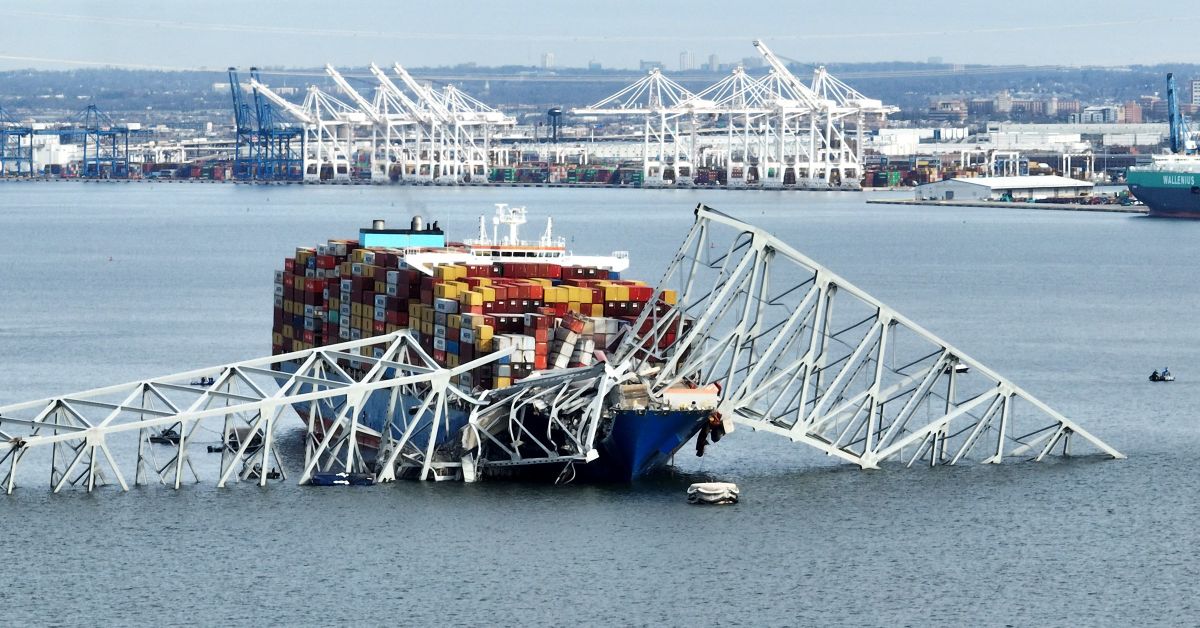
The catastrophic collapse of Baltimores Francis Scott Key Bridge, triggered when a powerless container ship slammed into its support columns on March 26, 2024, is now at the center of a sweeping federal criminal case that officials say was both foreseeable and avoidable.
According to RedState, federal authorities now contend that the disaster was not a freak accident but the result of calculated negligence and deception, and the Department of Justice has moved to hold the ships foreign operators and a key technical official criminally liable. In a high?profile escalation, the DOJ has announced indictments against two overseas corporations and a shoreside technical superintendent, alleging a conspiracy to defraud the United States and conduct that directly led to the deaths of six construction workers who were simply doing their jobs on a bridge that should have been safe.
The Justice Department summarized the charges in a public statement and social media announcement: Foreign Operators and Technical Superintendent of M/V Dali Indicted for Roles in Key Bridge Crash Indian and Singapore Corporations and Company Official Charged with Conspiring to Defraud the United States and Causing the Death of Six Construction Workers. The agency underscored the gravity of the case by repeating that Foreign Operators and Technical Superintendent of M/V Dali Indicted for Roles in Key Bridge Crash Indian and Singapore Corporations and Company Official Charged with Conspiring to Defraud the United States and Causing the Death of Six Construction Workers.
Acting Attorney General Todd Blanche framed the incident as a textbook example of a disaster that never should have happened. The collapse of the Francis Scott Key Bridge was a preventable tragedy of enormous consequence, said Acting Attorney General @DAGToddBlanche.
He stressed that the government intends to pursue accountability to the fullest extent of the law. This indictment is a critical step toward holding accountable those whose reckless disregard for maritime safety regulations caused this disaster. Six construction workers lost their lives, critical infrastructure was destroyed, pollutants were released into the Patapsco River and Chesapeake Bay, and the economic damage now exceeds five billion dollars. This Department is committed to securing justice for the victims and ensuring those responsible are held to account.
The DOJs Tuesday press release identifies the defendants as Synergy Marine Pte Ltd of Singapore and Synergy Maritime Pte Ltd of Chennai, India, along with 47?year?old Indian national Radhakrishnan Karthik Nair. They are charged with conspiracy, willfully failing to immediately notify the U.S. Coast Guard of a known hazardous condition, obstruction of an agency proceeding, and making false statementsallegations that, if proven, point to a pattern of cutting corners and hiding problems rather than fixing them.
U.S. Attorney for the District of Maryland Kelly O. Hayes announced the charges at a press conference aboard the NS Savannah, a historic vessel docked in Southeast Baltimore with a clear view of the mangled remains of the Key Bridge. Hayes laid out a damning technical narrative, explaining that the Dali lost power twice and that the second, fatal blackout was caused entirely by illegal acts by the operators.
As prosecutors described it, the first power failure appears to have stemmed from a loose wire in a high?voltage switchboard, but the ships design included redundancies and automatic restart systems that allowed it to recover quickly. The first power loss was likely caused by a loose wire in a high voltage switchboard, but critical systems on the dolly were designed with redundancies and automatic restart capabilities, so the dolly quickly regained power after the first blackout. However, shortly after the vessel regained power, a second loss of power occurred. The second loss of power happened because the defendants relied on a flushing pump to supply fuel to two of the dolly's generators. The flushing pump, however, did not automatically restart. Instead, it needed to be manually restarted when the flushing pump was not restarted in time.
Prosecutors further allege that the defendants misrepresented their use of that flushing pump and deliberately disregarded known electrical issues that jeopardized the vessels safe operation. In other words, rather than investing in proper maintenance and compliance with safety rules, the operators allegedly chose shortcuts that ultimately turned a massive cargo ship into a runaway battering ram aimed at a critical piece of American infrastructure.
Federal officials have now formally charged the Dalis operator and an associated employee in connection with the deadly collapse. Federal prosecutors have filed criminal charges against the operator of the Dali cargo ship and an employee tied to the deadly collapse of Baltimores Francis Scott Key Bridge. Investigators allege the crew recklessly cut corners and ignored known electrical problems on the vessel that caused catastrophic harm, including the deaths of six highway workers.
The fallout from that catastrophic harm has rippled far beyond the immediate loss of life. The preventable accident shut down a vital four?lane segment of Interstate 695, choking a major East Coast artery for commerce and daily commuters alike, and the bridges destruction has already cost billions in disrupted trade and logistical chaos for businesses that rely on predictable, efficient transportation networks.
Reconstruction is underway, but the timeline and price tag underscore the scale of the damage. Current projections estimate the new bridge will not be completed until 2030, at a staggering cost of $5.2 billionan enormous burden for taxpayers and a stark reminder of what happens when safety regulations are treated as optional rather than mandatory.
For conservatives who have long warned about the dangers of lax enforcement, opaque foreign operators, and the outsourcing of critical infrastructure responsibilities, the Dali case reads like a grim vindication. As the legal process unfolds, Synergy and its affiliates can expect to face not only criminal exposure but also massive civil liability, and in the meantime, expect Synergy to be on the hook for billions.
Login