
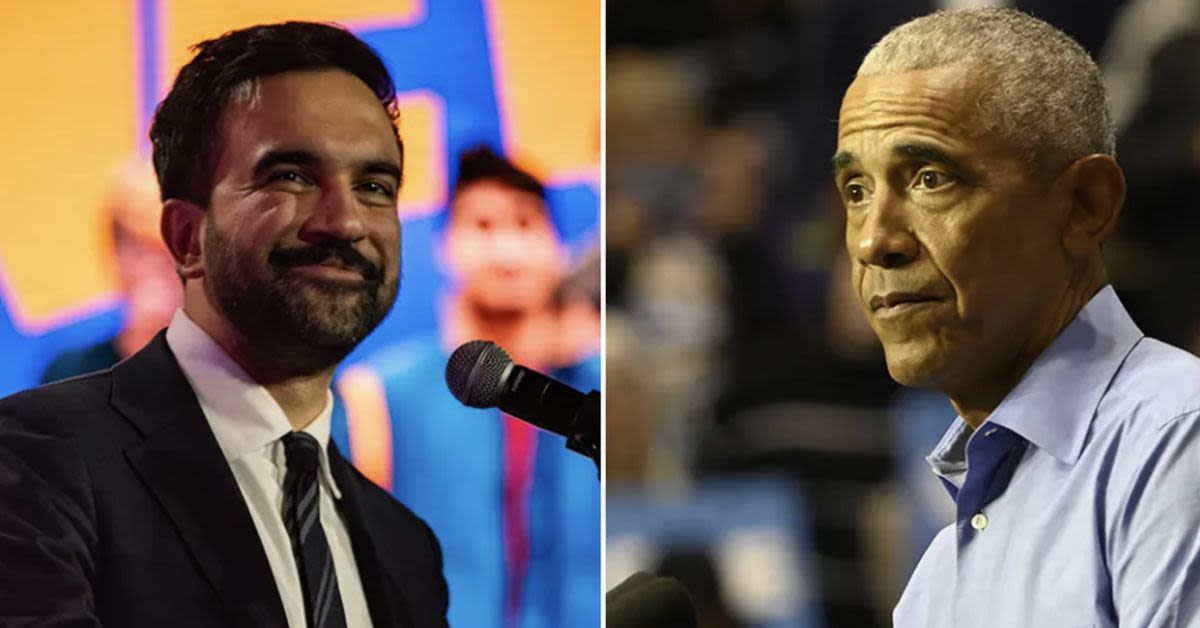
Former President Barack Obama used a high-profile late-night appearance to lavish praise on far-left New York City Mayor Zohran Mamdani, hailing the self-described socialist as an extraordinary talent while sketching his vision for the future of the Democratic Party.
The prerecorded interview with outgoing Late Show host Stephen Colbert, aired Tuesday and filmed at the Obama Presidential Center in Chicago, quickly turned from nostalgia to a pointed discussion of the ideological tug-of-war inside the Democratic Party. According to The Post Millennial, Colbert pressed Obama on the growing tensions between the partys centrist establishment and its increasingly aggressive progressive wing.
Obama signaled that his concerns extend beyond Democratic infighting, saying he wants not only a more disciplined Democratic Party but also a functioning GOP that serves as a principled counterweight. In the conversation, he said he would like to see Republicans act as a loyal opposition, a phrase that underscores how far, in his view, the current political climate has drifted from traditional norms of debate and governance.
Colbert set the stage by contrasting moderate Democrats with their hard-left counterparts, telling Obama, So you have great leaders. You have people like [Virginia Governor] Abigail Spanberger and [ New Jersey Governor] Mikie Sherrill, very centrist. But then you have further left, like AOC and Zohran Mamdani. He then asked bluntly, What direction do you think would be best for this party to actually achieve change?
Obama responded by recalling a familiar question from his presidency about what reforms he wanted to see in Washington. "Id say Id love a loyal opposition. Id love a Republican. Part that was conservative in some ways, that didnt agree with me on a whole bunch of stuff, but believed in rule of law and judicial independence and empirical evidence and science, and wasnt constantly tapping into our worst impulses."
He also downplayed the notion that Democrats are hopelessly fractured between progressives and traditional liberals. I'm not so worried about this so-called rift between the left and liberals, as you described it, Obama told Colbert. Because I think that within the Democratic Party, and I would argue a bunch of independents and even some Republicans as well, there's an overarching belief in equality, fairness, if you work then you should be able to make a living wage and support a family and retire with dignity.
From Obamas perspective, the disagreements are less about core values and more about policy details and tactics. He added, There are a bunch of things that we agree on. And it's really more of a question of, what are the specific things that we have to do.
It was in this context that Obama elevated Mamdani, a figure whose openly socialist agenda has raised alarms among conservatives concerned about the leftward drift of urban governance. You look at somebody like Mamdani, who I think is an extraordinary talent, Obama said. He wants people to be able to afford housing in New York. Well, you know, I would assume liberals in New York want the same thing.
Obama then shifted from ideology to style, suggesting that Democrats real challenge lies in how they communicate their agenda to ordinary Americans. I'm more interested in for Democrats is do you know to just talk to regular people like we're not in a college seminar, right? he said.
Colbert, who has frequently championed progressive causes, echoed that sentiment while again boosting Mamdani. I think that's one of the powers that Mamdani has, Colbert said, prompting Obama to agree with a terse affirmation: That's correct.
Colbert went further, praising Mamdanis persona as much as his politics. Not only does he talk like a normal person, but he lives a normal life, but also, he names what is obviously wrong. Obama enthusiastically concurred, replying, Yes! And not have a bunch of gobbledygook around it... Just talk like normal people talk.
For conservatives, Obamas embrace of a socialist city leader as a model for Democratic talent underscores how far the partys center of gravity has shifted left, even as he insists the internal divide is overstated. His call for a loyal opposition rooted in the rule of law and empirical evidence stands in stark contrast to his comfort with figures like Mamdani, whose housing and economic policies lean heavily on government intervention rather than market solutions and individual responsibility.
Login