
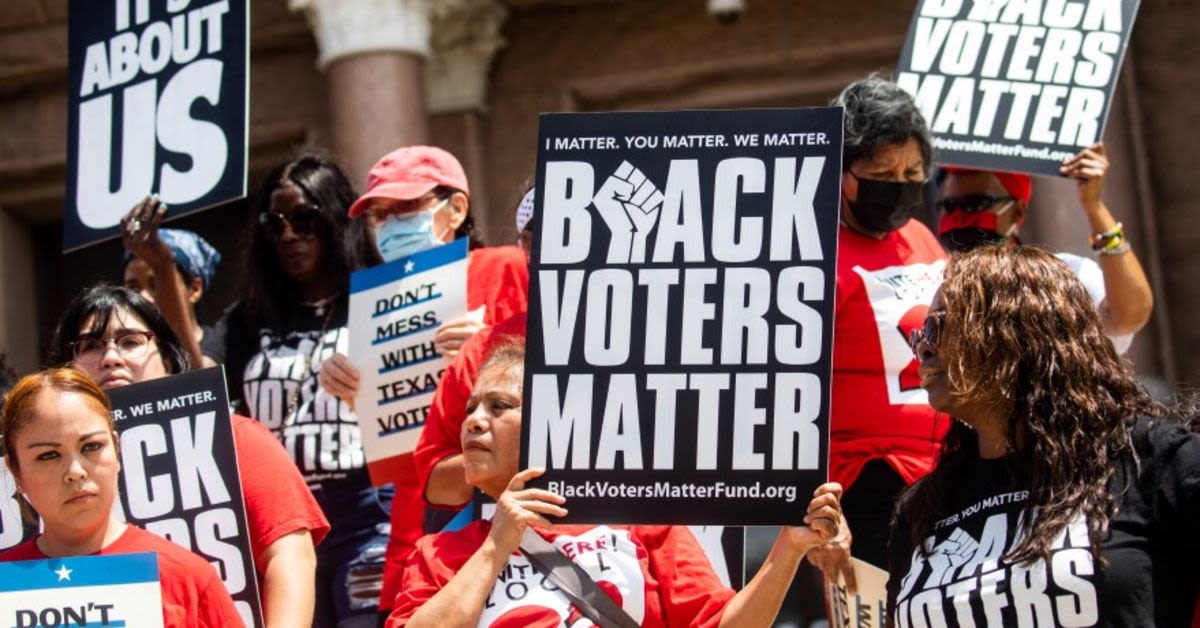
Black voters, especially younger African Americans, are steadily breaking from their historic allegiance to the Democratic Party and moving toward the GOP, rattling a political order Democrats and their media allies long assumed was permanent.
According to RedState, this shift has been visible for years to anyone willing to look past progressive talking points and legacy media narratives. Its most dramatic expression came with Donald Trumps 2024 victory, when Black support for the Republican nominee reached levels that would have been unthinkable in the Obama era.
As RedState reported in 2024, The wildcard in this election was the Black vote. Trump made gains in the Black community, especially among Black men. He was at 11 percent in 2020 and achieved 25 percent in 2024. What was once dismissed as an anomaly is now hardening into a durable trend, and the same outlets that spent years insisting Trump was uniquely toxic to minorities are suddenly scrambling to explain why their narrative no longer matches reality.
A deeper generational and structural realignment is underway, one that is steadily uncoupling Black identity from automatic Democratic Party loyalty and turning a once-monolithic bloc into what analysts now describe as political free agents open to Republican appeals.
Grassroots voices have been sounding this alarm for some time, warning Democrats that their habit of treating Black voters as a captive constituency would eventually backfire: Stop taking the black vote for granted. Black people are waking up and leaving the Democratic Party. Nobody owns us.
What truly stuns the commentariat is not merely that this shift is happening, but that it is happening under the man they have spent nearly a decade branding as a uniquely dangerous bigot.
As one recent report put it, President Trump is making gains with Black voters despite posting racist videos, using racist rhetoric and advancing policies critics say erase slavery history and weaken voting rights.
An Axios analysis of recent polling and historical data underscores how significant this break is from the past six decades of political behavior. An Axios review of recent data shows breaks in the strong Black support for Democrats going back to John F. Kennedy's 1960 presidential run and Barack Obama's historic 2008 win.
For a Democratic establishment that once treated Barack Obama as the pinnacle of Black political enthusiasm, the idea that Trump could outperform the light bringer among segments of Black voters is nothing short of heresy. Yet that is precisely what the numbers suggest: Trump is not merely holding his own; he is expanding Republican appeal in communities Democrats long assumed were theirs in perpetuity.
Even left-leaning analysts concede that this is less about Trump personally persuading lifelong Democrats and more about a changing electorate that no longer sees party labels as extensions of racial identity. Trump is benefiting less from persuasion and more from a changing electorate. It's younger, more diverse and less tied to traditional party loyalties, said Theodore Johnson, a senior adviser at New America.
Johnson told Axios, The numbers we're seeing now are higher than they were eight years ago but Black voters were a different kind of voter coming out of the Obama presidency. He added, When you detach partisan identity from racial identity, you get more Black voters willing to take a chance on a Republican. That's not a realignment. It's more political free agents.
From a conservative vantage point, this is precisely what many on the right have argued for years: that Black Americans are not a political monolith and that the assumption of permanent Democratic ownership is both insulting and politically shortsighted. For decades, Democrats and too many Republicans alike have chased either identity-politics theatrics or donor-class priorities, leaving working-class Black votersalong with many other ordinary Americansfeeling ignored, patronized, or outright exploited.
Trump, for all his rhetorical rough edges, broke that pattern by speaking directly to economic opportunity, national pride, and shared prosperity in language that did not segregate Americans into grievance-based categories. He repeatedly emphasized that both parties had failed key constituencies, including Black communities, and he made a point of acknowledging those voters when they defied elite expectations and backed his candidacy.
In his inaugural address, Trump explicitly recognized the Black and Hispanic voters who helped propel him to the White House and framed their support as part of a broader national renewal.
In the portion of his speech about unifying the nation and the increase of support among the spectrum of Americans that brought about his electoral victory and his presidency, Trump specifically crafted a Thank You and a commitment to Black and Hispanic communities.
He declared, To the Black and Hispanic communities, I want to thank you for the tremendous outpouring of love and trust that you have shown me with your vote. We set records and I will not forget it.
That kind of direct gratitude and promise of reciprocity stood in stark contrast to the Democratic habit of assuming loyalty and then delivering little beyond rhetoric and symbolic gestures.
At the same time, recent Supreme Court decisions have begun to unwind some of the structural advantages Democrats built into the electoral system under the banner of civil rights. The Courts ruling limiting how Section 2 of the Voting Rights Act can be administered and sharply restricting racial gerrymandering has forced both parties to compete more honestly for votes rather than relying on racially engineered districts with predetermined outcomes.
As a result, legacy media outlets that once treated the Black vote as a static, unchanging asset on the Democratic ledger are now being forced to confront the reality of fluid, competitive politics. They are discovering, belatedly, that the Black vote has slipped from the Democrats iron grip and is increasingly up for grabs in ways that could reshape national and state-level contests for years to come.
Even CNN, hardly a bastion of conservative thought, has been compelled to acknowledge the magnitude of the shift.
Network analyst Harry Enten, in his typically animated style, recently walked viewers through polling that shows Republicans chipping away at the long-term advantage the Democrats have had with Black voters, with African-Americans.
Enten highlighted Gallup data showing that Trumps approval rating among Black Americans has risen notably during his second term.
Enten pointed out the Gallup information that among Blacks, Trump has a 16 percent approval rating in his second term. This is a four-point gain from where Trump was in his first term, with an approval rating of 12 percent. It's not about just the number; it's the fact that presidents generally do not gain ground in approval in their second term.
Looking ahead, Enten warned that these numbers are not just curiosities; they carry serious electoral consequences. Enten projected, This has major implications for elections down the line. Because Democrats, especially in a lot of these tight races, you talk about places like Georgia, right down in the South. You see this type of movement for Trump actually gaining ground; this could have major ramifications and could help put Republicans over the top in a number of Southern places in the midterm elections.
He went further, framing the development as part of a broader, sustained movement rather than a fleeting blip. Enten said, I see this absolutely as part of a bigger trend. Donald Trump's Republican Party is absolutely gaining ground, not just him gaining in terms of his approval ratings, but look at the party ID margin, Kate, because this to me is absolutely stunning.
Crucially, this is not just about older, churchgoing Black voters who have long harbored culturally conservative instincts but still pulled the Democratic lever out of habit or fear of the alternative. Younger Black voters, raised in an era of social media, economic uncertainty, and broken political promises, are increasingly rejecting the politics of perpetual grievance and demanding tangible results.
As one younger voice bluntly put it, Weve been telling yall this since 2016. Younger black voters are demanding more from democrats than our elders. Fear mongering doesnt work on us, weve known our future is screwed for a long time. ??????
That sentiment reflects a generational impatience with the old Democratic formula of warning about Republican racism every election cycle while presiding over failing schools, unsafe neighborhoods, and stagnant economic prospects.
Legacy media, deeply invested in the narrative of Trump as an existential threat to minorities, now finds itself in an awkward position as its own polling and on-the-ground reporting contradict years of moral panic. Democratic strategists, meanwhile, continue to rely on gaslighting and fear campaigns, insisting that any Black voter who considers the GOP is either misled or betraying their community, even as more voters quietly tune them out.
The reality confronting both the media and the Democratic Party is stark: a message centered on the American Dream, national excellence, and policies that expand opportunity for everyone is proving far more compelling than decades of failed social engineering and identity politics. When Republicans talk about jobs, school choice, public safety, entrepreneurship, and secure borders as benefits for all Americansincluding Black Americansthey are offering a concrete alternative to the status quo.
Conservatives have recognized this opening for years, arguing that if the GOP would simply show up, listen, and deliver, many Black voters would respond to a platform grounded in faith, family, work, and freedom. Now, as the data catches up with that intuition, legacy media is racing to explain a phenomenon it spent years denying, while Democrats confront the possibility that their most reliable constituency is no longer guaranteed.
Whether this moment becomes a full-scale political realignment or remains a looser era of political free agents, the old assumption that the Black vote is permanently welded to the Democratic Party is crumbling. For Republicans willing to compete on ideas and performance rather than stereotypes and neglect, the opportunity to build lasting, cross-racial coalitions around conservative principles has never been clearer.
Login