
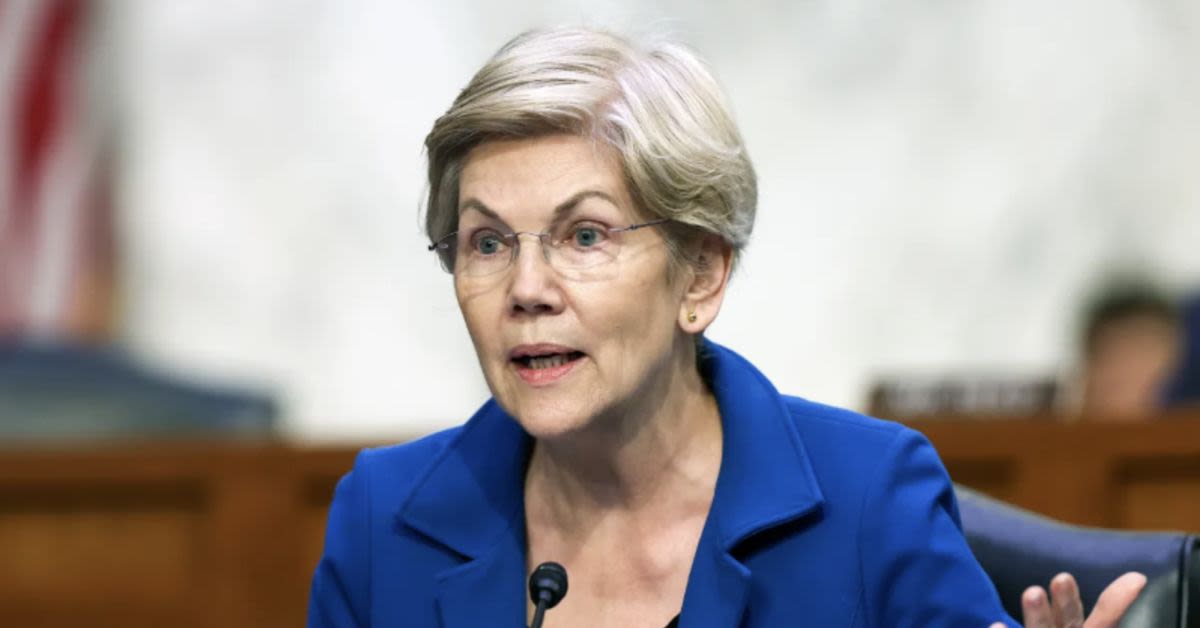
Sen. Elizabeth Warren of Massachusetts spent her Saturday in Portland, Maine, throwing her considerable political weight behind Graham Platner, a hard-left Senate hopeful whose record includes praise for Hamas, online smears of rural Mainers and sexual assault victims, and a long-ignored Nazi-era tattoo.
According to the Washington Free Beacon, Warren appeared with Platner at a crowded Holiday Inn ballroom, offering a full-throated endorsement that underscored the Democratic Partys ongoing lurch toward its most radical elements. Warren told the audience that Platner "has the values" to serve in the Senate and would bring "accountability" to Washington, D.C., casting him as a champion of class warfare rather than a candidate with a troubling past.
Platner, she declared, "is a man who not only has the values, but a man who believes in accountability, and we need a little accountability coming out of Washington right now," before pivoting to her familiar populist refrain: "Billionaires don't want to pay taxes, and nobody in Washington will get in that fight. Well, Graham Platner's gonna."
Platners own record on accountability is more complicated than Warrens applause lines suggested, as he has spent much of his campaign apologizing for a trail of inflammatory Reddit posts that would have ended the careers of less ideologically convenient candidates. He has admitted to calling white rural Mainers "racist and stupid," questioning why black people "don't tip," and blaming sexual assault victims for their own rapes, all while presenting himself as a progressive reformer. On top of that, he has been far less contrite about a Totenkopf tattooa skull-and-crossbones emblem used by the Nazi SSthat he wore on his chest for years and only covered up as his Senate run began to attract scrutiny.
Platner has attempted to brush off the Nazi imagery as a misunderstanding, insisting that the tattoo is "an eminently reasonable thing" because he supposedly did not know what the symbol meant before entering the race. His associates, however, have described him as a history enthusiast who openly referred to the design as "my Totenkopf," raising obvious questions about his claimed ignorance. Even more striking is that Platner has never apologized for a 2014 online comment in which he praised a Hamas operation that killed five Israeli soldiers, a stance that places him squarely in the camp of the Democratic Partys increasingly vocal anti-Israel fringe.
"Looks like an all around well executed and successful small unit raid to me," Platner wrote at the time, offering a cold, tactical appraisal of the terrorist attack. "Pragmatically I have little problem with killing an enemy combatant who you attempt to capture but for whatever reason cannot." Those remarks, which would be disqualifying in a party serious about combating extremism, have instead been effectively excused by a leading figure of the Senate Democratic leadership team.
Warrens decision to campaign with Platner also represents a direct rebuke to Senate minority leader Chuck Schumer, who had worked behind the scenes to recruit Maine governor Janet Mills into the race. Schumers calculation was straightforward: Mills, a sitting governor with a more conventional profile, would be easier to sell to a general electorate than a candidate burdened with Nazi symbolism, Hamas praise, and misogynistic online commentary. Yet Warren, who serves as vice chair of the Senate Democratic conference, endorsed Platner in March, even though he has openly stated he would not support Schumer as Democratic leader, praising him instead as someone who would "actually deliver change for working people in the Senate."
If Platner prevails in Junes Democratic primarya scenario that appears increasingly plausible as recent polling shows him holding a double-digit lead over Millsthe result could significantly damage Democratic hopes of reclaiming the Senate. Incumbent Republican senator Susan Collins, a moderate with a long record of winning statewide in Maine, would likely face a deeply polarizing opponent whose radicalism and personal baggage could alienate swing voters and independents. While Platner outraised both Mills and Collins in the first quarter of 2026pulling in $4.1 million compared with Collinss more than $3 million and Millss $2.6 millionCollins still holds a cash-on-hand advantage, and Platners fundraising has already slipped from the $4.6 million he collected at the end of 2025.
Platners numbers also pale in comparison to the $27 million raised by another young Democratic newcomer, James Talarico in Texas, underscoring that national donors may be wary of fully embracing a candidate with such a controversial profile. The Democratic establishments gamble, driven by Warren and the partys activist base, is that ideological fervor and anti-billionaire rhetoric can overcome the liabilities that would normally doom a statewide campaign in a purple-leaning state. For conservatives, the race offers a revealing test of whether Democrats are prepared to prioritize ideological purity over electability, even at the cost of ceding a winnable seat to a Republican incumbent.
The Portland rally itself showcased the ideological company Platner keeps, as a series of speakers from the far-left flank of the party took the stage before Warren. April Fournier, a Portland city councilor and Native American activist, delivered a blunt class-war message to the crowd, declaring, "We need to get rid of, you know, the millionaires, and we need to bring the working class back." Her rhetoric went even further than Platners, despite the fact that he attended an elite Connecticut boarding school and is the grandson of a world-famous architect celebrated for "opulent" designs, a background that sits uneasily with his populist branding.
Fournier framed her remarks in sweeping historical and racial terms, saying, "My people have been here since time immemorial, but this country was built on the backs of workers, of families, of students, and of the middle class, but it does everything to keep us out. And all of that wealth is held by the 1 percent and it's not shared." She then escalated her critique of American capitalism and representative government, adding, "The wealth should be shared, but also power should be shared. Not one person deserves to hold it all, and that's what these wealthy elite are trying to do, and that has to stop."
Another speaker, abortion and climate activist Zoe Reich, portrayed Platner as a product of radicalization rather than a fringe outlier, describing him as "a regular guy, perhaps radicalized by his own experiences, who wants to change our country for the better." Reich invoked the words of activist Mariame Kaba, a leading figure in the movement to dismantle traditional law enforcement and incarceration systems, quoting her as saying, "Let this radicalize you rather than lead you to despair." Kaba, who authored a book advocating the dismantling of "the prison industrial complex," has become a touchstone for the abolitionist left, and her influence at a mainstream Senate campaign event underscores how far Democratic politics have shifted.
The rallys VIP section offered further evidence of that shift, featuring Deqa Dhalac, a Somali-born Maine state lawmaker who has been named as a "person of interest" in a congressional fraud investigation. Platner has previously campaigned with Dhalac and publicly embraced her, calling her a "good friend" during a January event, a relationship that raises additional questions about his judgment and the ethical standards of his inner circle. For voters concerned about integrity in public office, the presence of a figure under federal scrutiny at a high-profile campaign event is unlikely to inspire confidence.
Warren, however, used her time on stage to celebrate the broader progressive movement rather than address any of the controversies swirling around Platner and his allies. She praised a range of Democratic figures, including openly socialist New York City lawmaker Zohran Mamdani and Virginia governor Abigail Spanberger, who initially ran as a moderate but has increasingly aligned with her partys leftward drift. "We win when we back the candidates who have the courage to fight for the big changes so that this country is not one that just works for a handful of billionaires at the top, but a country that works for working people everywhere," Warren told the crowd, framing the intra-party divide as a battle between courageous reformers and a corrupt elite.
Warren then pointed to recent Democratic victories as proof that her brand of politics can succeed, saying, "You don't have to take my word for it, on whether or not we can win on that. We're already winning on that: Zohran Mamdani in New York, Abigail Spanberger in Virginia, Mikie Sherrill in New Jersey." For conservatives, those examples highlight the growing normalization of socialist and quasi-socialist ideas within the Democratic mainstream, as well as the partys willingness to blur the line between traditional liberalism and outright redistributionism.
Platners Portland rally was only one stop in a busy campaign weekend that also included a Friday town hall in York, about 45 miles to the south. There, he faced a pointed challenge from a woman who confronted him over his past Reddit posts blaming sexual assault victims for their own rapes, asking, "I'm just wondering, did you have a particular come-to-Jesus moment, or was it just a bad day or what?" Her question captured a broader unease among voters who may share some of Platners economic grievances but are deeply troubled by his history of demeaning and dismissive comments about women and minorities.
In response, Platner attempted to shift blame onto his military background, describing the culture of his former profession rather than taking full personal responsibility. He characterized the environment as corrosive, saying the "infantry is a very hyper-masculine, frankly hyper-violent world," and claimed that his worldview began to change only later, while attending George Washington University. There, he said, he met female veterans who had experienced sexual assault, encounters he credits with reshaping his perspective, though critics may question whether this late-stage conversion is politically convenient rather than sincere.
The York exchange was not the first time Platner has been pressed by survivors of sexual violence over his online record. In November, another sexual assault survivor confronted him about his Reddit assertion that rape victims need to "take some responsibility for themselves," a remark that encapsulates the victim-blaming attitude he now insists he has left behind. The woman broke down as she pleaded with him to show "true remorse" for the comment rather than offering what she described as "shallow words," a moment that underscored the emotional toll of his rhetoric on those directly affected by sexual violence.
Despite the mounting questions surrounding his past statements, associations, and ideological commitments, Platner has continued to enjoy the backing of one of the Senates most prominent progressives, and the Democratic Partys activist base shows little sign of abandoning him. Warren and Platner did not respond to requests for comment, leaving voters to weigh his record against his promises without further clarification from either the candidate or his most influential supporter.
For Republicans and moderates alike, the Maine Senate race is fast becoming a referendum not only on Platner himself, but on whether the Democratic Party is prepared to embrace a candidate whose extremism, both rhetorical and symbolic, would once have been unthinkable in a major-party contest.
Login