
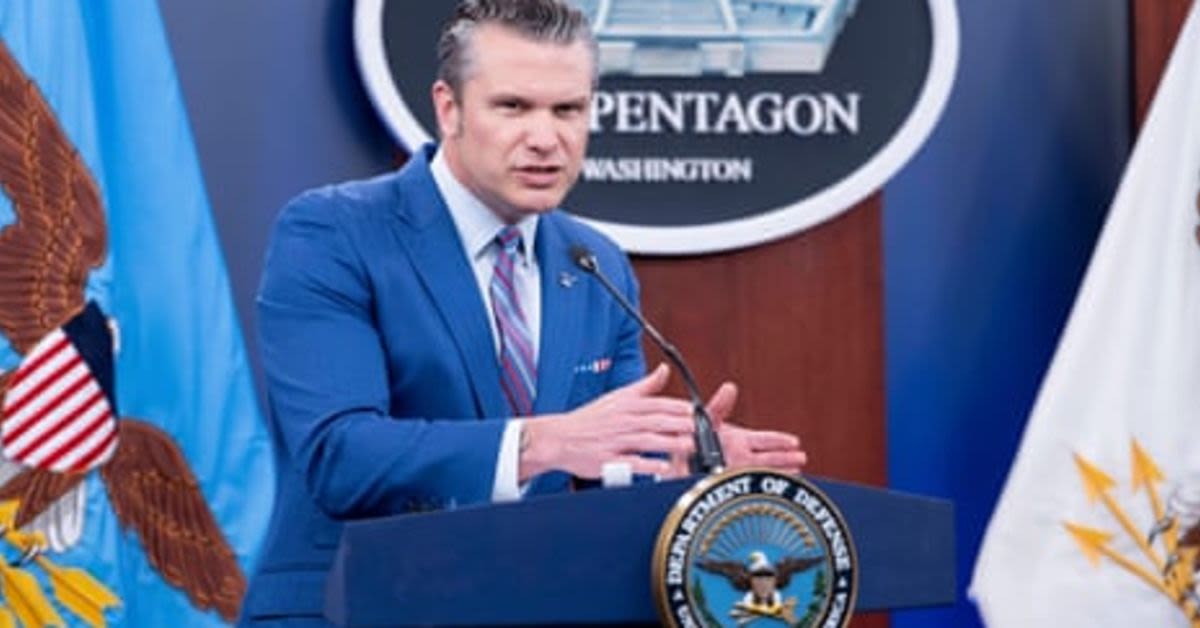
Department of War Secretary Pete Hegseth used a Pentagon press briefing on Friday to deliver a blunt warning to NATO and other US allies he accused of free riding on American power in the Strait of Hormuz as the confrontation with Iran passed the 55-day mark.
According to The Post Millennial, Hegseth argued that Washington has shouldered a disproportionate share of the burden in keeping the vital waterway open while nations that depend far more heavily on its traffic have largely stayed on the sidelines. He urged European and Asian partners to stop relying on American protection and to begin contributing meaningful military support to secure the passage.
Hegseth stressed that the United States, now an energy superpower thanks to domestic production, has far less direct economic exposure to disruptions in the Strait than its allies. It's also worth saying this should not be America's fight alone. We barely use the Strait of Hormuz as a country. Our energy doesn't flow through there, and we have plenty of energy. Just look at the new global conga line headed to Texas, a beautiful picture, Hegseth said, underscoring how US energy independence has changed the strategic equation.
From his perspective, the era in which Europe and Asia could depend indefinitely on American taxpayers and service members to underwrite their security is coming to an end. Europe and Asia have benefited from our protection for decades, but the time for free-riding is over. America and the free world deserve allies who are capable, who are loyal, and who understand that being an ally is not a one-way street. It's a two-way street. We are not counting on Europe, but they need the Strait of Hormuz much more than we do, and might want to start doing less talking and having less fancy conferences in Europe and get in a boat, he added, in a pointed rebuke of European political elites.
Pressed by reporters on whether European governments would step up as their jet fuel reserves dwindle, Hegseth dismissed recent diplomatic gatherings as little more than posturing. I know there's a lot of talks. You saw [what] I would call a silly conference in Europe last week, where they got together and talked about maybe doing something eventually, when things are done. Those are not serious efforts yet. We would welcome that. We would welcome a serious European effort to do something about this Strait and this passage, considering it's their energy capabilities that are most at stake, I think it's a wake-up call, he said, suggesting that Europes energy vulnerability has yet to translate into real action.
Hegseth also detailed the expanding scope of the American-led maritime campaign designed to choke off Irans ability to project power and fund its regime. As part of that effort, the United States has imposed an ironclad blockade that grows more powerful by the day, from the Gulf of Oman to the open oceans. Our Navy is enforcing this blockade without hesitation or apology, he stated, signaling a firm stance against Tehran and its proxies.
While the blockade is aimed at halting Iranian shipping, Hegseth noted that some vessels are still being permitted to transit the Strait under US control. That approach allows Washington to maintain pressure on the Iranian regime while managing global energy markets and commercial flows, a balance that underscores the leverage created by American naval dominance.
The Strait of Hormuz remains one of the worlds most critical chokepoints for crude oil and commercial shipping off Irans southwest coast. The Iranian regime and the Islamic Revolutionary Guard Corps have been firing on vessels transiting the area as their military infrastructure inside the country has been heavily degraded by US strikes, yet Irans own economy is deeply reliant on exports through the same waterway.
With the blockade tightening, the Trump administration is effectively constraining Tehrans economic lifelines while avoiding large-scale ground commitments, a strategy consistent with a conservative preference for strength through deterrence and targeted force. By using naval power and sanctions rather than open-ended nation-building, Washington is seeking to curb Iranian aggression without further entangling American troops in another Middle Eastern quagmire.
Chairman of the Joint Chiefs Dan Caine used the same briefing to spotlight the often-unseen professionals enabling these operations. On Friday, he singled out the intelligence community for its long-term, painstaking work in tracking Iranian capabilities and networks.
I want to honor members of the Joint Force today. I want to highlight and proudly describe the essential role of our intelligence enterprise and the role that they play in conducting our military operations. The totality of their work is the culmination of days, months, and in many cases, years of work by our uniformed and civilian intelligence professionals, we have been able to do the work that we are ordered to do because America's intelligence force, including our core collectors and analysts, have spent decades searching for every loose thread, Caine said, emphasizing that the current pressure campaign on Iran rests on decades of investment in American military and intelligence capabilities that many allies have been content to let the United States provide.
Login