
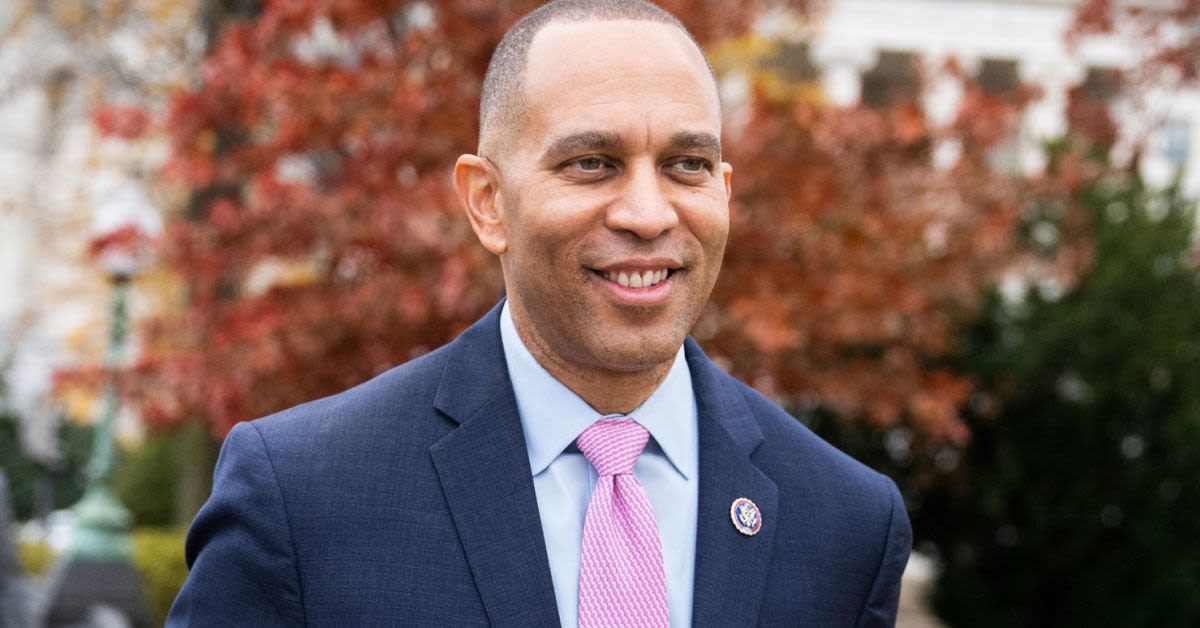
Many conservatives view House Minority Leader Hakeem Jeffries as a largely unserious, even clownish, political figure and his latest public appearance did little to challenge that perception.
During a Capitol Hill news conference held on what C-SPAN described as Take Your Kid to Work Day, Jeffries was confronted with a blunt question from a child that cut straight to the heart of his partys political woes, according to Western Journal. In a clip shared on X, the young questioner asked, Why do voters view Democrats so poorly? prompting laughter from the adults in the room, including the New York Democrat himself.
Jeffries initially handled the moment with a degree of good humor, deflecting with a joke that underscored the awkwardness of the query. Did your dad give you that question? he quipped, pointing to CNNs Manu Raju, as the room continued to chuckle at the childs candor.
As Jeffries attempted to pivot from levity to seriousness, the laughter lingered, briefly drowning out the start of his response. He tried to keep the tone light, warning Raju in jest, Im gonna have words with you after this, while wagging his finger at the reporter.
Up to that point, the exchange might have passed as a harmless, humanizing moment for a politician often seen as partisan and strident. What followed, however, was a boilerplate, jargon-laden answer that revealed why so many Americans and especially conservatives find Democratic leadership so unconvincing.
Listen, I think that we exist in an era right now when the American people are understandably frustrated with institutions, because far too many people in this country are struggling to live paycheck to paycheck. They cant thrive and can barely survive. With that, Jeffries launched into a familiar litany of grievances that managed to sound sympathetic while sidestepping any responsibility for the policies that have contributed to those struggles.
He then broadened his explanation to encompass nearly every major pillar of American civic life, as if the Democrats unpopularity were merely a side effect of a generalized national malaise. And so, he continued, theres a frustration with Congress, theres a frustration with institutional political parties, whether thats Democrats or Republicans, certainly a frustration with the courts, with organized religion, with the media, frustration with institutions of higher education, and, of course, frustration with the current president of the United States of America.
The formulation was telling: a sweeping indictment of institutions that conveniently diluted his own partys culpability. Rather than acknowledge specific policy failures or cultural extremism, Jeffries folded Democrats into a vague, amorphous category of distrusted entities, as though they were merely collateral damage in a broader crisis of confidence.
In doing so, he glossed over a glaring political reality that cannot be explained away by institutional fatigue alone. According to RealClearPolling, the Democratic Party currently suffers a net favorability rating of negative 22.7 more than four points worse than Republicans and over eight points worse than President Donald Trump.
Those numbers suggest something far deeper than generic frustration with politics-as-usual. They point to a public increasingly alienated by the lefts embrace of open borders, radical gender ideology, and a host of other policies that undermine social stability, economic security, and traditional values.
Even many users on X who are not aligned with Trump or the GOP were quick to highlight these substantive issues as the real drivers of Democratic unpopularity. In their view, the partys fixation on identity politics, its hostility to parental rights, and its soft-on-crime tendencies have eroded trust far more than any abstract disillusionment with institutions.
Jeffries, however, chose to offer a child a carefully sanitized narrative rather than an honest reckoning with his partys trajectory. By framing Democrats as mere victims of a broad cultural frustration, he avoided any admission that progressive policies have helped create the very conditions he lamented.
For conservatives, the episode encapsulated why they do not take Jeffries seriously, despite his occasional flashes of humor and self-awareness. When pressed even by a child he retreats to talking points that obscure more than they reveal, reinforcing the sense that Democratic leaders are more interested in managing perceptions than confronting the consequences of their own agenda.
Login