
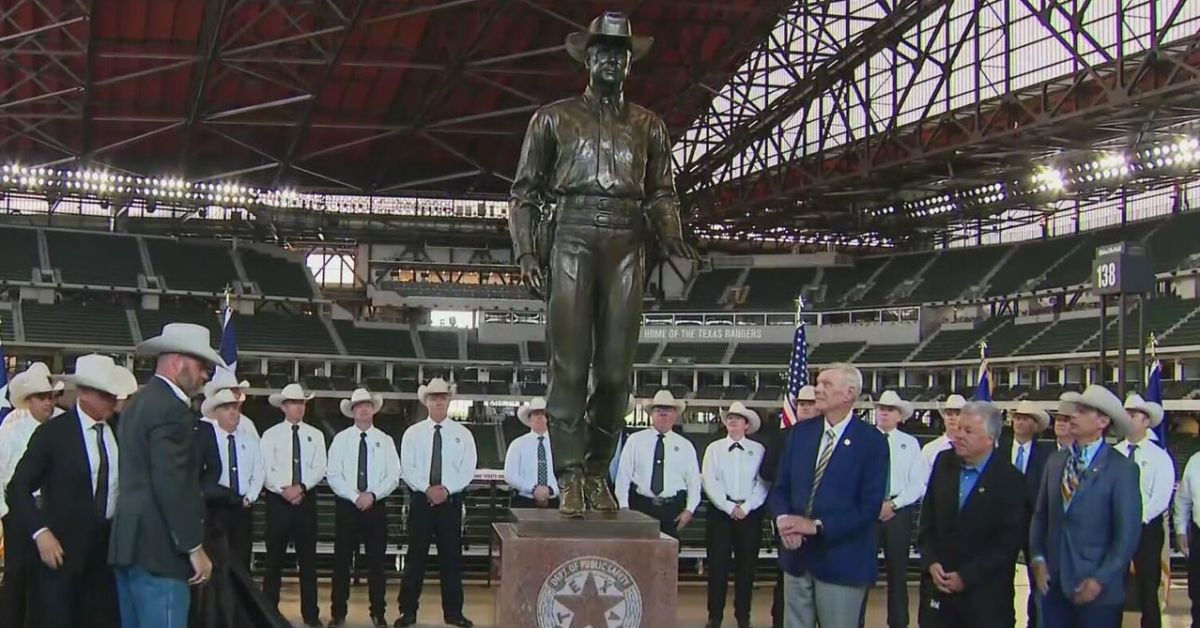
More than six weeks after the Texas Rangers unveiled their One Riot, One Ranger monument at Globe Life Field, progressive activists and their media allies are still working overtime to manufacture outrage over a statue honoring one of Texass most storied law enforcement institutions.
The 12-foot bronze figure, complete with the iconic cowboy hat and holstered six-shooter, was formally dedicated on March 2 and now stands along the left-field concourse, a visible nod to the franchises namesake and the states frontier legacy. According to Breitbart, this is hardly a new public display: the statue first appeared at Dallas Love Field Airport in 1963, only to be removed in 2020 after left-wing activists branded it racist and pressured local officials into capitulating.
Critics insist the work depicts Texas Ranger Captain Jay Banks, whom they accuse of leading efforts to preserve segregated schools during the 1950s. Activists also contend that the title One Riot, One Ranger stems from a gruesome 1930 incident in which a black man, accused of assaulting a white woman, was seized by a white mob and burned alive, with Rangers allegedly restoring order only after the lynching had occurred.
One sports outlet claimed the Rangers organization was wary of the statue and suggested the club tried to bury the story by scheduling the unveiling during spring training, when fewer reporters would be in Dallas. The same outlet further accused the team of stonewalling, alleging that executives refused to answer questions about the ceremony afterward, as if declining to feed a contrived controversy were itself an admission of guilt.
The reason to be wary of potential controversy was the man who served as the model for the statue: Jay Banks, a former Ranger law enforcement officer known for enforcing school segregation at Mansfield High School and Texarkana Junior College in 1956, at the direction of then-Gov. Allan Shivers, the outlet asserted. That framing conveniently ignores the broader historical context of the Texas Rangers and reduces a two-century-old institution to a single, contested interpretation of one mans role in one era.
Supporters of the monument reject the activists narrative and argue that the statue is intended to honor the lengthy history of the Texas Rangers as a law enforcement agency, not to glorify segregation. They maintain that the phrase One Riot, One Ranger traces back not to a lynching, but to an 1896 episode in which Rangers shut down an unsanctioned prize fight in Dallas, a story long embedded in Texas lore.
The Texas Rangers have long occupied a revered place in Texas history dating to the creation of the organization over 200 years ago, before the days of the Republic of Texas, the team said in a statement. The statue that stood for decades in Dallas will greet guests at Globe Life Field as a familiar symbol of our teams origin, enduring spirit, and connection to the community.
Undeterred, the same sports outlet attempted to juxtapose Major League Baseballs annual Jackie Robinson Day with the supposed racist symbolism of the statue in Arlington. On Wednesday, MLB will celebrate Jackie Robinson Day, the sports site added. Robinsons integration is one of the most celebrated elements of the sports history. Outside Globe Life Field, community leaders are planning a press conference to talk about why they believe this statue is antithetical to Robinsons legacy.
That rhetorical sleight of hand tries to turn a unifying celebration of Robinsons courage into a cudgel against a Texas landmark that predates the current culture-war climate by decades. Jackie Robinson Day has nothing to do with a statue installed more than a month and a half ago, and the monument itself is not a direct sculpted likeness of Jay Banks, even though Democrat Governor Allan Shivers once deployed Banks to block integration at Mansfield High School in 1956.
Archival records surrounding the statues creation do not identify Banks as the model, yet activists and sympathetic reporters continue to assert the connection as settled fact. Their claims, repeated often enough, are treated as evidence, even when the historical documentation fails to support the narrative they are determined to impose.
There are, however, photographs of Banks standing beside the statue after it was completed, and the aging Ranger reportedly boasted years ago that he had served as its model. That personal claim, while interesting, is hardly definitive proof of the artists intent, but it has been eagerly seized upon by those eager to brand the entire monument as a tribute to segregation.
Activists and NAACP representatives have targeted the statue since its days at Dallas Love Field, insisting that it glorifies racism and demanding its removal, a campaign that succeeded in 2020 amid the broader wave of iconoclasm sweeping the country. They have since tried to drag the Texas Rangers organization and Major League Baseball executives into the fray, pressing for public condemnations and policy statements, but team officials have wisely declined to indulge the outrage machine.
Instead of allowing a vocal minority to erase yet another piece of American heritage, the Rangers have chosen to let the statue stand as a reminder of the states complex, often heroic law enforcement history. The ongoing effort to conflate that legacy with the worst accusations of the civil-rights era says more about todays ideological crusaders than it does about a bronze Ranger greeting fans on their way to a ballgame.
Login