
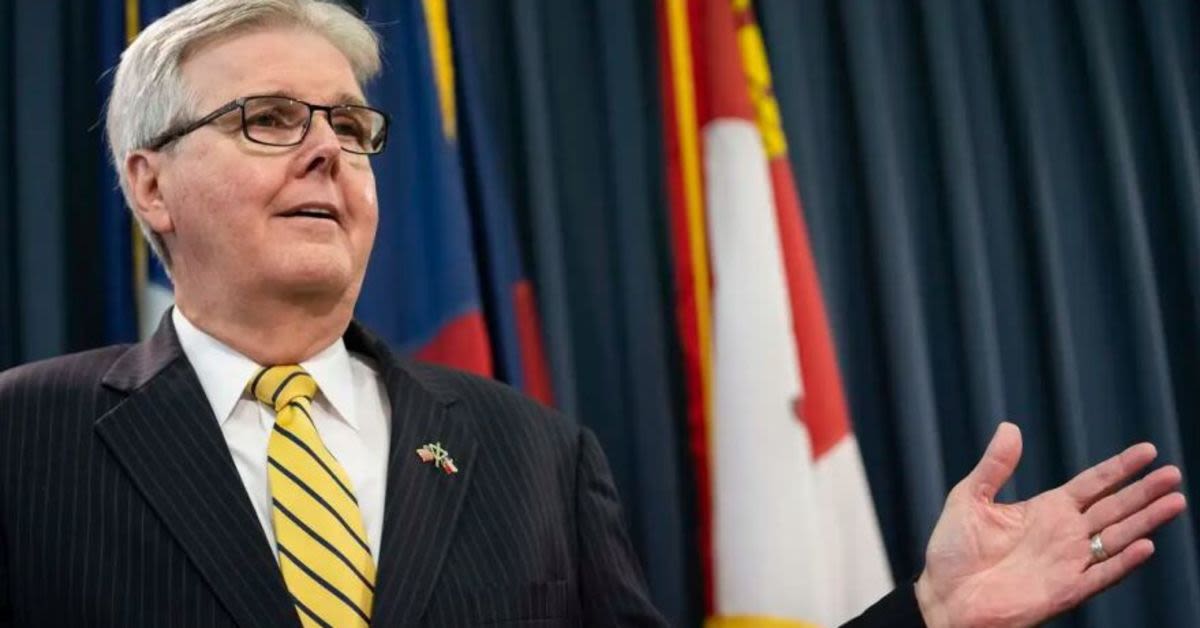
Texas Lt. Gov. Dan Patrick is pushing back against what he calls a long-standing myth in American public life: that the Constitution requires a separation of church and state.
According to Western Journal, Patrick, a Republican, now chairs the newly formed Religious Liberty Commission, an advisory body created by President Donald Trump through an executive order issued last May. The commissions mission statement on the Justice Departments website explains that it exists to advise the White House Faith Office and the Domestic Policy Council on religious liberty policies of the United States, including by recommending steps to secure domestic religious liberty and identifying opportunities to further the cause of religious liberty around the world.
Anticipating criticism from secular activists and the left, Patrick directly challenged the oft-repeated claim that the Constitution demands a strict wall between faith and government. For too long, the anti-God left has used this phrase to suppress people of religion in our country, he said, as reported by KRIV.
Patricks argument rests on a straightforward reading of the actual constitutional text, rather than the slogans that have grown up around it. The First Amendment states, Congress shall make no law respecting an establishment of religion, or prohibiting the free exercise thereof; or abridging the freedom of speech, or of the press; or the right of the people peaceably to assemble, and to petition the Government for a redress of grievances.
Nowhere in that language does the phrase separation of church and state appear, despite its constant invocation by progressives seeking to drive religious expression from the public square. The origin of the phrase lies instead in a private letter written by President Thomas Jefferson to the Danbury Baptist Association in Connecticut on Jan. 1, 1802.
In that correspondence, Jefferson wrote, I contemplate with sovereign reverence that act of the whole American people which declared that their legislature should make no law respecting an establishment of religion, or prohibiting the free exercise thereof, thus building a wall of separation between Church & State. Jefferson first quoted the First Amendment verbatim, then added his own interpretive gloss, with the pivotal word thus signaling that the wall metaphor was his personal construction, not constitutional text.
While Jeffersons stature as a founding father is undeniable, his phrase remains just that a phrase, not a binding clause of the Constitution. Over time, however, activist courts and secular advocates have stretched the First Amendment to suggest that any religious presence in public life is suspect, feeding the narrative that Americas founding was fundamentally secular.
Historical evidence undercuts that claim. Stand to Reason, a Christian apologetics organization, notes that 51 of the 55 delegates to the Constitutional Convention identified as Christian, with one delegates affiliation unknown and three described as deists.
The founders themselves repeatedly linked liberty to religious and moral foundations, a connection modern progressives often ignore or dismiss. Per Hillsdale College, former President John Adams wrote to the Massachusetts Militia in October 1798, Our Constitution was made only for a moral and religious people. It is wholly inadequate to the government of any other.
That warning underscores how far the culture has drifted from the convictions of the founding generation, as a God-fearing people have gradually ceded ground to an aggressive secular left without any constitutional necessity to do so. Patricks commission appears aimed at reversing that trend by defending believers rights in the public arena rather than retreating from it.
Among the issues under review by the Religious Liberty Commission are attacks on houses of worship, the debanking of religious organizations, parental rights in religious education, voluntary prayer in schools, and government displays that include religious imagery. Each of these areas has become a flashpoint where bureaucrats, corporations, and activist groups have sought to marginalize faith-based institutions and individuals.
Patrick has made clear he does not accept the premise that government must be hostile to religion or that public officials must check their beliefs at the door. He recognizes that theres nothing in it about a separation of church and state in the Constitution itself, and sees no reason to sit idly by and let faith be suppressed in a country that never intended for it to be.
Login