
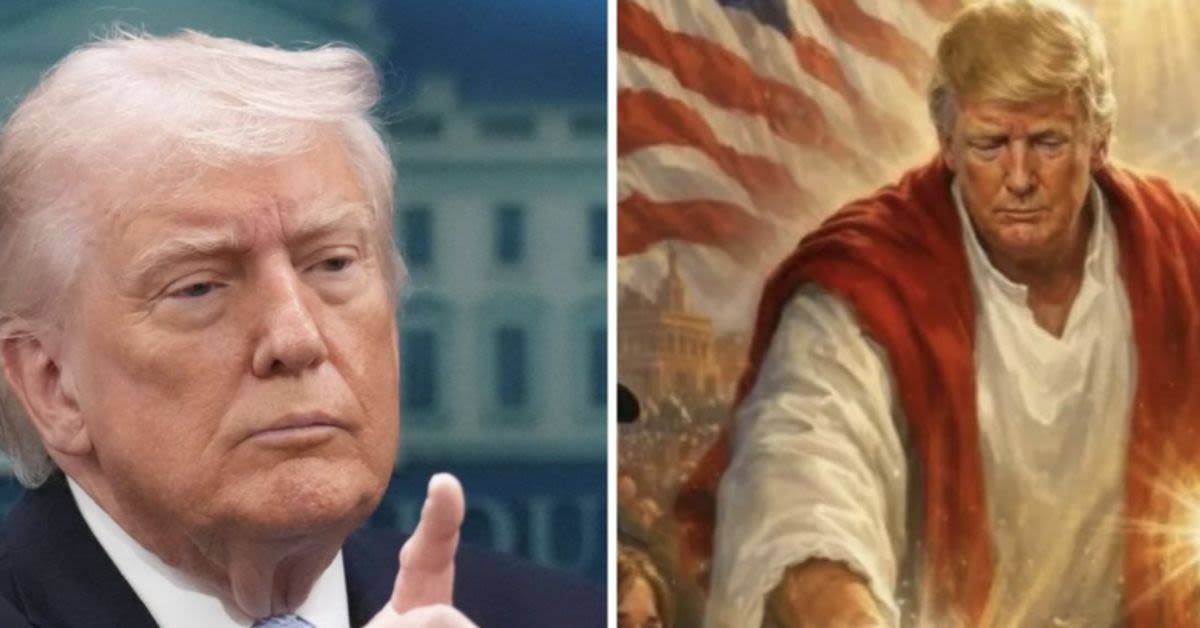
House Speaker Mike Johnson, R-La., privately urged President Donald Trump to remove an artificial intelligence-generated image from Truth Social that portrayed the president placing a glowing, healing hand on the head of a man lying prone.
The image, posted Sunday and deleted Monday, drew swift criticism from secular and religious commentators who claimed it cast Trump in an explicitly Christ-like role, according to Newsmax. In the AI rendering, Trump appears in flowing red and white robes, his hand and head radiating light as he touches the forehead of what appears to be a sick or injured man, while an American flag waves in the background and onlookers gaze at him in reverence.
Johnson, a self-described devout Christian and one of the most prominent evangelical conservatives in Congress, was pressed by a reporter on whether the post amounted to blasphemy.
I talked with the president about it as soon as I saw it and told him that I don't think it was being received in the same way he intended it, Johnson said in a video provided by KVOA-TV in Tucson, Arizona.
The speaker emphasized that Trump responded quickly once the reaction became clear and chose to take the image down.
He agreed and he pulled it down. That was the right thing to do. He explained how he saw that, and I don't think he thought it was sacrilegious at all. I think he showed great respect to others by removing it, Johnson added, framing the decision as an act of consideration toward Christians who might be offended.
The controversy erupted against the backdrop of Trumps escalating feud with Pope Leo XIV, who has sharply criticized the U.S.-Israeli campaign against Iran as inhumane, aligning himself with the global left on foreign policy and humanitarian rhetoric. Shortly before posting the AI image, Trump published a lengthy broadside against the pontiff on Truth Social, calling him WEAK on crime and terrible for Foreign Policy, a charge that resonated with conservatives who see the Vatican drifting into progressive politics rather than defending Western security and moral clarity.
When questioned by reporters Monday about whether he had intended to present himself as a Christ figure, Trump flatly rejected the claim. I did post it, and I thought it was me as a doctor and had to do with the Red Cross [because there was] a Red Cross worker there, which we support, he told reporters outside the Oval Office, insisting the symbolism was medical, not messianic.
Trump blamed the media for what he described as a willful misreading of the image, accusing his critics of manufacturing outrage. Only the fake news can come up with that one. I just heard about it and I said, 'How did they come up with that?' he said, arguing that the depiction was meant to highlight his role as a problem-solver and defender of ordinary Americans.
The president went further, casting the AI artwork as a metaphor for his political mission rather than a theological statement. It's supposed to be me as a doctor, making people better. And I do make people better. I make people a lot better, Trump said, echoing his long-standing claim that his policies have healed the economy, strengthened national security, and restored American pride.
For many religious conservatives, the episode underscored a familiar tension: Trump remains their most effective political champion, even as his brash style and unconventional imagery sometimes brush up against deeply held Christian sensibilities. Johnsons intervention highlighted that balance, with the speaker defending Trumps intent while making clear that reverence for Christ, not any political leader, must remain central for believers.
The clash with Pope Leo XIV added another layer, pitting a populist American president who prioritizes national sovereignty and a strong alliance with Israel against a pontiff increasingly viewed by conservatives as aligned with globalist, progressive causes.
Trumps criticism that the pope is WEAK on crime and terrible for Foreign Policy reflects a broader right-of-center frustration with religious leaders who, in their view, downplay the threats posed by terrorism, rogue regimes like Iran, and unchecked migration.
The AI image controversy also raises questions about how emerging technologies will be used in political messaging, particularly when they intersect with religious imagery and symbolism. While Trumps supporters may see such depictions as metaphorical or aspirational, his critics are eager to portray them as evidence of a cult of personality, a narrative the president and his allies insist is driven more by media hostility than by reality.
Johnsons role in persuading Trump to remove the post suggests that, within the conservative movement, there remains a strong desire to keep political fervor distinct from theological claims, even as many on the right believe Trump has been a historic defender of religious liberty. By acting quickly and quietly, the speaker signaled that conservatives can support Trumps agenda and confront the excesses of the left while still drawing clear lines around sacred Christian doctrine and imagery.
For Trump, the incident is unlikely to damage his standing with his base, which has long accepted his imperfections while valuing his willingness to fight entrenched elites, activist clergy, and what he calls the fake news. Yet the episode serves as a reminder that in an age of AI-generated content and hyper-partisan media, even a single image can ignite a national debate over faith, politics, and the proper place of religious symbolism in public life.
Login