
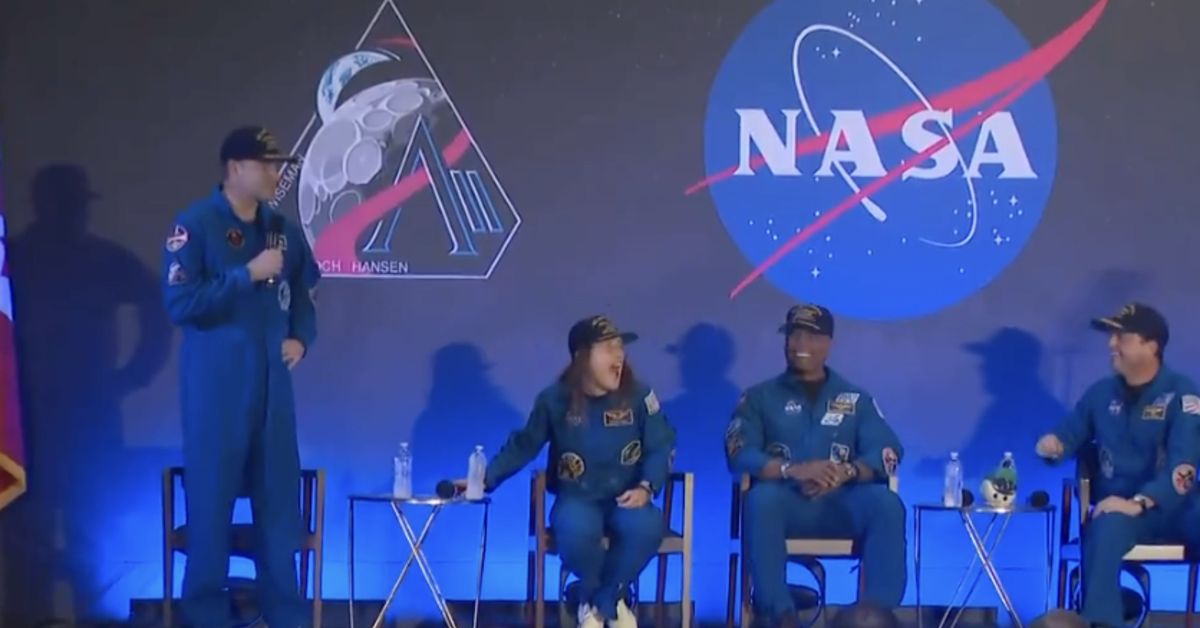
NASAs Johnson Space Center in Houston transformed into a homecoming stage for history on Saturday, as the four astronauts of Artemis II returned from their triumphant journey around the Moon and spoke publicly for the first time since their flawless re-entry and splashdown in the Pacific Ocean off San Diego.
According to RedState, Commander Reid Wiseman, Mission Specialist Christina Koch, Pilot Victor Glover, and Canadian Mission Specialist Jeremy Hansen were welcomed back not only by NASA personnel and their families, but by civic and government leaders and an enthusiastic public eager to celebrate Americas renewed presence in deep space. The event at Ellington Field in Houston doubled as both a technical milestone and a cultural moment, underscoring that the United Statesafter a 53?year hiatus from crewed lunar missionsis once again asserting leadership beyond low Earth orbit.
The celebration began with NASA Flight Operations Director Norm Knight urging the crowd to match the magnitude of the achievement. We just sent four people around the moon! he declared, drawing cheers from a gathering that understood the historic nature of what had been accomplished.
Knight framed the event as more than a welcome-home ceremony. It is my honor to welcome you to Ellington Field in Houston, as we celebrate the return of the Artemis II crew from their historic mission around the moon, he said. This afternoon, we're not only celebrating their safe homecoming, we're recognizing a milestone in space flight history that advances America's bold return to deep space: this time to stay.
He went on to recognize the families, NASA staff, and the national and international partners whose work and sacrifice made the mission possible. After those acknowledgments, Knight marked the formal end of the flight phase with a simple, resonant line: With their safe return to their families, the Artemis II mission is now complete.
Johnson Space Center Director Vanessa Wyche followed, emphasizing the global reach of the mission and the emotional connection it forged. Millions globally felt that connection throughout this mission. People didn't just watch, they were invested, she said, capturing how Artemis II transcended mere spectacle.
Wyche described the intangible but powerful Moon Joy that seemed to permeate the country and the world as the mission unfolded. She noted that a new generation had witnessed that, If you can dream it, you can be it, and predicted that this inspiration will lead to countless students to become the next scientists, engineers, inventors, mathematicians and astronauts. Who will dare to forge new frontiers in space and push the boundaries of what's possible for the benefit of all.
She then turned to the crew itself, underscoring their symbolic importance as well as their technical achievement. Wyche said the event was, a celebration of four pioneers who represent the very best of humanity. Who traveled farther than any humans have gone before, and who carried all of us along with them.
NASA Administrator Jared Isaacman had the honor of officially bringing the crew onto the stage, and he began by crediting political leadership that prioritized American space power. Isaacman thanked President Donald Trump and lawmakers for the mandate and resources to make this mission, and many others to come, possible. All the NASA workforce, the partners national and international, and especially the American taxpayers.
From a conservative perspective, his remarks underscored a core truth: bold national objectives require political will, clear mandates, and serious investment. Isaacman acknowledged that the mission carried a significant cost, but he framed that cost as a strategic investment in American innovation and leadership.
There is no doubt there is a price to pay when it comes to exploring the cosmos, he said. But there is also a return: a return in the jobs it creates, the technologies that improve life here on earth, and the inspiration it sparks in all those who choose to follow. And to people all around the world who look up and dream about what is possible: the long wait is over. After a brief, 53-year intermission, the show goes on, and NASA is back in the business of sending astronauts to the moon and bringing them home safely.
The crowd responded with sustained applause, clearly recognizing that this was not merely a scientific milestone but a reaffirmation of American capability and resolve. Isaacman then turned to the crew, giving them the introduction they had earned through years of training and ten days of flawless execution in space.
This is why it is now my great privilege to welcome to the stage: Commander Reid Weisman, Pilot Victor Glover, Mission Specialist Christina Koch, and Mission Specialist Jeremy Hansen. Ladies and gentlemen, your Artemis II crew, he announced, as the audience rose to its feet in a standing ovation.
The four astronauts, remarkably steady and energetic given the physical toll of spaceflight and re-entry, walked onto the stage to raucous applause. Their composure was a testament to their conditioning, the rigor of NASAs training pipeline, and the medical teams that had monitored them from splashdown to Houston.
Wiseman, still adjusting to gravity, took a moment before sitting, joking that he was feeling some motion sickness. Isaacman used that pause to place Artemis II in the broader arc of Americas return to the Moon and beyond.
Artemis II is the opening act in America's return to the moon, Isaacman said. As we stand here this evening, the mobile launcher is going back to the VAB, Artemis III will start to be assembled, and the next crew will begin to play their part, as we return to the lunar surface, we build the base, and we never give up the moon again.
He then addressed Wiseman directly, recalling a comment the commander had made months earlier. Commander Wiseman, Reid, you said in an interview back in February that you hoped this mission would be forgotten, overshadowed by all that was to come after. But I'm very sorry to disappoint you all. Artemis II will always be remembered. It was the moment we all saw the Moon again. Where childhoold dreams became missions. You helped the world to start believing again, and this is something that no one's ever going to forget. So, on behalf of NASA and the space-loving community from around the world: Thank you, for showing us your courage, your professionalism, your unity, and your humanity. Thank you, for showing us the Moon again. Thank you, for showing us Planet Earth again. And Thank you, for contributing to the greatest adventure in human history. Welcome home, Artemis II.
When Wiseman rose to speak, he immediately called his crewmates to his side so they could synchronize their watches, a ritual they had used throughout training and the mission to regain focus whenever they felt scattered. The simple act, performed in front of the cameras, served as a visual metaphor for unity, discipline, and shared purpose.
I have absolutely no idea what to say, Wiseman began, capturing the surreal nature of their transition back to Earth. Twenty-four hours ago the Earth was that big [pantomimed the size with his hands] out the window and we were doing Mach 39, and here we are back at Ellington, at home.
The audience laughed, and Wiseman high-fived his fellow astronauts before turning serious again. He spoke directly to his crewmates and their families, highlighting the unbreakable bond forged in the harshest environment humans have ever faced.
Victor, Christina, and Jeremy: We are bonded forever. And no one down here is ever gonna know what the four of us just went through. And it was the most special thing that will ever happen in my life. And our families are over here. And with the exception of Dot, Susie, and Jeannie, who are in the audience, but I don't know where they are. But Dot, I'm going to hit McDonald's later today, in honor of your husband. No one knows what the families went through, man. This was not easy. Being 200,000-plus miles away from home. Like, before you launch, it feels like it's the greatest dream on Earth. And when you're out there, you just want to get back to your families and your friends. It's a special thing to be a human and it's a special thing to be on Planet Earth.
The crew then embraced in a group hug, a spontaneous display of camaraderie that underscored the human side of a mission often discussed in terms of hardware and trajectories. Wiseman, regaining his humor, then turned the microphone over.
The only person who could follow that up is Victor Glover, so, let's go! he joked, prompting laughter from the crowd. Glover, widely regarded as the spiritual center of the crew, had already become known for his thoughtful, faith-infused messages from orbit.
Yet on this day, he admitted he was at a loss for words. I have not processed what we just did, and I'm afraid to start even trying, he said, before explaining what had been on his heart since launch.
When this started on April 3rd, I wanted to thank God in public. And I want to thank God again. Because even bigger than my challenge trying to describe what we went through, the gratitude of seeing what we saw, doing what we did, and being with who I was with... it's too big to be just be in one body.
He echoed Wisemans praise for the families, pointing to the commander and saying, And I wanted to thank our families, for everything that he just said, so [pointing to Wiseman] great words, great words, great words. Then he added a personal note of affection.
I love you. But not just those five, beautiful, cocoa-skinned ladies right here. But all of you, he said, referring to his family and extending that love outward to the broader community. He then turned to NASAs leadership, noting that while faces had changed since April 2023, the core values of the agency had not.
And I wanted to thank our leadership, Glover said. And it's changed since we were here in April of 2023, but the qualities haven't. And we are fortunate to be in this agency, at this time, together. And so, I'm gonna to sit down.
Before leaving the podium, he offered one more expression of gratitude, this time to the operational teams that had literally brought them home. Thank you also for our air operations for this facility and our ride home from San Diego. Thank you. I love you.
Christina Koch, who admitted she had been unable to sleep the night before, came prepared with written remarks. She framed the mission in terms of two intimate, earthly moments that bookended an extraordinary voyage.
Ten days ago, this journey started with our mission manager Sean Duvall, knocking on my door in crew quarters, and whispering, Christina, we're go for launch, get up! she recalled. And it ended last night, when my nurse on the ship put me to bed, and said, Ma'am, can I get a hug?
So, a lot has happened between those two moments, but the start and the end were human moments here on Earth, she observed, emphasizing that even the most advanced exploration remains grounded in simple human connections. Koch then reflected on a question she had often been asked in the lead-up to the mission, a question about what it means to be a crew.
Koch admitted that before this mission, Everything that came out of my mouth was completely without value. The experience of Artemis II, she said, had given her a deeper, more authentic answer.
The last 10 days I've gotten a little bit of a better answer on that question, she said. A crew is people, a group, that is in it all the time, that is stroking together every minute with the same purpose. That is willing to sacrifice silently for each other. That gives grace, that holds accountable. A crew has the same cares and the same needs. And a crew is inescapably, beautifully, dutifully linked.
She described the view of Earth from deep space, noting that what struck her most was not just the planet itself, but the vast emptiness surrounding it. So, when we saw tiny Earth, people asked our crew what impressions we had, she said. And honestly, what struck me wasn't necessarily just Earth. It was all the blackness around it. Earth was just this lifeboat hanging, undisturbingly in the universe.
Koch briefly lost her train of thought, pausing before finishing with a powerful metaphor that brought the missions lessons back home. So... I may have not learned... I know I haven't learned everything that this journey has yet to teach me, she said. But there's one new thing I know, And that is: Planet Earth. You. Are. A. Crew.
Jeremy Hansen, the Canadian astronaut whose presence on Artemis II marked a historic first for a non-American on a U.S. lunar mission, was the last of the four to speak. Well, it's been a lot, and this isn't helping. This is the furthest I've been away from Reid in a long time, he joked, prompting Wiseman to sit beside him and place a reassuring hand on his shoulder.
It's the human experience that is extraordinary for us, and it sounds like maybe for you too, Hansen said, before outlining three themes that had defined the crews shared journey. The first was gratitude, which he extended to his family, to NASA and its leadership, and to the Canadian Space Agency.
Hansen expressed that gratitude in both English and French, honoring his nation and its partnership in the Artemis program. Then he returned to English to highlight the courage of the teams who made difficult calls during the mission.
Gratitude for the bravery and the courage, for the teams to be 'No Go,' when we were , and 'Go,' when we were . That took a lot, he said. I don't think people will really ever fully comprehend how well supported and trained we were. It's almost unbelievable.
The second theme was joy, which the crew had encapsulated in a phrase they used among themselves. Hansen explained that they had coined the term Joy Train to describe a mindset that kept them aligned and moving forward together.
We're not always on the Joy Train, this crew, he admitted. There are many times we are not on the Joy Train. But we are committed to getting back on the Joy Train as soon as we can. And that is a useful life skill for any team trying to get something done.
Then came the final theme, which he said required the presence of his crewmates at his side. The last one is I need your help for this, come up here you guys, he said, as the others stood and locked arms with him.
The last one is Love, Hansen concluded. What you saw was a group of people who loved contributing, having meaningful contribution, and extracting Joy out of that. And what we've been hearing is that was something special for you to witness. And, the reason I had them form up here with me, is that when you look up here, you're not looking at us. We are a mirror reflecting you. And if you like what you see, just look a little deeper.
This is YOU, he said, as the crew once again embraced, embodying the unity and shared purpose that had carried them safely around the Moon and back. Their success, grounded in discipline, faith, and mutual responsibility, offered a quiet rebuke to the fractured politics and cultural cynicism so often seen on Earth.
Other speakers reinforced the theme of partnership and national purpose, including Canadian Space Agency President Lisa Campbell, who spoke in both French and English about the historic cooperation that placed Hansen aboard Artemis II. Republican Rep. Brian Babin of Texass 36th District, chairman of the House Science Committee, and Republican Rep. Greg Bonin of Texass 24th District, chairman of the House Appropriations Committee, also delivered remarks, underscoring Congresss role in sustaining Americas space ambitions.
Republican Rep. Michael Cloud of Texass 27th District closed out the guest speakers, tying the mission to faith, family, and the national character. Thank you for all you've done to inspire us to dream again. You, and everyone who has supported you. It is... as a father, I have three kids, and I know some of you do too. For them to have something to look to: to dream again, to build again, to achieve again. Us as a nation desperately needed this, the world needed this. We needed to see what could be done when we could come together, again, Cloud said.
He drew on Scripture to frame the mission in theological as well as scientific terms. I'm reminded of the Psalmist in Psalm 8: He said, even as we look to the night sky, and as we look at creation and behold the stars and the moon, we begin to think about what is mankind from God's perspective. And so, this trip gave us a different way of looking at ourselves. And the way that you have displayed the best of us has been extraordinary and has given us a perspective as we continue to push ahead into the future.
This is a noble cause, it's a worthy case, it's worthy of our best efforts as a nation, and thank you for what you've done, Cloud continued. You've given us something to dream again, you've inspired us, and you've given us something we can build upon for the future. God Bless You.
Norm Knight returned to the podium to close the formal program, once again directing credit where it was due. He thanked the Artemis II crew and then turned to the thousands of men and women whose work, often unseen, had made the mission possible.
To the workforce across NASA and our partners: This achievement belongs to you, Knight said, capturing a truth that resonates deeply with those who believe in limited but purposeful governmentgovernment that sets clear goals, empowers excellence, and then trusts skilled professionals and private partners to deliver. As Artemis II transitions from mission to memory, its legacy will rest not only in the data it gathered, but in the renewed confidence it has given a nation that still dares to look up, dream big, and lead.
Login