
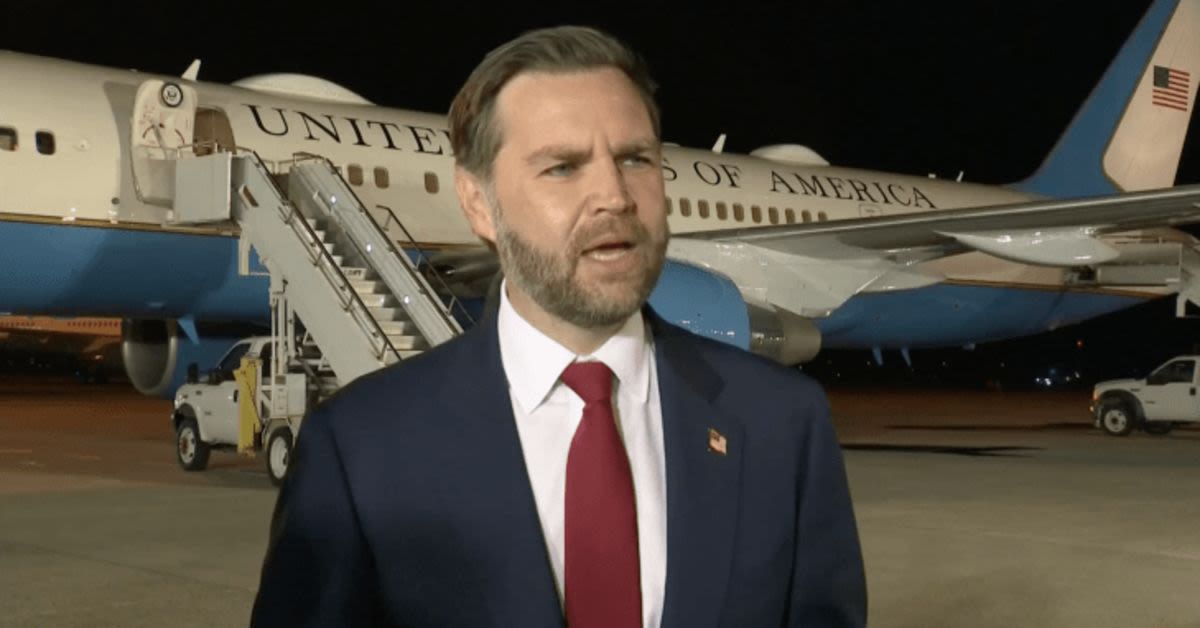
Vice President JD Vance is stepping squarely into the center of President Donald Trumps foreign policy strategy as he leads a high-stakes effort to determine whether Iran is genuinely interested in de-escalation or merely stalling for time.
According to RedState, Vance departed Friday aboard Air Force Two for Islamabad, Pakistan, where he will head a U.S. delegation in talks with senior Iranian officials amid a tenuous ceasefire. The team includes Special Envoy Steve Witkoff and the president's son-in-law Jared Kushner, underscoring that the White House views this as a pivotal test of whether Tehran intends to honor the fragile agreement reached earlier in the week.
Before leaving Joint Base Andrews, the vice president addressed reporters and signaled a firm but measured approach to the negotiations. "As the president of ?the United States said, if the Iranians are willing to negotiate in good faith, we're ?certainly willing to extend the open hand," Vance said.
He immediately followed that olive branch with a warning that the administration will not tolerate manipulation or delay tactics from the regime in Tehran. "If they're going ?to try to play us, then they're going to ?find the negotiating team is not that receptive."
This mission is far from a ceremonial photo-op for Vance, who is already widely regarded as the Republican frontrunner for the 2028 presidential nomination. The decision to send the vice president into such a volatile diplomatic environment signals both the seriousness of the talks and the political sensitivity surrounding any deal with Iran.
Pakistan has been aggressively pushing to broker an agreement and has succeeded in getting both sides to the table, but its ambitions add another layer of complexity. Islamabad is hungry for a diplomatic victory even as the ceasefire itself remains precarious, vulnerable to collapse if Iran senses weakness or division in the American position.
Vance arrives in Pakistan with a dual mandate: determine whether Tehran is serious about peace and make unmistakably clear that the Trump administration is not interested in diplomatic theater. He is simultaneously solidifying his status as a central architect of the administrations foreign policy and gaining critical experience on the world stage that could shape his political future.
His charge this weekend is straightforward and uncompromising: To tell Iran that if it wants an off-ramp from further confrontation, this is its best opportunity. If instead it chooses to stall, bluff, or bury ambiguity in the fine print, Vance has already indicated that the window for such gamesmanship is closing rapidly.
This trip to Pakistan is Vances second major foreign engagement in a single week, underscoring the administrations reliance on him as a diplomatic heavyweight. Earlier, he traveled to Hungary to back Prime Minister Viktor Orbn, a key European ally of President Trump, as Orbn faces a difficult reelection battle.
In Budapest, Vance used the visit to reaffirm the administrations support for Orbns nationalist, sovereignty-first agenda and to criticize the European Union for meddling in Hungarys internal affairs and obstructing its energy policies. That same unapologetically conservative posture now follows him to Islamabad, where the message to Iran is equally clear: the United States is open to peace, but it will be pursued from a position of strength, not appeasement.
Login