
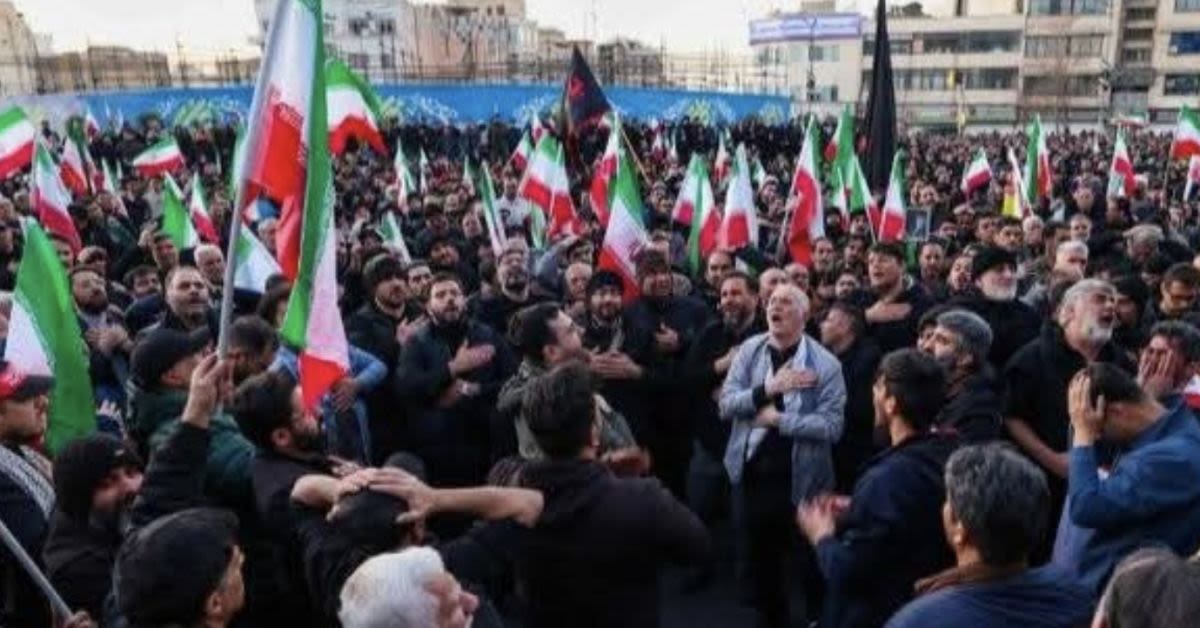
The Islamist regime in Tehran staged nationwide mourning ceremonies on Thursday to mark 40 days since the killing of longtime dictator Ayatollah Ali Khamenei, drawing large, state-orchestrated crowds but conspicuously failing to produce any public appearance by his son and proclaimed successor, Mojtaba Khamenei.
According to Breitbart, the commemorations were the first major, regime-ordered gatherings since both Iran and the United States, with Pakistan acting as intermediary, announced a two-week ceasefire that paused the hostilities ignited in late February. On February 28, President Donald Trump unveiled Operation Epic Fury, a U.S. military campaign designed to cripple Tehrans illicit nuclear program and its missile and drone capabilities, and he further declared that the operation had eliminated the elder Khamenei that same day.
Working in coordination with the Israel Defense Forces (IDF), the Pentagon has reportedly taken out dozens of senior figures within the Iranian state, leaving the question of who is actually running the country unresolved. With the Islamic Revolutionary Guard Corps (IRGC) a U.S.-designated terrorist organization and President Masoud Pezeshkian both formally subordinate to the supreme leader, the absence of verifiable involvement by Mojtaba Khamenei has cast a cloud of uncertainty over the regimes chain of command.
In March, the regime announced that Mojtaba Khamenei would inherit his fathers role, and several written communiqus have since been issued in his name, yet he has not appeared in public or released any authenticated audio messages. Filling the vacuum, Pezeshkian and Foreign Minister Abbas Araghchi have taken to the streets of Tehran and other venues, attempting to project authority and continuity on behalf of a leadership structure that appears increasingly opaque.
Reports from Thursdays marches suggest that Pezeshkian was present at the events, while Mojtaba Khamenei remained unseen, despite state media insisting that one of the central purposes of the gatherings was to affirm loyalty to the supreme leader. The regimes inability or unwillingness to present its new dictator in person has fueled speculation that the leadership transition is either incomplete, contested, or being concealed for reasons the authorities refuse to explain.
The Tasnim News Agency, a mouthpiece closely aligned with the IRGC, announced that officials had ordered mass assemblies through 8 p.m. local time on Thursday to facilitate mourning the martyrdom of the Imam of the Ummah [Muslim community]. By holding pictures of the martyred leader of the revolution and chanting slogans, the participants express their sympathy with him, Tasnim reported, adding, Also, the audience released their cry on the street of the Islamic Republic and declared their allegiance to Ayatollah Seyyed Mojtabi Hosseini Khamenei, the Supreme Leader of the Islamic Revolution.
State outlets broadcast footage of large crowds across the country carrying portraits of the deceased Khamenei alongside Iranian flags, a familiar spectacle in a system that relies heavily on choreographed displays of loyalty. Yet the visual propaganda could not mask the glaring absence of the man the regime insists is now the ultimate authority, nor could it dispel doubts about whether he is capable of exercising power at all.
Under Shiite tradition, the 40th day after a persons death known as the chehelom is typically marked by visits to the grave and prayers at the burial site. The Iranian government has never confirmed that Khamenei was buried or disclosed the location of his remains, suggesting that the regime has chosen to keep the supreme leaders final resting place secret, a decision that undercuts the religious symbolism it is trying to exploit.
The independent outlet Iran International noted that many Iranians on social media questioned the rationale for mass mourning events when there is no tomb to visit. Forty days have passed and his corpse is still lying around. The fortieth is a sacred day in Shiite tradition, when people gather at a grave for a proper ceremony. But for him, none of that is possible, one observer was quoted as saying, while others ridiculed the regime for holding one of its ceremonies in a Christian church in Tehran, an odd choice for a government that prides itself on its hardline Islamist identity.
Separately, the IRGC issued a statement on Thursday insisting that Khamenei remained as influential as his lifetime even after death and boasting that Iran had delivered one hundred lethal blows to the United States, though it offered no evidence or specifics. In reality, dozens of Iranian officials have been killed in the current confrontation, while there is no public record of any U.S. government officials being killed or injured, underscoring the propagandistic nature of the IRGCs claims.
The IRGC also used the occasion to reaffirm its allegiance to Mojtaba Khamenei, signaling that the powerful paramilitary force intends to preserve the Khamenei familys grip on power. That pledge, however, does little to clarify whether Mojtaba is actually directing events or merely serving as a symbolic figurehead while others within the security apparatus and political elite maneuver behind the scenes.
Since the elder Khameneis death, the status and whereabouts of his son have remained shrouded in mystery, feeding a swirl of rumor and conjecture. After state media proclaimed him the new supreme leader, officials released photographs and read aloud a written statement purportedly from Mojtaba, and the regime organized events compelling citizens to swear allegiance to his image on posters, yet he has never appeared in person before the public.
In the information vacuum, increasingly wild stories have circulated, including claims that Mojtaba Khamenei is gravely wounded, hospitalized, or unconscious. Some rumors have gone further, alleging that Khamenei is homosexual, though such claims have not been substantiated and do not explain why the regime, which routinely fabricates charges against its enemies, would be unable to stage even a brief, tightly controlled appearance to dispel doubts.
On Monday, the U.K.-based Times reported that Mojtaba Khamenei was unconscious in a hospital in the holy city of Qom, citing unnamed sources. The following day, the Washington, DC, outlet Axios claimed that American and Israeli officials had learned that Khamenei personally intervened to secure the ceasefire, a narrative that, if true, would suggest he is both alive and politically active, yet none of the governments involved have publicly confirmed these accounts.
For now, the regimes insistence on mass displays of loyalty to an unseen leader, its secrecy over the elder Khameneis burial, and its reliance on bombastic IRGC rhetoric highlight a system that appears more fragile than it admits. As Tehrans rulers attempt to project strength at home and defiance abroad, the unanswered question of who truly wields power in the Islamic Republic continues to cast a long shadow over Irans future and the stability of a region already on edge.
Login