
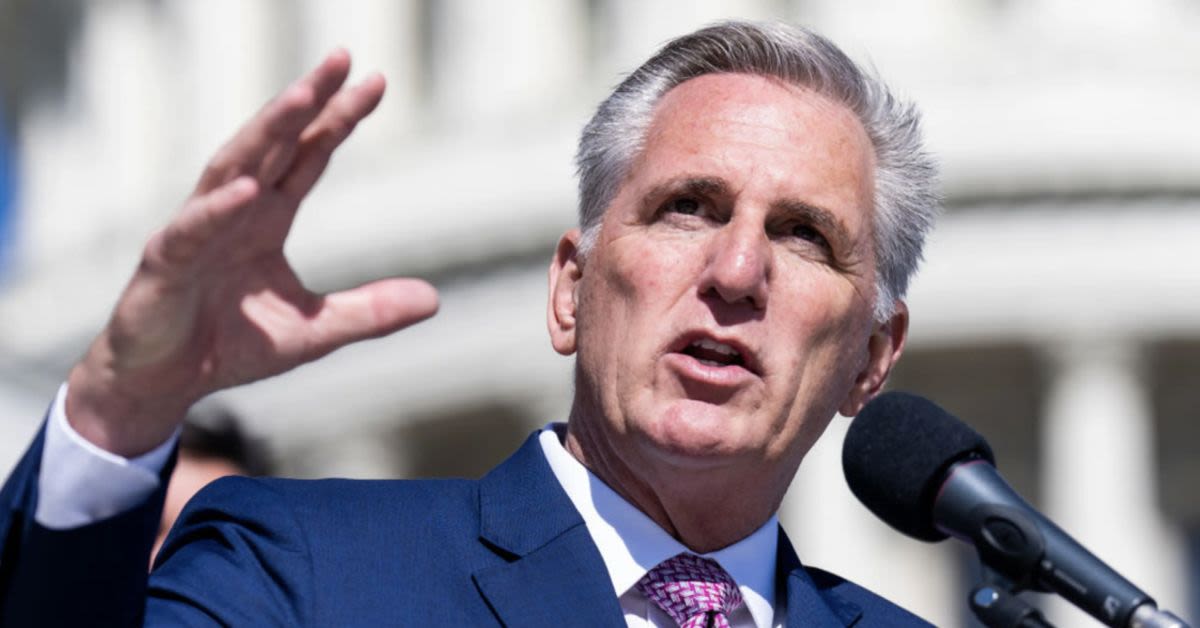
Former House Speaker Kevin McCarthy used a live CNBC appearance Wednesday to chastise co-anchors Joe Kernen and Andrew Ross Sorkin for bickering over polling and politics instead of letting him answer questions about the Biden administrations controversial ceasefire deal with Iran.
The tense exchange unfolded on Squawk Box after Sorkin pressed McCarthy on the political fallout from the agreement. According to Mediaite, Sorkin framed the issue through the lens of public opinion and internal White House dynamics, telling McCarthy, Politically, how do you see this? You know, if you look at most of the polls, the American public is largely not behind this. Maybe they will get behind this, depending on the outcome, I dont know. There was a fascinating report in yesterday suggesting effectively that [Benjamin] Netanyahu oversold the possibilities here in terms of what was possible and that the president was persuaded by him despite other people, including obviously the vice president, trying to push back on all of this. Before McCarthy could respond, Kernen jumped in to challenge the polling narrative and highlight Republican support for the move.
Kernen immediately countered Sorkins framing by emphasizing that GOP voters overwhelmingly back the policy. You know that 75% of Republicans are for this move. And he won that-, the only poll that matters is that that one in the November of 2024. So Democrats are 70 or 80% against it- Kernen began, underscoring a familiar conservative argument that election results, not selective surveys, are the ultimate measure of public sentiment.
Sorkin, clearly irritated, tried to rein in the back-and-forth and re-center the conversation on the guest. We have a guest that were interviewing, and so lets hear what the guest has to say about this, again, he said, attempting to cut off Kernens commentary. But Kernen pressed on, pivoting to broader partisan divides and Democratic hostility toward President Donald Trump.
So you heard about the polls? The Democrats dont like Trump. Lets lead with that. They dont like, you know, theyre 80% against this. But they do want to defund DHS and they do wanna- Kernen continued, drawing a sharp contrast between Republican support for a strong national security posture and the lefts increasingly radical stance on border enforcement and homeland security. Sorkin tried to interrupt with, Im not sure- before McCarthy finally stepped in to seize control of the conversation.
Alright, let me answer the question, McCarthy said, cutting through the crosstalk as Sorkin again tried to restore order. Lets just talk to Kevin here, and then we can debate the facts about what polls say or dont say, Sorkin added, acknowledging that the anchors on-air dispute was overshadowing the substance of the issue.
McCarthy then delivered the line that instantly captured the moment and the mood. You guys are making me feel like a child of divorce. Let me go through it, he said, likening the dueling hosts to feuding parents while positioning himself as the adult in the room ready to address policy rather than media theatrics. From there, he laid out a broader, historically grounded defense of the administrations action, focusing on long-term strategic outcomes rather than fleeting polling snapshots.
So the thing I was thinking, an action like this, youre not gonna answer that question by a poll in a day. Its gonna be longer duration, McCarthy argued, stressing that serious foreign policy cannot be judged by overnight surveys. So when you look at this in history, was the president right to make sure Iran did not get a nuclear weapon? And if you remind people of the actions they took when they funded the proxies, the terrorist attack inside Israel, the attacks from the Houthis, I think history will prove this is right.
He went on to link strategic success to tangible benefits for American families and U.S. allies. How it ends that they dont have the uranium and the strait is open, I think come November and the price of fuel is down, that poll that looks today, whether it be Democrats, independents, or others, will be much different, McCarthy said, pointing to energy prices and regional stability as the real tests of policy success. He also emphasized that the operation avoided the kind of costly ground war conservatives have long warned against.
And any actions such as this when you take it that he didnt take troops on the ground, that we didnt have a large number of casualties, and he changed the course of history, and if more people are able to join the Abraham Accords, long-term people will look at that, that that was a very smart move, McCarthy continued, tying the move to the Trump-era Abraham Accords and a broader realignment in the Middle East that many on the right view as one of the last administrations signature achievements. He further highlighted American technological and intelligence capabilities as a point of national pride.
When you look at when our airmen is down and the CIA is using special technology that no one has before, this is an amazing feat thats gone through, and if the economy continues to stay strong, I think that judgment has to be done later than after today, McCarthy concluded, urging patience and perspective rather than the instant, poll-driven verdicts favored by much of the media.
The segment, aired live on CNBC, ultimately showcased not only McCarthys defense of a hard line against Iran and its terror proxies, but also the growing disconnect between media narratives and the long-term strategic thinking conservatives argue is necessary to keep America secure.
Login