
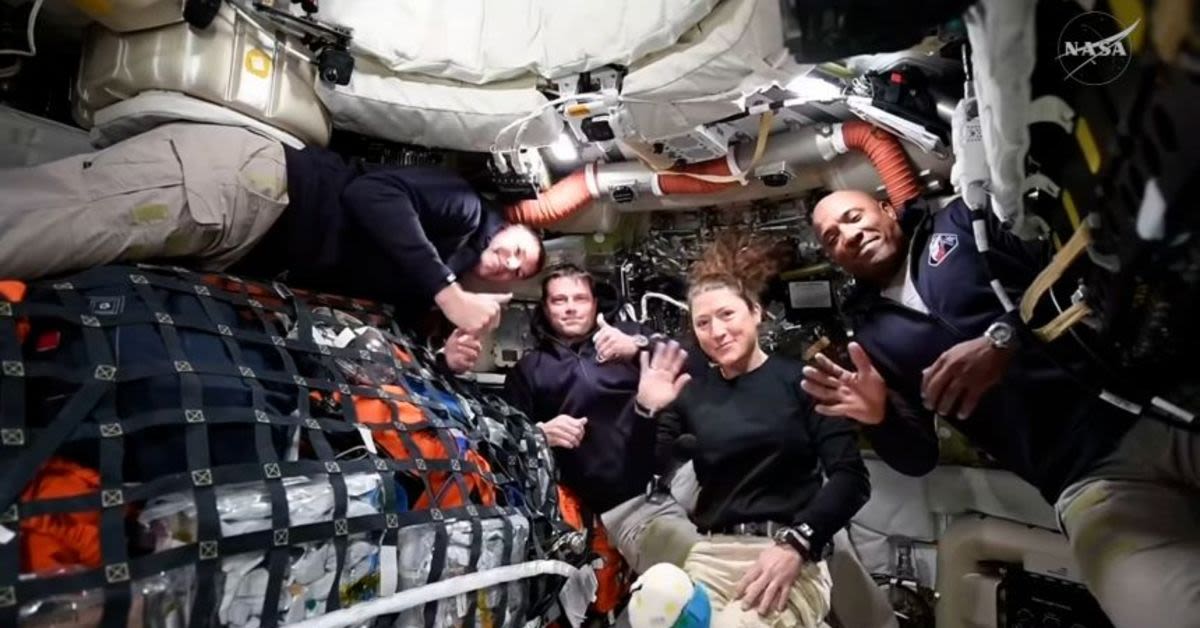
As Americas Artemis II crew arcs toward the moon under President Trumps second administration, the astronauts are not only pushing the limits of human exploration but also delivering images that remind the world why the United States still leads in space.
According to RedState, the mission has already produced a visual first for mankind, with NASA revealing that, In this new image from our @NASAArtemis II crew, you can see Orientale basin on the right edge of the lunar disk. This mission marks the first time the entire basin has been seen with human eyes. That achievement underscores how, decades after Apollo, American astronauts are still the ones charting new frontiers while other nations struggle to keep pace.
The crews vantage point also highlights the sheer distance from home, as Earth shrinks to a fragile shard of blue in the blackness. One last look at Earth before we reach the Moon. This view of the Earth was captured on April 5, the fourth day of the Artemis II mission, from inside the Orion spacecraft. The four astronauts will reach their closest approach of the Moon tomorrow, April 6, NASA reported, a reminder of both the isolation of deep space and the extraordinary engineering that makes such travel possible.
Yet this is no mere sightseeing tour for social media; the mission is designed to gather critical data that will shape future lunar operations and, ultimately, a sustained American presence on and around the moon. As Artemis II swings around the Moon on Monday, astronauts will track historic Apollo sites, scout future landing zones and capture rare views of nearby planets, NASA explained, outlining a workload that blends reverence for past achievements with preparation for the next phase of exploration.
NASA further detailed the plan during its daily Artemis II mission status briefing at Johnson Space Center in Houston, emphasizing the scientific and strategic value of the flyby. The two Apollo sites they'll be able to see here at the beginning are the Apollo 12 and 14 landing sites as they progress through the several hour period where the moon is illuminated, Artemis II Lunar Science lead Kelsey Young said, underscoring how todays astronauts are literally flying past the landmarks of American greatness.
Life aboard the spacecraft is demanding, a far cry from the romanticized vision of effortless space travel often promoted by Hollywood and progressive fantasists. No days off when youre Moonbound. @Astro_Christina continues prep for tomorrows lunar flyby after completing her workout. Meanwhile, our entire world watches in anticipation with hope and excitement as the @NASAArtemis II crew presses on toward the Moon, NASA noted, capturing both the discipline of the crew and the global attention focused on this American-led mission.
Artemis II is the first time in more than 53 yearssince Apollo 17 in December 1972that NASA has sent American astronauts into deep space, defined as beyond near-Earth orbit, restoring a level of ambition that many feared Washingtons bureaucracy had permanently lost. Mondays operations, scheduled for April 6, promise a series of tightly choreographed maneuvers and observations that will test hardware, human endurance, and mission planning in ways that will echo for years.
Like the stunning rescue this Easter Sunday of a U.S. pilot who had ejected inside enemy territory in Iran, the Artemis II mission showcases the unbelievable promise of American technology and the American spirit, a combination that thrives when government remembers its proper role: empowering excellence rather than smothering it in regulation.
NASA will air live coverage of the lunar flyby Monday at 1 p.m. EST, and as the agency notes, POV: You're flying by the Moon. This visualization is designed to show you what exactly the Artemis II astronauts will see outside their window during their lunar flyby. Here, the seven-hour visualization is compressed into 28 seconds. ? (1/4), offering citizens a front-row seat as American astronauts once again prove that, with the right leadership and priorities, this nation still knows how to reach for the stars.
Login