
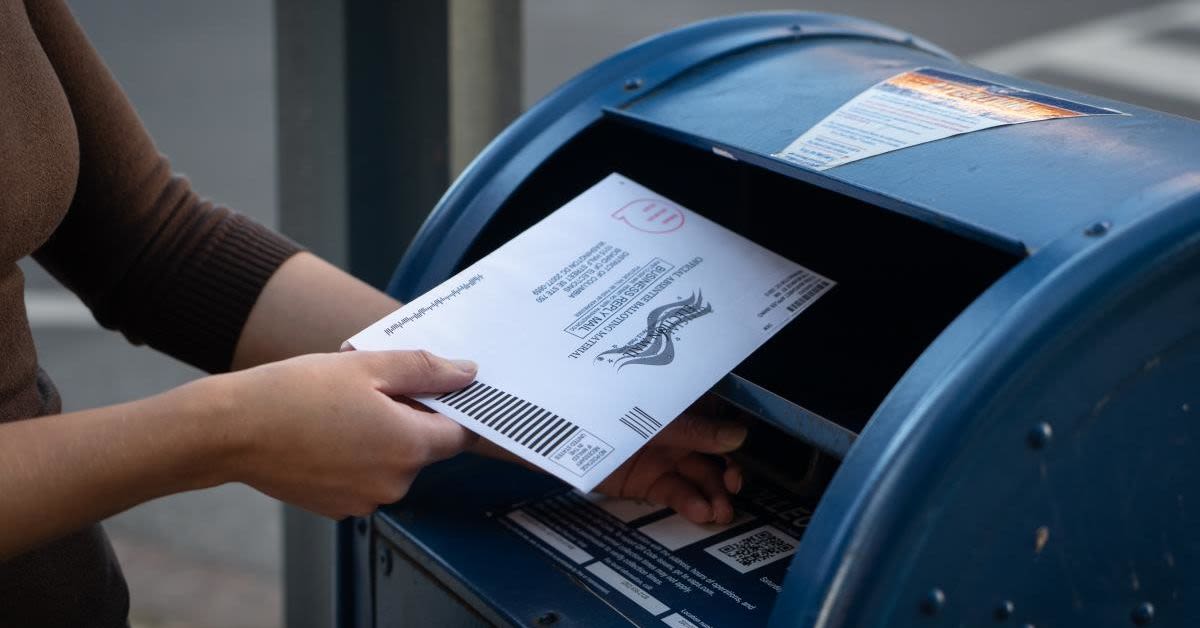
Democratic leaders have launched a sweeping legal offensive to halt President Donald Trumps latest effort to tighten mail-in voting rules ahead of the midterm elections.
The Democratic National Committee, Senate Minority Leader Chuck Schumer, House Minority Leader Hakeem Jeffries, and their principal campaign arms filed a federal lawsuit Wednesday seeking to block the Presidents executive order aimed at curbing vulnerabilities in absentee voting. According to RedState, the order directs federal agencies to verify U.S. citizenship using Social Security and Department of Homeland Security data, instructs the U.S. Postal Service to mail absentee ballots only to voters on state-approved lists, and mandates unique barcodes to track each ballot through the system.
The speed and ferocity of the Democratic response suggest a party deeply unsettled by even modest attempts to tighten election safeguards. For years, these same leaders have portrayed the existing mail-in framework as sacrosanct, yet they now appear determined to stop what many Americans view as basic, commonsense protections against fraud.
The plaintiffs claim that Trump is attempting to manipulate the process for partisan gain, asserting in their filing that he is trying to "rewrite election rules for his own perceived partisan advantage." The irony is hard to miss, given that Democrats have repeatedly pushed sweeping federal takeovers of election law that would permanently tilt the playing field in their favorpot, meet kettle.
Their complaint leans heavily on apocalyptic language about executive overreach, invoking the Founders in an effort to paint routine election integrity measures as a constitutional crisis. "Our Constitution's Framers anticipated this kind of desire for absolute power. They recognized the menace it would pose to ordered liberty and the ways in which it would corrode self-government like an acid," the complaint reads, before insisting, "That careful division of authority has held fast against President Trump's attacks."
At the core of Trumps order is a principle that most citizens instinctively accept: only Americans should decide American elections. The directive explicitly affirms that "The right to vote in Federal elections is reserved exclusively for citizens of the United States under the Constitution and Federal law," a statement that should be uncontroversial but has somehow become partisan in todays climate.
The White House has framed the move as a sharp break from the Biden eras lax approach to election security. "Unlike the Biden Administration, which pursued its political agenda instead of fair elections, President Trump is putting the American people back in charge," a White House fact sheet reads, underscoring the administrations argument that secure elections are a prerequisite for legitimate self-government.
This executive action would be unnecessary had Senate Republicans managed to pass the SAVE America Act, a broader legislative package to shore up election integrity nationwide. With that effort stalled, the President has made clear he will not sit idle while another election cycle unfolds under rules that invite abuse, warning that America cannot afford a repeat of a stolen election.
Trump has been blunt about what he believes motivates Democratic opposition to voter ID and citizenship verification. "The Democrats refuse to vote for Voter I.D., or Citizenship. The reason is very simple They want to continue to cheat in Elections," he wrote on social media, adding pointedly, "This was not what our Founders desired."
He has also signaled that the executive order is only one part of a broader strategy to restore confidence in the ballot box. The President has promised to develop and present a comprehensive legal argument to the American people, vowing, "There will be Voter I.D. for the Midterm Elections, whether approved by Congress or not!"
The medias reaction has been predictably hostile, with left-leaning outlets rushing to frame the order as an assault on democracy rather than a defense of it. On CNN, commentator Scott Jennings "INFURIATES the CNN panel by reading voter fraud headlines live on air Democrat rolls her eyes and Abby Phillip immediately rushes to issue a defensive statement," as Phillip "was melting down about Trumps executive order cracking down on mail-in ballot fraud."
For the President, having a robust legal rationale ready is essential, given that Democrats were always likely to drag any serious election security measure into the courts. They have followed the same playbook on border enforcement, religious liberty, and regulatory reformusing litigation to stall or sabotage conservative policies that enjoy broad public support.
The lawsuits overheated warnings about absolute power may resonate with liberal judges and sympathetic newsrooms, but they are unlikely to persuade voters who simply want to know their ballot counts. To ordinary Americans, the demand is straightforward: they want assurance that their vote is not being canceled out by fraudulent or ineligible ballots, and they see little reason to trust a political class that resists even minimal verification.
Trump has also cautioned that if Democrats regain full control of Washington, they will move swiftly to entrench their power structurally. He has warned that they would add two new states, expand the Supreme Court from nine to 21 justices, and abolish the filibuster in their first week back in charge, fundamentally rewriting the rules of American governance.
"Our Country will never be the same if they allow these demented and evil people to knowingly, and happily, destroy it," he observed, capturing the sense among many conservatives that the stakes extend far beyond one election cycle. From this perspective, the fight over mail-in ballots is part of a larger struggle over whether the United States remains a constitutional republic with secure borders, defined citizenship, and trustworthy elections.
At bottom, the President is asking for basic citizenship checks and verified mail-in ballot listssteps that should transcend party lines in any serious democracy. With Democrats alone standing in opposition to these safeguards, and with the midterms fast approaching, the courts will now have to decide whether they stand with those who demand integrity at the ballot box or those who prefer a system that remains vulnerable to abuse.
Login