
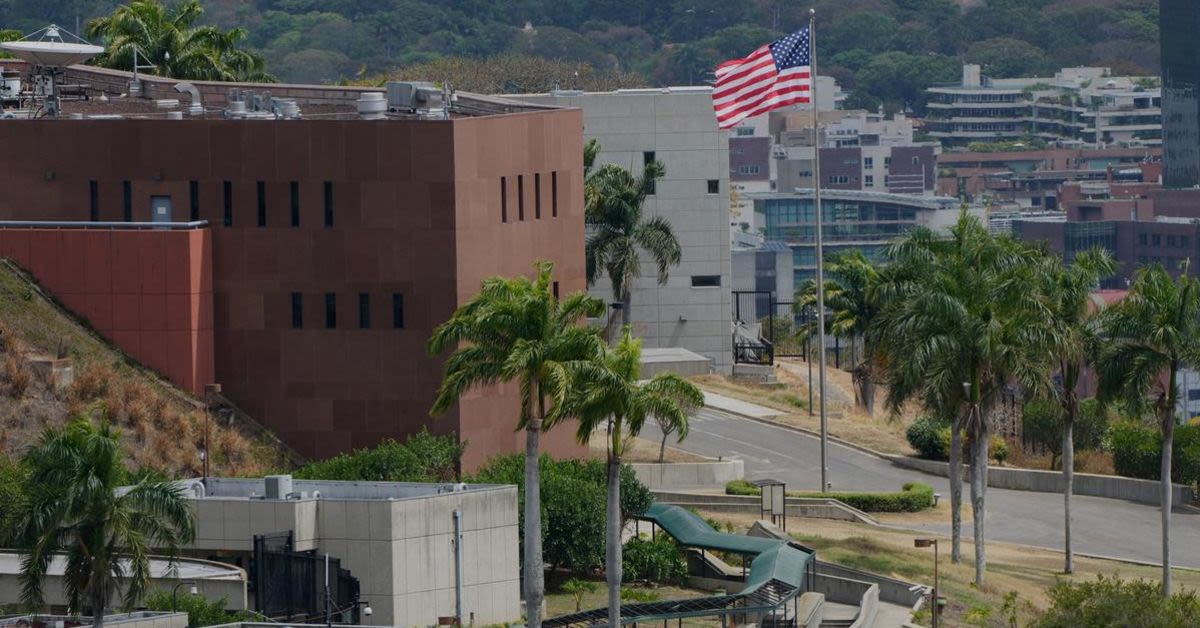
For the first time in seven years, the American flag is once again flying over the United States Embassy in Caracas, signaling a dramatic shift in Washingtons posture toward a nation long suffocated by socialist dictatorship.
The embassy formally resumed operations on Monday, less than three months after the January operation that removed Venezuelan strongman Nicols Maduro from power, according to Western Journal. The compound, shuttered for years as the country descended into economic ruin and political repression, required extensive work before reopening, including significant remediation of mold and other damage accumulated during its long abandonment.
Today, we are formally resuming operations at the U.S. Embassy in Caracas, marking a new chapter in our diplomatic presence in Venezuela, the State Department announced in a news release. The resumption of operations at U.S. Embassy Caracas is a key milestone in implementing the Presidents three?phase plan for Venezuela and will strengthen our ability to engage directly with Venezuelas interim government, civil society, and the private sector, the release said.
In comments published by the State Department, Secretary of State Marco Rubio framed the embassys reopening as evidence that U.S. policy is successfully helping Venezuela emerge from the wreckage of the Maduro era. I think its moving along very well. We said it from the very first day after that operation happened. I said our hope is, number one, to stabilize the country, Rubio said.
Rubio emphasized that the administrations strategy was designed to avoid the chaos that often follows the collapse of authoritarian socialist regimes. We didnt want to see civil war. We didnt want to see systemic collapse. We didnt want to see a mass migration event. Youve seen none of these things, he said.
The secretary argued that Venezuela, once a cautionary tale of socialisms failures, is now cautiously stepping back toward normalcy and market participation. Rubio said Venezuela is slowly awakening from its nightmare.
What youve seen is that for the first time in decades, Venezuela is now selling their oil in the global market at full market price, and the money is coming back to Venezuela and being spent for the benefit of the Venezuelan people, he said. Its being spent to buy medical goods and equipment. Its being spent to cover the salaries of teachers and police officers and civil servants and people that sanitation workers and things of this nature. So its a very important part, Rubio said.
From Rubios perspective, this shift marks a decisive break from the corruption and cronyism that defined the Maduro years, when oil wealth was diverted to regime insiders and foreign allies instead of ordinary citizens. He stressed that the administrations approach is deliberately incremental, reflecting a conservative preference for stability, institution-building, and private-sector engagement rather than sweeping, top-down schemes.
Rubio described the broader framework as a deliberate, phased strategy to restore Venezuelas capacity for self-governance and economic growth. The second phase after the stabilization occurs, or concurrent with the stabilization, is a period of recovery in which you try to recover the elements of the country that allow it to prosper and grow, and that is attracting businesses back, creating the kind of stability that brings businesses back. Were seeing that begin to happen, he said.
But youre also seeing civil life come back to life. Independent media is now allowed to operate. Political prisoners have been released. Political parties are forming again. People are speaking and participating in public life, he said.
Rubio made clear that the ultimate objective is not merely economic repair but a durable constitutional order grounded in the rule of law and investor confidence. And finally, you want to see a full transition, because in order for Venezuela to fulfill its economic potential, it has to have a stable, democratic government that people are willing to invest in that economy because they know that theyre protected by laws and courts and legitimacy, he said.
He also praised the new leadership in Caracas for embracing responsibility rather than repeating the failed central-planning model that devastated the country. Rubio said officials running the country have become solid partners.
So we are well on our way to achieving this. A lot of credit goes to the interim authorities who have assumed this responsibility. Weve reopened our embassy. We enter in dialogue with them every single day. We feel very positive about it, he said.
For Washington, the restored embassy is more than a symbolic gesture; it is a practical tool for advancing a conservative vision of regional stability built on free markets, accountable governance, and strong civil society. For Venezuelans, it represents a tangible sign that the era of isolation and ideological experimentation at their expense may finally be giving way to a future anchored in democratic legitimacy and economic freedom.
Login