
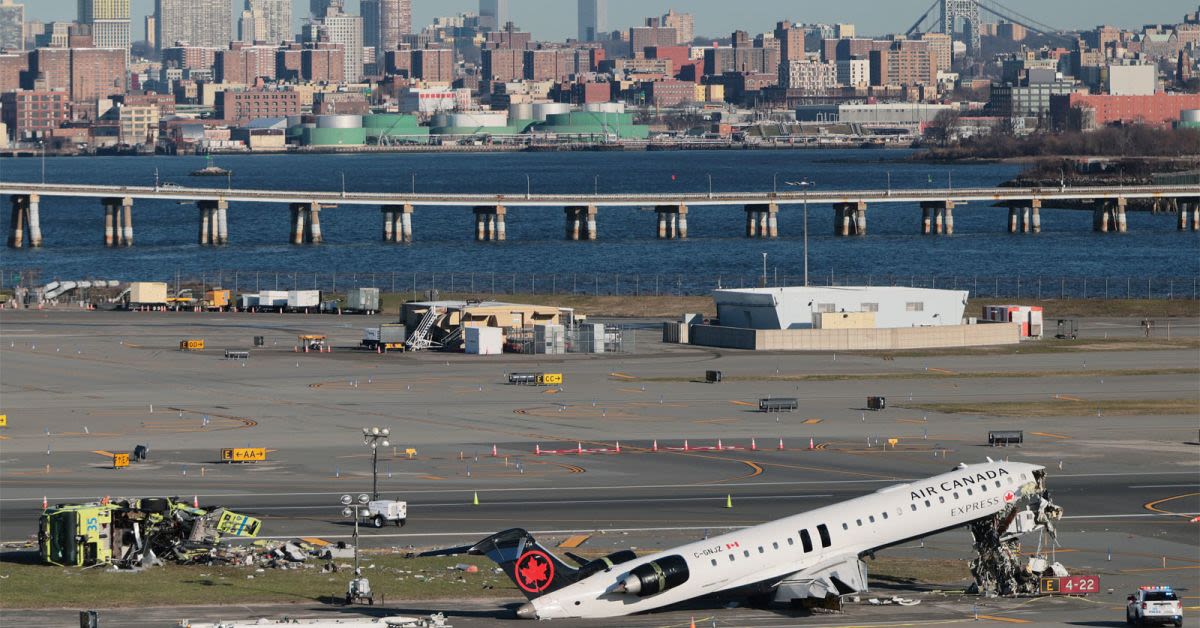
Air Canada chief executive Michael Rousseau, already under fire for his handling of Canadas bilingualism rules, is now preparing to leave the airline as political pressure mounts in the wake of a deadly crash in New York.
According to The Post Millennial, the carrier announced Monday that Rousseau intends to retire by the end of the third quarter of 2026, remaining as president and CEO while the board oversees a managed succession. His planned departure follows a fresh wave of criticism over a video address he recorded after Air Canada Express Flight 8646 crashed at LaGuardia Airport, killing both pilots and injuring more than 40 passengers and crew.
The message, delivered almost entirely in English despite the airlines legal obligations under Canadas Official Languages Act, triggered outrage among francophone advocates and nationalist politicians in Quebec. The ten elected members of the committee unanimously adopted a motion to ask the CEO of Air Canada to come and explain himself, the Official Languages Committee said in a statement, underscoring the seriousness with which Parliament is treating the matter.
By Tuesday afternoon, the Office of the Commissioner of Official Languages had logged 84 complaints related to Rousseaus video, a striking figure for a single communication. Bloc Qubcois leader Yves-Franois Blanchet escalated the political pressure, writing, In light of this sad and gross lack of respect towards the loved ones and family of the pilot from Coteau-du-Lac, Antoine Forest, a French-speaking Quebecer, the head of Air Canada must very seriously ask himself whether he has not clearly disqualified himself for the position he holds.
Air Canada has attempted to blunt the backlash by stressing that Rousseau recorded the message before leaving for the crash site and that French subtitles were added to ensure accessibility in both official languages. That explanation has done little to calm critics who argue that, in a country where taxpayers have long supported the national carrier, a unilingual English response to a tragedy involving a Quebec pilot is politically and culturally tone-deaf.
The airlines board, for its part, emphasized that Rousseaus retirement is part of a long-planned succession process that has been underway for more than two years. Directors say the transition includes an internal development program for senior executives and an external global search that was launched in January 2026, suggesting the leadership change is not purely a reaction to the current controversy.
In a nod to the political realities of operating a quasi-national institution in a bilingual federation, the board said it will weigh candidates ability to communicate in French as one of several key criteria. Rousseau has agreed to remain available beyond his tenure to support a smooth transition, a move likely aimed at reassuring investors and customers that operational stability will be maintained.
Board chair Vagn Srensen offered a fulsome endorsement of Rousseaus record, stating, On behalf of the entire Board, I want to thank Mike for his many contributions to Air Canada as he progressed from Chief Financial Officer to Deputy CEO and then to CEO and Board member. We are grateful for the determined leadership he has provided not only in steering our company through the 2007-2008 financial crisis, COVID and other challenges, but also in capturing opportunities such as the acquisition of Aeroplan, in restoring the solvency of our pension plans and in advancing customer centricity and employee well-being priorities, adding, Our upcoming AGM will allow us to further recognize his achievements which include a legacy of financial strength.
Rousseau, for his part, struck a conciliatory tone as he prepares to exit the stage of a heavily regulated, politically sensitive industry. It has been my great honour to work with the dedicated and talented people of Air Canada and to represent our outstanding organization, including as chair of the Star Alliance chief executive board and on the board of directors of the International Air Transport Association, he said, adding, I look forward to supporting our company during this important transition period.
As President Trumps second administration continues to emphasize national identity, respect for cultural traditions, and accountability from large corporations, the Air Canada episode highlights how elite decision-makers can lose touch with the people they serve. The next CEO will not only inherit a financially stronger airline, but also a clear warning that ignoring language, culture, and basic respect for grieving families carries real political and reputational costs.
Login