
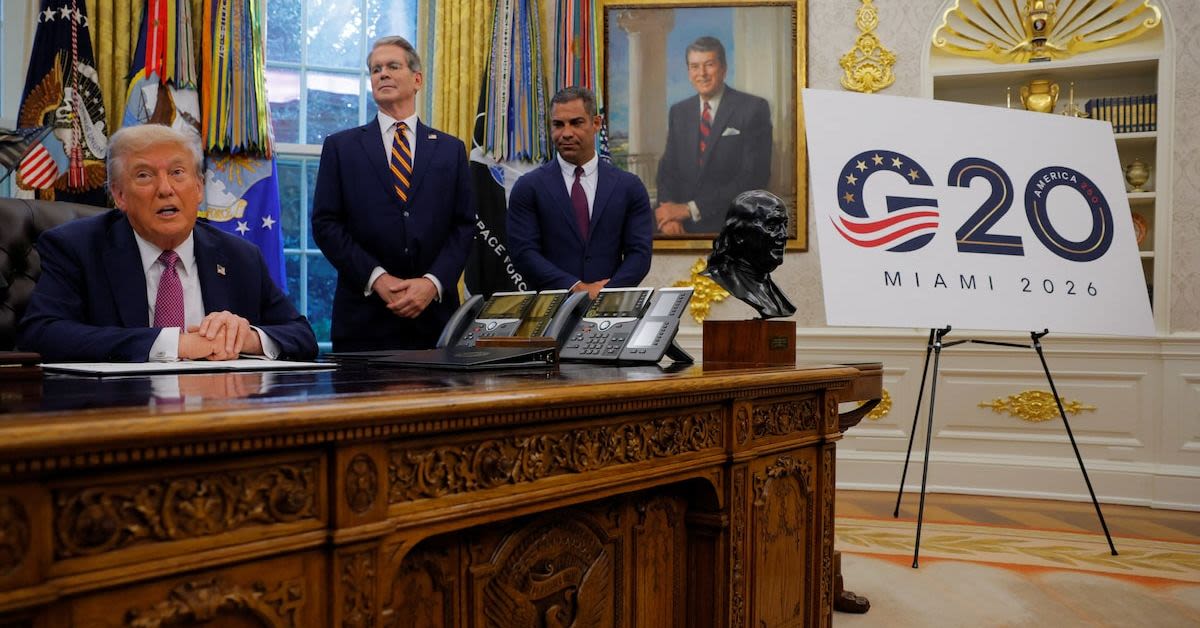
President Donald Trump used a high-profile appearance at the Future Investment Initiative (FII) Priority Summit in Miami Beach on Friday to frame his administration as both tough on Iran and determined to restore law and order at Americas borders.
Speaking to an audience of investors, policymakers, and business leaders, Trump tied together the days two dominant issues: the U.S. military campaign against Irans terror apparatus and the ongoing fight in Washington over funding the Department of Homeland Security. According to RedState, he cast the moment as a historic turning point in the Middle East, arguing that American strength under his leadership is finally dismantling a regime long accustomed to menacing its neighbors and threatening the West.
Trump told the crowd that the United States and its allies are closer than ever to the rise of a Middle East, free at last from Iranian terror, aggression, and nuclear blackmail. He added, Tonight, we're closer than ever to the rise of the Middle East that is finally free at last from Iranian terror... For 47 years, Iran has been known as the bully of the Middle East but they are not the bully any longer.
For 47 years, Iran has been known as the bully of the Middle East but they are not the bully any longer, he reiterated, underscoring his belief that Tehrans power projection is being decisively rolled back. In Trumps telling, the Islamic Republic is no longer dictating terms to the region, but instead is facing the consequences of decades of malign behavior.
The president reminded the audience that he had ordered the strike that killed Iranian General Qasem Soleimani during his first term, a move widely praised by conservatives as a long-overdue act of deterrence. He suggested that even some within the Iranian hierarchy may have quietly welcomed the removal of a feared enforcer, saying, He was so powerful that I really think that the leadership of Iran was extremely happy when I took him out, but they don't say that but nobody's going to be asking them anymore because they're not here either.
But now they're not here either, Trump observed, referring to the broader decapitation of Irans terror leadership in the ongoing Operation Epic Fury. In his view, the campaign is not only punishing the regime but also creating the conditions for a more stable and less violent Middle East.
Turning to the economic and strategic choke point of the Strait of Hormuz, Trump said negotiations with Iran are underway but insisted that Tehran must fully reopen the waterway to global commerce. He used the moment to needle both the regime and the press, quipping, We're negotiating now, and it would be great if we could do something, but they have to open it up. They have to open up the Strait of TrumpI mean Hormuz. Excuse me, I'm so sorry. Such a terrible mistake.
They have to open up the Strait of TrumpI mean Hormuz. Excuse me, I'm so sorry. Such a terrible mistake, he repeated with a grin, anticipating that hostile outlets would portray the line as a gaffe rather than a joke. He noted that the fake news media would likely seize on the slip to mock him instead of acknowledging the underlying seriousness of the standoff.
Trump then linked the Iran confrontation directly to domestic politics, arguing that the crisis underscores why it is absolutely vital for Democrats in Congress to stop blocking funding for the Department of Homeland Security. He accused the left of using the budget fight to advance an open-borders agenda that leaves Americans vulnerable at a time of heightened global danger.
For 42 days, [Democrats] have tried to completely eliminate funding for the number one duty of government, which is keeping America safe. They want no ICE, they want no Border Patrol, they want no protection of any kind, re-opening our Borders, and stopping all immigration enforcement in our country, Trump charged, portraying their position as reckless and ideologically driven. From his perspective, the refusal to fund DHS is not a routine partisan dispute but a direct assault on national sovereignty and public safety.
The president also reflected on how history might judge his tenure, expressing a desire to be remembered less as a warmonger than as a leader who used strength to secure peace. I know it doesn't sound right for me to say this, but I'd love my legacy to be made as a great peacemaker because I really believe I'm a peacemaker. It doesn't seem it right now, but I think I'm a peacemaker, he said.
If Trump succeeds in forcing Iran to abandon decades of terror sponsorship and nuclear blackmail, he argued, the result could be an end to 47 years of threats and bloodshed and the emergence of a more cooperative government in Tehran. Such an outcome would not only enhance American security but also vindicate a conservative foreign policy built on peace through strength, decisive action, and an unapologetic defense of U.S. interests.
Login