
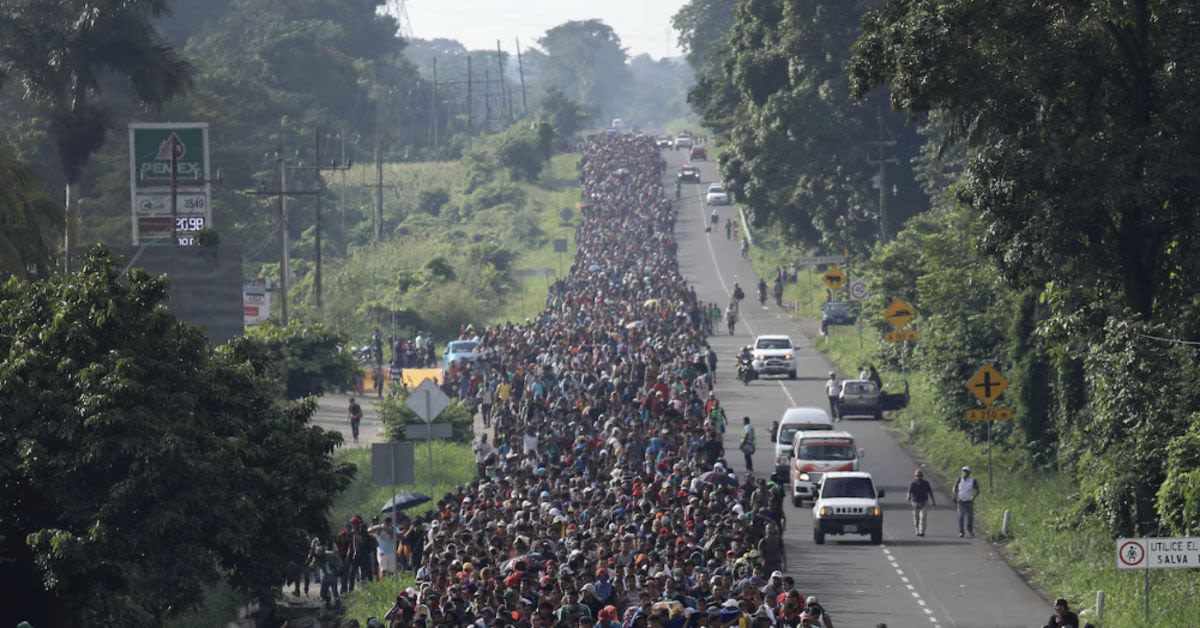
A restless group of migrants stranded in the southern Mexican city of Tapachula is attempting to organize a new caravan northward, hoping that movement will succeed where Mexicos paralyzed asylum system and stagnant job market have failed.
According to Breitbart, the would-be caravan, which organizers have dubbed Genesis, is composed largely of Cuban and Honduran nationals who are gathering in Tapachulas Miguel Hidalgo central park near the Guatemala border to discuss their plans. They are aiming to recruit at least 500 participants for the journey into central Mexico, but the effort remains in its infancy and no firm departure date has been set.
Local outlet Diario del Sur reports that, despite the visible frustration among migrants, organizers have so far struggled to enlist sufficient numbers to launch the caravan. The groups intention is to follow established northbound routes through the border state of Chiapas, reach the neighboring state of Oaxaca, and then continue deeper into Mexico in search of work and stability.
As reported by Breitbart Texas, the Genesis effort echoes a previous caravan of roughly 1,200 migrants that set out from Mexicos southern border with Guatemala in October 2025, aiming for Mexico City rather than the U.S. frontier. That earlier group openly declared that they were disillusioned with Mexicos slow asylum process and had no intention of seeking asylum in the United States, only to be returned to Tapachula after authorities promised expedited refugee processing.
For migrants trapped in bureaucratic limbo, the lack of legal refugee status in Mexico has immediate and punishing consequences, barring them from formal employment in factories or shops and excluding them from government social security benefits. Without documentation, they are left vulnerable to exploitation, often forced into informal labor where employers can underpay and overwork them with little fear of legal repercussions.
The migrants now pushing to leave Tapachula say their asylum applications are being ignored by the Mexican Commission for Refugee Assistance (COMAR) and the National Institute of Migration (INM). They argue that the systems dysfunction has effectively turned the southern border region into a holding pen, where thousands wait indefinitely with no lawful path to support themselves.
A report in La Jornada notes that many of those planning the exodus complain of scarce job opportunities and, when work is available, they say they work for low wages and long hours. The same report cites estimates that roughly 75,000 foreign migrants are currently stranded along Mexicos southern border, a situation it links to the tightening of immigration policies under the Trump administration.
Many in the Tapachula group are recent Cuban migrants who were deported from the United States, according to La Jornada. Their presence underscores how U.S. enforcement, when actually applied, can disrupt unlawful migration flows and return responsibility to sending and transit countries rather than leaving American communities to absorb the consequences.
Immediately upon taking office, President Trump moved to dismantle key Biden-era programs that had effectively normalized mass parole into the United States under the guise of asylum processing. He pushed to discontinue programs such as CBP-One that allowed 1,400 migrants to enter the United States illegally each day at land border ports for the purpose of making an asylum claim, and he also cancelled the Cuban, Haitian, Nicaraguan, and Venezuelan (CHNV) parole scheme which allowed 1,000 migrants daily from those countries to enter through airports in the United States.
The impact on illegal border crossings has been dramatic, with Border Patrol apprehensions at the southwest border dropping to fewer than 10,000 per month since Trumps inauguration. At the current pace, total apprehensions are projected to remain under 100,000 for the fiscal year, a stark contrast to the final year of the Biden administration, when 1,530,523 illegal aliens were apprehended by the Border Patrol, according to U.S. Customs and Border Protection.
For conservatives who have long argued that firm enforcement and the dismantling of abuse-prone parole pipelines are essential to restoring order, the numbers now emerging from the border validate that approach even as Mexico struggles with the fallout. The stalled Genesis caravan in Tapachula, the backlog in COMAR and INM, and the tens of thousands of migrants marooned in southern Mexico all highlight a basic reality: when Washington stops incentivizing illegal entry, the pressure shifts back to regional governments and international institutions, which must finally confront the consequences of years of permissive, progressive migration policies.
Randy Clark, a 32-year veteran of the United States Border Patrol who retired as Division Chief for Law Enforcement Operations overseeing nine stations in the Del Rio Sector, has chronicled these developments with the perspective of someone who has watched the border crisis unfold on the ground. His ongoing commentary, available on X (formerly Twitter) at @RandyClarkBBTX, continues to track how policy choices in Washington reverberate from Tapachulas central park to the Rio Grande and beyond.
Login