
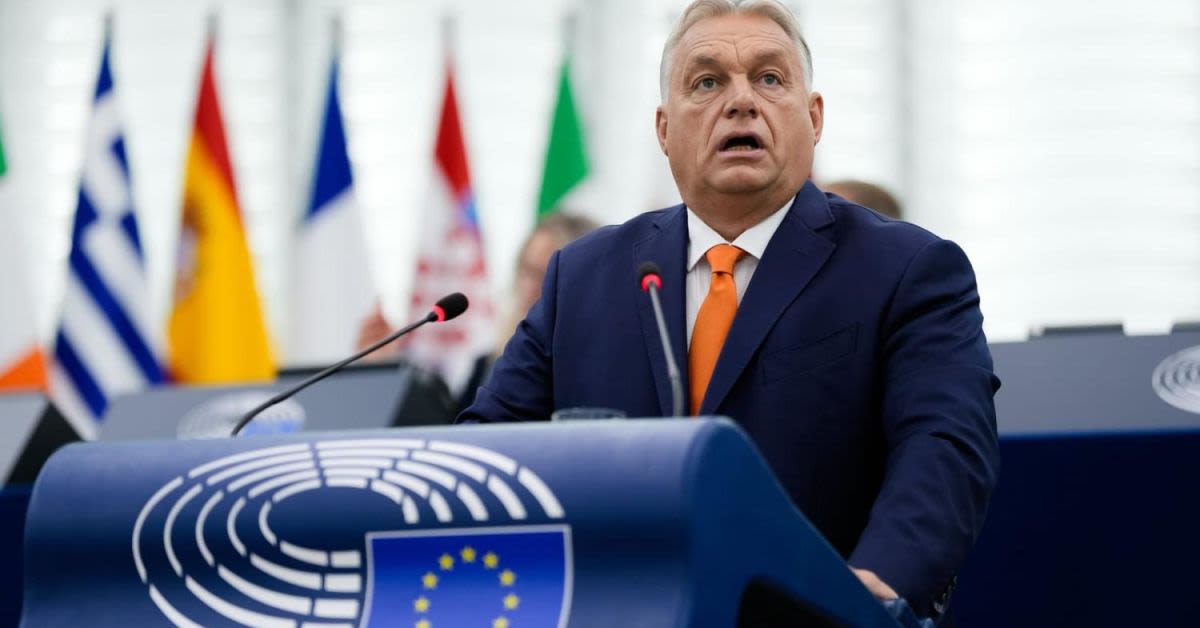
With the MAGA movement gaining momentum across continents, the entrenched globalist establishment and its Democratic Party allies are scrambling to preserve their influence, and Hungary has emerged as a central battleground in this escalating ideological conflict.
According to Gateway Pundit, the Hungarian government intensified its warnings on March 12, 2026, about foreign interference in the opposition Tisza Party. Prime Minister Viktor Orbn, speaking to the nation on state media, drew attention to a classified national security report, soon to be declassified, that he said proves Ukrainian involvement in covertly channeling money to Tisza.
This is not speculation or a suspicion; its documented in a written report submitted to the national security committee, Orbn declared. He further disclosed that Hungarian authorities had seized tens of millions in cash tied to a Ukrainian bank on Hungarian soil, and that these sums precisely matched the amount Tisza Party leader Pter Magyar had publicly claimed his movement urgently needed.
This Ukrainian connection is not an isolated curiosity but rather a vivid indicator of a broader pattern of foreign influence operations. These efforts, often aligned with Democratic Party priorities and routed through U.S. aid mechanisms and opaque proxy networks in Eastern Europe, appear aimed at infiltrating Hungarian politics and destabilizing sovereign, conservative-led governments such as Orbns.
For years, Democratic operatives and their allies have constructed a dense web of coordinated financial channels, using venture funds and non-governmental organizations to cultivate what they view as a compliant regime in Budapest. This campaign is not about nurturing authentic democracy; it is about reshaping national politics to conform to a globalist agenda that weakens borders and dilutes national identity.
The strategy is calculated: erode national sovereignty, empower transnational bureaucracies, and install leaders who reliably echo the globalist line. Evidence of this approach is embedded in the activities of USAID and the National Endowment for Democracy (NED), both funded by American taxpayers and marketed as benign instruments of development and democracy promotion, yet functioning in practice as tools of political engineering.
Since 2008, USAID has been channeling resources into Hungarian NGOs, with at least $20.2 million distributed between 2021 and 2025 alone to opposition-friendly outlets such as 444.hu and tltsz. These funds have helped construct what critics describe as an artificial civil society, designed less to represent organic grassroots sentiment and more to challenge and ultimately displace Orbns conservative government.
USAIDs Central Europe Program, launched in 2022, injected millions more under the familiar pretext of strengthening democratic institutions. In the Hungarian context, that phrase has increasingly become a euphemism for undermining the choices of Hungarian voters and weakening the authority of their elected government.
Between 2023 and 2024, tltsz reportedly derived 1015 percent of its budget from these USAID-linked channels. By 2025, Hungarys Sovereignty Protection Office had identified USAID as the financial backbone for organizations such as the Autonomy Foundation, which in turn redistributed money to activist cells and opposition-aligned initiatives.
NEDs role has been similarly troubling, with the organization funding anti-government media and civil groups in Hungary since 2008. Its own annual reports boast of supporting more than 2,000 projects worldwide each year, with Hungary receiving its share of this foreign-funded activism.
In 2018, NED-backed groups such as the Hungarian Helsinki Committee were denounced domestically as Soros mercenaries for their role in stoking political conflict and undermining national policy. From 2008 to 2016, NEDs grants to Hungarian entities exceeded $5 million, ostensibly to promote media pluralism during a period of economic strain.
Until Donald Trumps 2016 victory disrupted the status quo in Washington, Democrats and their network of NGOs and quasi-governmental bodies operated these channels with little restraint. They interfered in Hungarian affairs with near impunity, using the language of democracy to justify what many Hungarians view as blatant political meddling.
Stung by their 2016 defeat and recognizing that a resurgent nationalist right posed a mortal threat to their European integration project, Democrats regrouped under the familiar slogan of saving democracy. In practice, that meant doubling down on efforts to weaken conservative governments abroad that aligned with Trumps America First philosophy.
In 2017, Higher Ground Labs (HGL) was founded by Obama-Biden campaign veterans such as Betsy Hoover, Shomik Dutta, and Elizabeth MacLaughlin. Based in Chicago, HGL positioned itself as a venture fund dedicated to progressive political technology, effectively serving as a high-tech armory for left-wing campaigns.
By 2021, HGL had deployed more than $50 million across 46 startups, rapidly expanding the technological arsenal available for electoral warfare. These toolsdata analytics, microtargeting platforms, and digital mobilization systemswere not confined to U.S. borders but increasingly exported to reshape political landscapes abroad.
That same year, HGL secured a controlling interestover 80 percent via its Fund Three Limited Partnershipin DatAdat, a political technology firm later rebranded as Estratos Digital and headquartered in California. While nominally an American company, Estratos Digital has been deeply active in European politics, including in Hungary.
This acquisition was anything but neutral; it effectively transplanted the Democratic Partys cutting-edge campaign machinery into Hungarian opposition operations. Armed with sophisticated voter targeting and data tools, opposition parties gained capabilities that many see as foreign tech infiltration, weaponized to distort and ultimately override sovereign electoral processes.
At the center of this apparatus stands the Lunda fundraising platform, owned and operated by Estratos Digital and heavily utilized by the Tisza Party. Its role came under intense scrutiny after a 2026 leak of publicly disclosed donor data exposed the platforms vulnerabilities and raised serious questions about foreign access to Hungarian political information.
The February breach spilled sensitive dataincluding names, phone numbers, email addresses, and transaction histories of thousands of donorsonto the dark web forum LeakBase. This incident not only compromised individual privacy but also highlighted the systemic risks of outsourcing political infrastructure to opaque, foreign-linked entities.
Hungarys Sovereignty Protection Office had already raised red flags in 2024, noting that Lundas servers were located in Austria, its operations were shrouded in secrecy, and it was suspected of maintaining ties to Ukrainian IT companies. These concerns were later reinforced by intelligence findings.
A 2025 report connected Lundas developers to Ukrainian nationals allegedly entangled in U.S. intelligence networks, effectively granting foreign actors potential access to Hungarian voter and donor data. Such access, in the hands of politically motivated operatives, is a direct invitation to manipulation and blackmail.
Leaked user profiles reportedly trace back to these Ukrainian IT specialists, suggesting a pipeline through which sensitive political information could be harvested and exploited. For a country determined to protect its sovereignty, this pattern looks less like benign cooperation and more like a blueprint for election subversion.
The web of interference grows denser with the involvement of Action for Democracy (A4D), a foundation backed by George Soross network. In 2022, A4D transferred roughly $5.5 million to Hungarys united opposition, a massive infusion of foreign money into the countrys political bloodstream.
Most of this funding flowed through Pter Mrki-Zays Everybodys Hungary movement, disguised as payments for data services and advertising contracts. Behind the technical language lay a straightforward reality: foreign cash was being deployed to tilt Hungarys electoral playing field against its conservative government.
Hungarian intelligence reports have documented the scale of these transfers in detail. A4D wired HUF 3.174 billionabout $7.9 million at the timeto opposition structures, with 58 percent of that sum landing in the coffers of Everybodys Hungary, while the remainder shored up allied media and activist fronts.
Mrki-Zay himself acknowledged receiving HUF 1.8 billion from A4D for culture-change projects that conspicuously avoided explicit party branding. Meanwhile, a Swiss intermediary funneled an additional HUF 887 million to Oraculum 2020 Kft., the company behind the propaganda site Ezalnyeg.hu, further saturating the media space with anti-government messaging.
Altogether, more than HUF 4 billion in illicit or opaque funds distorted the 2022 elections, according to Hungarian authorities. This torrent of money stands as a stark illustration of how Soros-linked networks export political chaos in an effort to break conservative strongholds and replace them with pliant, globalist-friendly regimes.
As Democrats intensify their confrontation with Republicans at home, the broader Democratic machine is simultaneously advancing its globalist agenda within the European Union. Hungarys parliamentary elections, scheduled for April 12, 2026, have thus become a focal point in a much larger struggle over the future of national sovereignty in Europe.
The objective is clear: remove Viktor Orbn, a steadfast ally of Donald Trump and a vocal critic of Brussels overreach, and replace him with a leadership more amenable to EU centralization and progressive social policies. For years, Democrats and their partners have poured money into Hungarian opposition forces, manipulating the political environment with tactics reminiscent of their operations in countries like Romania.
This brazen interference threatens not only Hungarys independence but also the broader MAGA-aligned resistance to globalist encroachment across the continent. If a conservative bulwark like Hungary can be toppled through foreign-funded campaigns and data-driven manipulation, other nationalist governments will be next in line.
Recent polling underscores the volatility of the moment, with the Tisza Party reportedly polling between 39 and 53 percent, while Orbns Fidesz hovers between 37 and 48 percent. Such swings suggest that the left and its foreign backers are deploying every available tacticfinancial, technological, and informationalto tip the scales.
Unless these clandestine financial pipelines and digital influence operations are exposed and dismantled, globalist actors will retain the capacity to manipulate the April 2026 elections. The stakes extend far beyond Budapest, potentially shifting the balance of power in Europe away from Trumps allies and toward his most determined adversaries.
The investigations launched by Hungarys Sovereignty Protection Office into A4D and related entities highlight the gravity of the threat. With key national security reports slated for declassification, the Hungarian public may soon see the full extent of the foreign interference that has been operating in the shadows.
True sovereignty requires more than symbolic gestures; it demands rigorous accountability and the political will to confront powerful external interests. For conservatives across Europe and in the United States, preserving MAGA-aligned leaders such as Orbn is essential to dismantling the Democrats transnational machine and defending the principle that nations, not NGOs or foreign bureaucrats, should determine their own destinies.
Hungarians now face a stark choice: accept a manufactured opposition sustained by foreign money and foreign technology, or reaffirm their right to chart their own course free from outside manipulation. The pattern is unmistakable: Democracy is not preserved by covert cash transfers and imported campaign tools; it is upheld by the clear, uncoerced voice of the people.
Login