
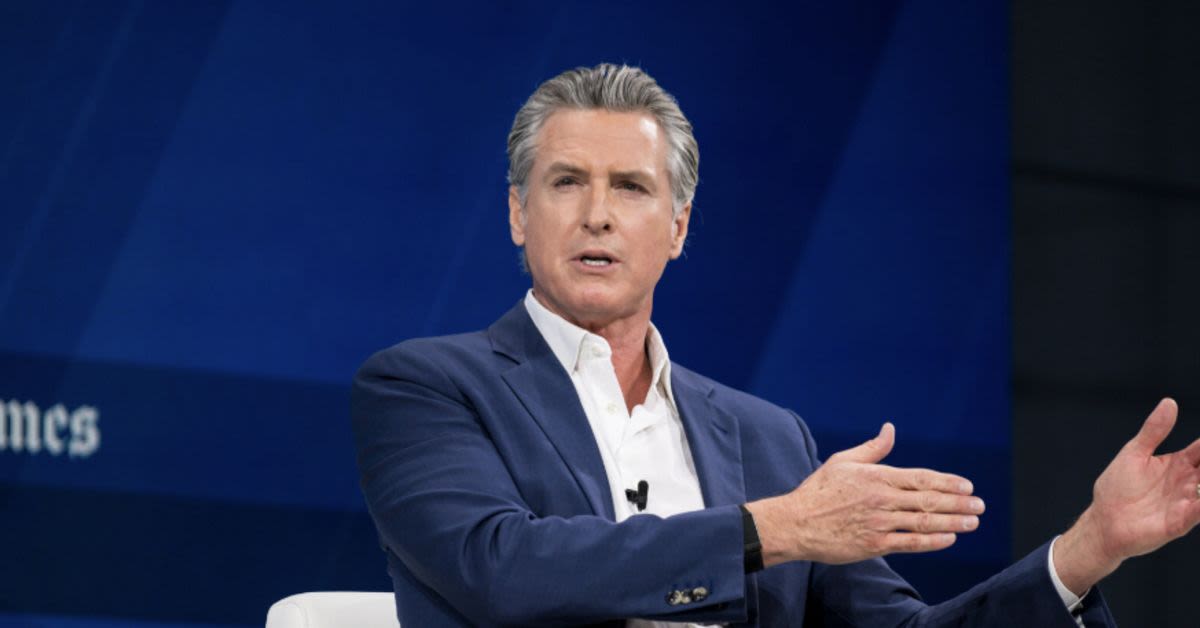
California Gov. Gavin Newsom has not formally entered the 2028 presidential race, but his national media blitz and relentless self-promotion leave little doubt that he sees the White House as his next career move.
According to Western Journal, that ambition collides awkwardly with his record in Sacramento, where he inherited a massive budget surplus and quickly transformed it into a staggering deficit while leaving core state crises crime, homelessness, and the exodus of residents and businesses largely untouched. He also embraced a marquee infrastructure effort in the form of a high-speed rail project that has become synonymous with cost overruns and delays, and now he is presiding over another symbol of California excess: a $114 million wildlife overpass that, years after groundbreaking, is not yet helping any monarch butterflies or mountain lions cross anything at all.
The Wallis Annenberg Wildlife Crossing, designed to span the 10-lane U.S. 101 Freeway northwest of Los Angeles, was launched with great fanfare in 2022, when Newsom boasted that in addition to the $54 million the state had already committed, officials could complete the job within another $10 million, probably. That optimistic projection has since collided with reality, as the project has fallen behind schedule and ballooned in cost, turning what was billed as a cutting-edge conservation effort into yet another cautionary tale of Californias big-government mismanagement.
As Christopher Rufo and Kenneth Schrupp reported in City Journal, the bridge is now years behind its original timeline and millions of dollars over budget, with critics arguing that it has morphed into a taxpayer-funded patronage vehicle for environmental activists. Nearly four years after the ceremony, the bridge is past due and the project some $21 million over budget, they wrote, noting that What was supposed to be the worlds largest wildlife crossing has become a jobs program for environmentalists, with taxpayers on the hook for what WAWC leader Beth Pratt told us is an overpass for everything from monarch butterflies to mountain lions.
Pratt, a high-profile environmentalist often photographed in cougar-themed sweaters, serves on the Partner Leadership Team of the Wallis Annenberg Wildlife Crossing (WAWC) and acts as the projects most visible advocate. She is also a regional executive director of the National Wildlife Federation, which in 2021 received a $25 million grant from Wallis Annenberg and the Annenberg Foundation for the bridge that now bears the late philanthropists name.
Even that substantial private funding has not insulated the project from spiraling costs, as Pratt herself acknowledged earlier this year while wearing a hard hat and a #SAVELACOUGARS jersey at the construction site. In January, she announced a potential $21 million cost overrun and sought to deflect blame by pointing to national economic and policy factors, saying she attributed the overage to tariffs, inflation, [and] labor problems.
Pratt insisted that the public should not view the crossing as a fiasco, despite the delays and overruns that would doom a similar effort in the private sector. Theres no boondoggle, she said, adding that Given the times were living in, a potential $21 million overage is not that bad.
The current state of the project, a partially completed concrete structure rising over the freeway, has become a visual metaphor for Californias broader governance problems under Newsom: grandiose promises, lavish spending, and underwhelming results. For critics, the image of an unfinished, nine-figure butterfly and cougar bridge in a state struggling with basic public order and affordability is almost too on-the-nose.
From a political standpoint, the most prudent course for Newsom and his team would have been to downplay the controversy, avoid social media theatrics, and hope the story faded amid Californias constant churn of bad news. Instead, his press operation chose to escalate, turning a local embarrassment into a national talking point and reinforcing the perception that the governor is more interested in partisan posturing than in competent stewardship of taxpayer dollars.
The governors press office fired back on X, formerly Twitter, with a post framing criticism of the project as evidence of right-wing callousness toward public safety and the environment. The account declared that MAGAs outrage over a project that literally SAVES LIVES tells you everything! and went on to defend the crossing as a scientifically grounded necessity.
This freeway project, grounded in decades of research, restores a critical wildlife corridor and reduces DEADLY collisions on one of the busiest highways in the country protecting both drivers and animals, the post read, attempting to recast the debate as a binary choice between compassion and cruelty. The statement further claimed that the construction timeline had been pushed back largely due to severe weather last year, a justification that conveniently sidesteps years of regulatory and management failures that have plagued infrastructure across the state.
For many observers on the right, this response missed the point entirely, as the core objection is not the abstract idea of wildlife protection but the chronic pattern of overpromising and overspending on projects that never seem to arrive on time or on budget. The fact that this particular debacle involves a $100 million-plus butterfly bridge only underscores how detached Sacramentos priorities have become from the everyday concerns of families struggling with high taxes, high crime, and high housing costs.
Newsom then attempted to own his conservative critics by posting images of unfinished infrastructure in Republican-led states such as Florida and Texas, implying that red-state leaders are no better at delivering on big projects. The gambit backfired when it emerged that some of the highlighted projects had already been completed or decommissioned, turning the governors attack into yet another self-inflicted wound.
The episode has reinforced a broader narrative that Newsoms political brand is built more on media savvy and ideological signaling than on effective governance or fiscal restraint. For conservatives, the Wallis Annenberg Wildlife Crossing has become a symbol of what happens when progressive elites treat taxpayer money as an inexhaustible resource to fund fashionable causes, even as core state functions deteriorate.
As Democrats quietly position Newsom as a leading contender for 2028 and perhaps even as a backup option should President Joe Biden step aside the spectacle of a governor presiding over a $114 million, behind-schedule wildlife overpass while lecturing other states on competence and compassion is hard to ignore. If this is the best the left can offer as its next standard-bearer, many Americans may decide they prefer leaders who fix roads and balance budgets before building an overpass for everything from monarch butterflies to mountain lions, butterflies included.
Login