
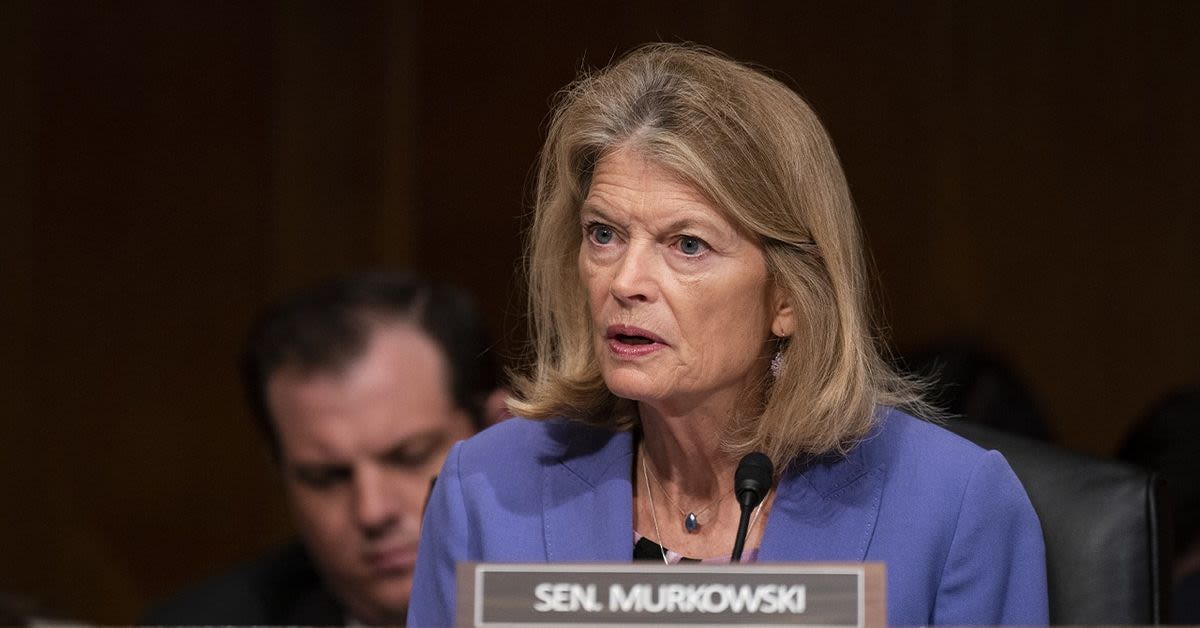
Senator Lisa Murkowski has openly declared she will not support the SAVE America Act, aligning herself with Democrat rhetoric that claims the bill would strip voting rights from Alaskans.
According to The Gateway Pundit, the Alaska Republican, long viewed with suspicion by conservatives, is among 25 GOP senators who have refused to back a standing filibuster to advance the SAVE Act, a key election integrity measure. RINO Senate Minority Leader John Thune has likewise declined to marshal Republican votes for the procedural move, effectively helping Democrats block legislation designed to ensure that only American citizens cast ballots in federal elections.
Pressed this week by Lindell TV reporter Alison Steinberg, Murkowski did not hedge. The implementation in a rural state like Alaska is gonna disenfranchise an extraordinary majority, and while I support citizenship voting and voting ID, I wanna make sure that its implementable, she said, repeating a familiar left-wing talking point that voter ID laws somehow suppress turnout rather than protect the ballot box.
Steinbergs on-camera exchange laid bare Murkowskis position. When asked directly, Where do you stand on the SAVE America Act? Do you support getting this legislation passed to protect our elections? Murkowski replied, Uh, not as it is drafted, no, before insisting, The implementation in a rural state like Alaska is gonna disenfranchise an extraordinary majority, and reiterating, while I support citizenship voting and voting ID, I wanna make sure that its implementable.
Her claim stands in stark contrast to the actual text of the SAVE America Act, which is straightforward: no identification, no vote. Far from being some obscure or onerous regime, the bill simply requires that anyone registering to vote present one of several common, citizenship-verifying documents that millions of Americans already possess or can readily obtain.
Under the Act, a prospective voter may register by providing (1) A form of identification issued consistent with the requirements of the REAL ID Act of 2005 that indicates the applicant is a citizen of the United States. Alternatively, a citizen can use (2) A valid United States passport, or (3) The applicants official United States military identification card, together with a United States military record of service showing that the applicants place of birth was in the United States.
The law also permits (4) A valid government-issued photo identification card issued by a Federal, State or Tribal government showing that the applicants place of birth was in the United States. If a voter lacks those, the Act allows (5) A valid government-issued photo identification card issued by a Federal, State or Tribal government other than an identification described in paragraphs (1) through (4), but only if presented together with one or more of the following. Those supplemental documents are precisely the kinds of records Americans routinely use to prove citizenship in other legal contexts.
Among the acceptable supporting documents is (A) A certified birth certificate issued by a State, a unit of local government in a State, or a Tribal government which (i) was issued by the State, unit of local government, or Tribal government in which the applicant was born; (ii) was filed with the office responsible for keeping vital records in the State; (iii) includes the full name, date of birth, and place of birth of the applicant; (iv) lists the full names of one or both of the parents of the applicant; (v) has the signature of an individual who is authorized to sign birth certificates on behalf of the State, unit of local government, or Tribal government in which the applicant was born; (vi) includes the date that the certificate was filed with the office responsible for keeping vital records in the State; and (vii) has the seal of the State, unit of local government, or Tribal government that issued the birth certificate. These are standard, long-established criteria, not some novel barrier dreamed up to keep citizens from the polls.
The Act further allows (B) An extract from a United States hospital Record of Birth created at the time of the applicants birth which indicates that the applicants place of birth was in the United States, or (C) A final adoption decree showing the applicants name and that the applicants place of birth was in the United States. For Americans born abroad to U.S. parents, the bill accepts (D) A Consular Report of Birth Abroad of a citizen of the United States or a certification of the applicants Report of Birth of a United States citizen issued by the Secretary of State.
Naturalized citizens are not excluded; they may present (E) A Naturalization Certificate or Certificate of Citizenship issued by the Secretary of Homeland Security or any other document or method of proof of United States citizenship issued by the Federal government pursuant to the Immigration and Nationality Act. The law even recognizes tribal status, permitting (F) An American Indian Card issued by the Department of Homeland Security with the classification KIC. In other words, the measure is tailored to include every category of lawful American voter while shutting the door on non-citizens.
Murkowskis resistance, therefore, appears less about logistics in a rural state like Alaska and more about political alignment with Democrats and establishment Republicans who have consistently undermined robust election safeguards. Her stance mirrors the broader reluctance of GOP leadership, embodied by figures like Thune, to fight aggressively for secure elections, despite grassroots demands for exactly the kind of protections the SAVE America Act would provide.
The confrontation with Murkowski was not the only instance of Republican incumbents bristling when challenged on their records. As The Gateway Pundit previously noted, Steinberg also pressed Senator John Cornyn over his pro-amnesty, red flag laws, anti-border law record, prompting the Texas Republican to lash out and accuse her of being paid by the Paxton campaign!
Im just a concerned American citizen representing millions of other Americans, Steinberg replied, before Cornyn doubled down: Youre a paid influencer because none of thats true, and you know it, he said. The exchange underscored a growing divide between conservative voters demanding secure borders and honest elections, and a Republican establishment that too often responds with hostility rather than accountability.
Login