
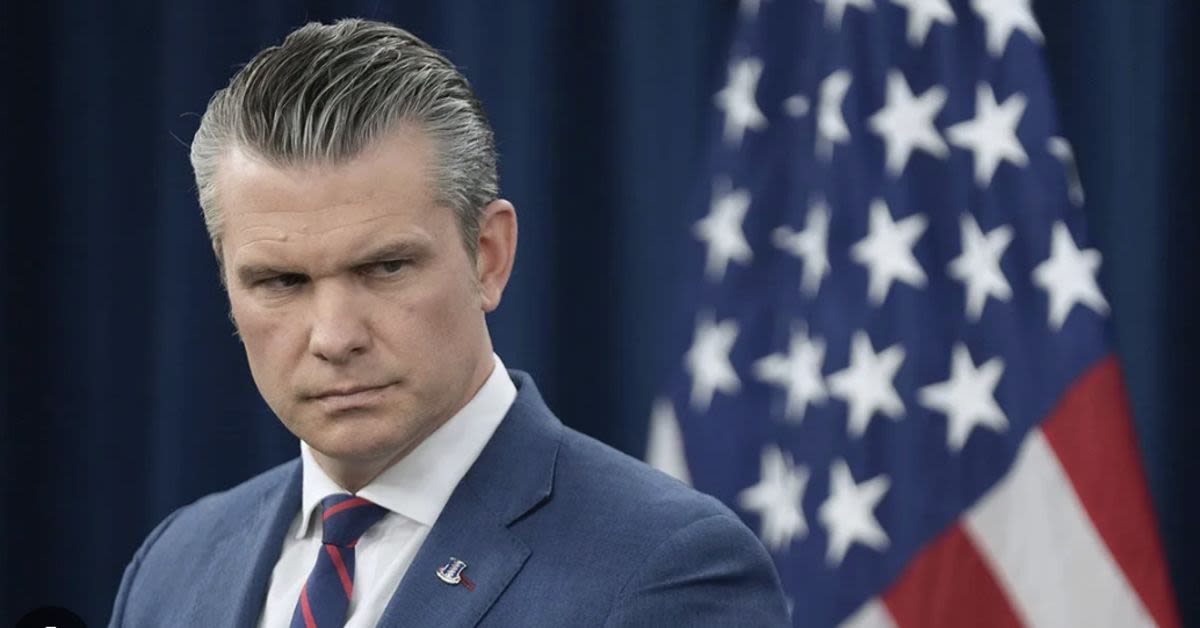
Pete Hegseth is pressing the national media to describe the escalating conflict with Iran in terms that align with the Trump administrations preferred storyline rather than with the broader realities on the ground.
The Fox News personality, who has styled himself the Secretary of War, made his expectations unmistakable when he blasted television coverage of the fighting and began proposing his own substitute headlines. As reported by Mediaite, he objected to banners such as Mideast war intensifies, insisting they mislead viewers about the nature of the conflict and urging outlets instead to stress Iranian weakness and American strength with formulations like Iran increasingly desperate or Iran shrinking.
What made his complaint notable was that Hegseth did not challenge the underlying facts being reported, only the way those facts are framed. The war has undeniably widened across the region, with Iranian strikes hitting civilian and energy infrastructure and renewed threats to shipping in the Strait of Hormuz once again rattling global markets, a situation Foxs Laura Ingraham herself effectively described as a dire crisis on her Thursday night program.
Those developments accurately capture the current phase of the conflict, which combines overwhelming U.S. military superiority with mounting political turbulence and economic risk. Hegseths anger is directed not at inaccuracies but at interpretations that emphasize escalation, uncertainty, and potential costs rather than a narrative of American dominance and Iranian decline.
In his view, coverage that highlights rising danger, strategic ambiguity, or economic vulnerability amounts to distorted framing that undercuts U.S. resolve. Coverage that foregrounds Iranian desperation and American advantage, by contrast, mirrors the storyline the administration wants citizens to internalize as they watch events unfold.
The dispute he is waging is therefore about narrative control rather than factual veracity. It is an effort to police the boundaries of acceptable wartime reporting so that the public conversation begins from the White Houses preferred assumptions instead of from independent journalistic inquiry.
That impulse sheds light on why President Donald Trump was comfortable elevating a former Fox News commentator into a senior Pentagon role. Hegseth entered government after years as one of Trumps most dependable on-air allies, a figure whose job was less to probe the administrations foreign policy claims than to amplify them and to dismiss skeptical coverage as partisan or frivolous.
The combative, loyalty-first posture that once played out in cable news segments has now migrated to the Pentagon podium. From that perch, Hegseth is attempting to discipline the press into adopting a more deferential, administration-centric lens on war reporting.
His recent attack on CNN underscored the pattern. The network reported that the administration may have underestimated the economic and strategic fallout of Iranian interference in the Strait of Hormuz, a chokepoint vital to global energy supplies and thus to Western prosperity.
Hegseth brushed off the story as patently ridiculous, insisting Iran has menaced the waterway for decades and that American planners were fully aware of the stakes. In a statement to Mediaite, CNN stood by its reporting, signaling that it would not be bullied into abandoning scrutiny of the administrations risk calculations.
Within the framework Hegseth is advancing, the substance of such reporting becomes almost incidental. The central objective is to draw a bright line around what kinds of questions and emphases are deemed legitimate, casting any focus on planning failures, strategic exposure, or economic downside as inherently suspect or politically motivated.
The headline fight makes the distinction plain. A banner that reads war intensifies simply describes observable facts: fighting is spreading, targets are broadening, and the strategic stakes are rising for the United States and its allies.
A banner that reads Iran shrinking does something very different; it encodes the administrations preferred interpretation of those same facts and presents that narrative of inevitable Iranian collapse as the starting point for public understanding. Hegseth is effectively demanding that journalists adopt that conclusion first and then build their coverage around reinforcing it, rather than allowing the conclusion to emerge from independent reporting.
The standard he is advancing also appears conspicuously selective. During the Biden administration, Hegseths commentary on Fox routinely spotlighted battlefield reversals, policy missteps, and strategic confusion in Ukraine and other theaters, without any suggestion that such criticism might embolden adversaries or undermine national unity.
In that era, aggressive scrutiny of the commander-in-chiefs foreign policy was treated as a vital component of democratic debate, not as a betrayal of the national interest. Now that a Republican administration is steering the war effort, similar scrutiny is rebranded as fake news, irresponsible coverage, or journalism that allegedly gives comfort to Americas enemies.
If the press corps were to accept Hegseths framing, wartime reporting would look markedly different from what Americans have historically expected in a free society. Coverage would begin with the administrations storyline of momentum and mastery, and reporters would be nudged to fit facts into that template rather than to test it against unfolding reality.
Questions conservatives themselves have long valuedwhether the strategy is actually working, whether risks were fully weighed, and whether the economic and geopolitical costs are mounting beyond what voters were toldwould be pushed to the margins in favor of morale-boosting narratives. Citizens would still see images of the war on their screens, but without a press willing to challenge official spin, they would be left with far less of the independent, skeptical reporting that allows a free people to judge for themselves what a distant conflict truly means for their security, their liberties, and their future.
Login