
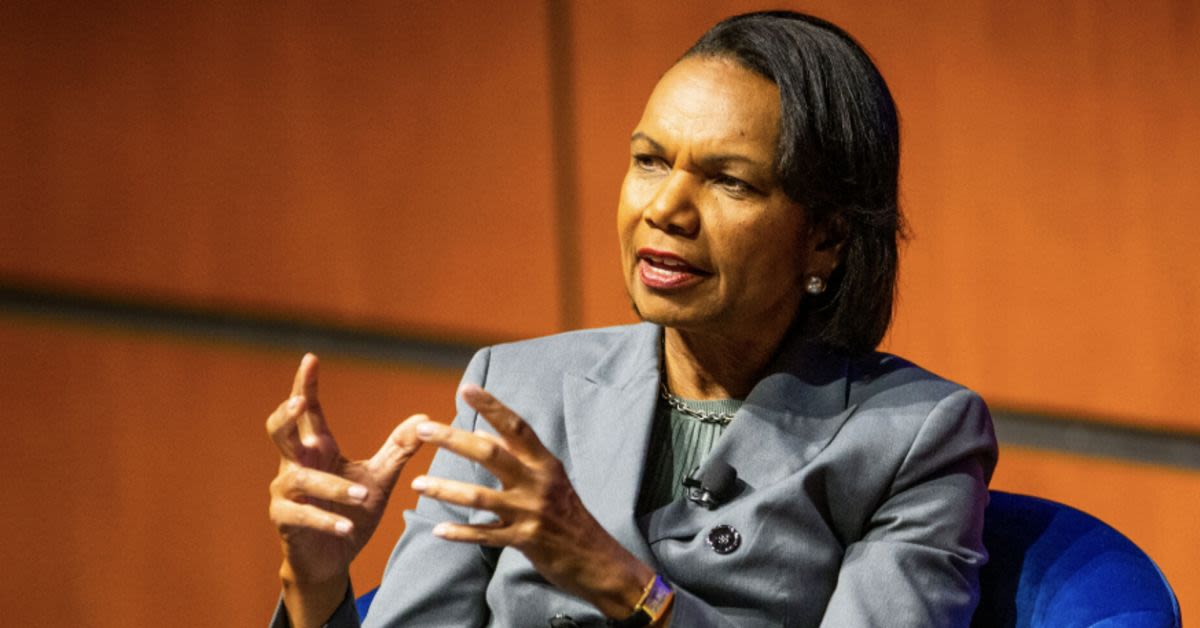
Former Secretary of State Condoleezza Rice is urging President Donald Trump to "take care of Iran for good," hailing "Operation Epic Fury" and the killing of Iranian Supreme Leader Ali Khamenei as a decisive step against a regime she says has waged a decades-long war on the United States.
Her remarks came in a televised interview in which she framed the current U.S.-Israeli military campaign as a long-delayed reckoning with one of Washingtons most entrenched enemies. According to Newsmax, Rice, who served as secretary of state during President George W. Bushs second term, argued that the operation marks a necessary escalation in a conflict that Tehran has been driving for nearly half a century.
"Iran has been at war with us for at least 47 years," Rice said, underscoring her view that the Islamic Republics hostility is neither new nor reactive but foundational to its foreign policy. "If you ask people about Iraq, what was the source of many of our casualties in Iraq, youll get estimates as high as 75% or 80% of them were due to Iranian-made roadside bombs."
Rice maintained that the objective of the current campaign must be to cripple Irans capacity to menace the United States, Israel, and other American partners in the region. "If you can render Iran essentially incapable of military action against us and against our allies, thats worthy," she said on Fox News Channel.
She described the strategy behind "Operation Epic Fury" as focused and justified, not reckless or open-ended. "What theyre trying to do is to neuter Iran as a military power in the region," she added, making clear that the aim is not occupation but the dismantling of Tehrans war-making capabilities.
Rice emphasized that Irans threat extends far beyond its borders, pointing to the regimes long-standing investment in terrorist proxies. "They have developed the military capability to reach outside the boundaries of Iran, including Hezbollah and Hamas, which they both arm and equip," Rice said.
For Rice, any attempt to downplay the danger posed by the Islamic Republic ignores a long and bloody record. "To say that this regime was not a threat its ahistorical," she argued, noting that Tehrans malign activities have been well documented for decades.
She cited the 1979 hostage crisis, in which American diplomats were held for 444 days, and the 1983 Beirut barracks bombing that killed 241 U.S. service members as early markers of Irans war against the West. "I myself negotiated four Security Council resolutions calling them a threat to international peace and security because of their nuclear ambitions," Rice said, recalling her tenure at the State Department.
The latest round of U.S.-Israeli operations followed the collapse of negotiations over Irans nuclear program, after Tehran refused to abandon uranium enrichment. The Trump administration had insisted that the regime dismantle its nuclear efforts entirely, and when talks stalled, Washington began reinforcing its military posture across the Middle East.
Since the launch of Operation Epic Fury, Iran has responded with retaliatory strikes on U.S. and Israeli targets, attacks that have already claimed the lives of six American service members. Rice characterized Tehrans response as a grave miscalculation that only strengthens the case for a sustained campaign to dismantle its military and nuclear infrastructure.
"I see it as a series of decisions and a worthy goal," she said of the operation, rejecting the notion that the campaign is impulsive or unfocused. "Taking care of Iranian military and nuclear capabilities is very important."
At the same time, Rice cautioned that the internal dynamics of Iran a country of more than 90 million people with deep ethnic, religious, and political divisions will complicate whatever comes after the regimes weakening. She suggested that any post-Khamenei landscape could be volatile, requiring careful management by the United States and its allies to avoid a power vacuum that extremists might exploit.
Military pressure on Tehran has been building for months, with earlier U.S. strikes targeting key nuclear facilities at Fordow, Natanz, and Isfahan. According to U.S. officials, those attacks inflicted serious damage on Irans nuclear infrastructure and significantly delayed its weapons program, vindicating the argument that force, not diplomacy alone, is necessary to curb the regimes ambitions.
Rice argued that the broader effort to degrade Irans military power is not merely punitive but essential to restoring a measure of stability to a region long destabilized by Tehrans aggression. "This really is a now-crippled Iran," she said, contending that a weakened regime is "good for the region" and a vital step toward preventing further terrorism and nuclear escalation.
Her comments reflect a worldview that many conservatives share: that peace is best preserved through strength, not concessions, and that rogue regimes respond only to credible force. In that context, Rices endorsement of Trumps hard line on Iran underscores a broader critique of past policies that sought accommodation with Tehran and, in her view, only emboldened its leaders.
For Rice and others who served in the Bush administration, the current confrontation is the culmination of a conflict that has been simmering since the Islamic Revolution, repeatedly flaring in attacks on Americans and their allies. By calling on Trump to "take care of Iran for good," she is effectively arguing that the United States has reached a point where half-measures and temporary deals are no longer acceptable, and that only a decisive rollback of Irans military and nuclear capabilities can secure American interests and protect the free world.
Login