
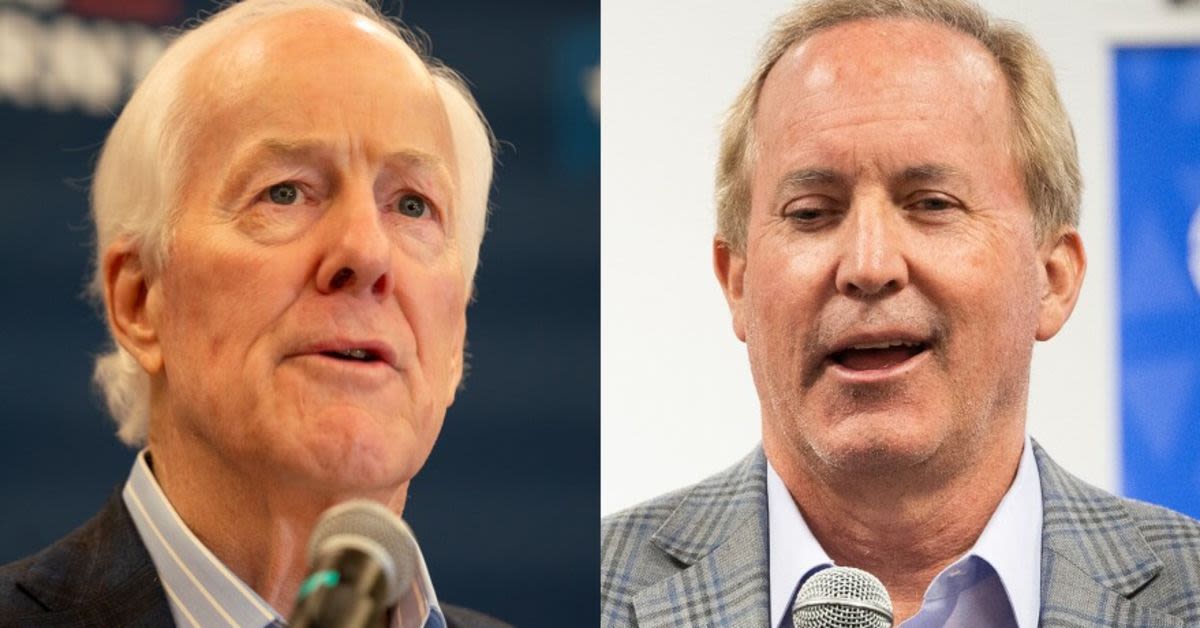
Incumbent Sen. John Cornyn exceeded most expectations in Tuesdays Texas Republican Senate primary, forcing a runoff with Attorney General Ken Paxton in a contest that has become a proxy war between the partys establishment and its populist, MAGA-aligned base.
The Associated Press (AP) called the race at 10:50 a.m. ET, with Cornyn narrowly ahead as ballots continued to be tallied. With an estimated 65.8 percent of the vote counted, Cornyn held 658,274 votes, or 42.5 percent, while Paxton trailed closely with 632,472 votes, or 40.8 percent. According to Breitbart, Rep. Wesley Hunt finished a distant third with roughly 13 percent of the projected vote, a showing that not only ends his Senate bid but will also leave him out of office when his current House term expires.
The contest quickly became the most expensive Senate primary in American history, as the Washington Republican establishment, led by the National Republican Senatorial Committee, mobilized aggressively to protect Cornyn. Cornyn and his allies poured tens of millions of dollars into the race, saturating the airwaves with ads boosting the four-term senator and hammering both Paxton and Hunt.
Hunt, once seen as a rising conservative star, found himself under sustained fire over his attendance record in the House. That line of attack focused on missed votes both before and after his last-minute decision to jump into the Senate race, and Cornyns allies turned on him with particular ferocity once polling suggested Hunts early surge might block Cornyn from making the runoff.
The barrage against Paxton, however, took on a far more personal and bitter tone, underscoring the deep divide between the partys grassroots and its leadership class. Cornyns campaign led the charge, highlighting Paxtons divorce, allegations of infidelity, and his long list of legal and ethical troubles issues that Texas voters have repeatedly discounted while returning Paxton to office as one of the states most combative conservative figures.
Cornyn insisted throughout the campaign that he could not simply step aside and allow Paxton to carry the Republican banner in Washington. Judgment Day is coming for Ken Paxton, he declared Tuesday night, framing the runoff as a moral and ethical test for Texas Republicans rather than a mere intraparty squabble.
The spending gap was staggering: Cornyn and his allies outspent Paxton and his supporters by roughly $69 million to $4 million on advertising, according to the New York Times, with some estimates placing the disparity even higher. Yet that financial onslaught failed to deliver the knockout blow Cornyn needed to avoid a runoff, and few political handicappers had predicted that he, rather than Paxton, would emerge as the narrow frontrunner once the dust settled.
Instead of eroding Paxtons base of support, Cornyns spending appears to have cannibalized Hunts backing, dragging the congressman down to a disappointing third-place finish that fell short of most polling. That outcome suggests many voters concluded early that only Cornyn and Paxton were viable options, leaving Hunt stranded as a protest choice in a race defined by the clash between institutional power and populist insurgency.
Cornyns better-than-expected showing may not be enough to unlock a new wave of donor enthusiasm heading into the May runoff. Many of Hunts supporters who did not break for Cornyn on Election Day are widely seen as more ideologically aligned with Paxton and therefore more likely to rally behind the attorney general in a two-man race, though the deep-pocketed establishment forces backing Cornyn are unlikely to retreat quietly.
Senate Majority Leader John Thune (R-SD), a key Cornyn ally who helped steer tens of millions of dollars into the Texas race, is expected to intensify his efforts to secure an endorsement from President Donald Trump. Thune previously failed to persuade Trump to back Cornyn before the primary, as the president publicly flirted with supporting each of the three candidates at different points, ultimately declining to endorse anyone and saying he liked all three men.
Cornyns allies had hinted in the final days before the primary that more damaging revelations about Paxton might surface, raising expectations of a late-breaking scandal. Yet given Cornyns need for the strongest possible showing to justify continued investment, it strains credulity to believe his team would have withheld potent opposition research if it existed, suggesting the establishment may have already fired most of its ammunition.
Adding to the intrigue, Cornyn projected an oddly fatalistic tone as Election Day approached, oscillating between pessimism, indifference, and a kind of stoic resignation. The senator repeatedly said he was running out of a sense of duty and optimism about the countrys future, but he notably stopped short of expressing real confidence that he would prevail.
Cornyn also stumbled into controversy when he remarked that only the most radical people show up in the primary, a comment that landed poorly with the very voters he needed to court. Attempting to walk back the remark, he later clarified, I just mean people who maybe are not representative of the Republican Party, a distinction that did little to reassure grassroots conservatives already skeptical of Washington insiders.
The dynamics of the runoff could be further shaped by the Democratic primary, where state representative and progressive preacher James Talarico emerged as the nominee. Talarico is widely viewed as a more formidable general election opponent than his rival, the fiery Rep. Jasmine Crockett, and Washington-based Cornyn supporters have seized on his victory to argue that Paxton would jeopardize Republicans hold on the seat in November.
Paxton and his allies reject that narrative outright, portraying it as a self-serving ploy by establishment Republicans more interested in protecting their own power than in expanding the GOPs Senate majority. They argue that resources should be directed toward truly competitive states rather than spent trying to crush a MAGA-aligned conservative in deep-red Texas, where the real fight is over the partys direction, not its partisan control.
John spent $100 million, what a waste of money, Paxton said Tuesday, blasting the spending spree as a misallocation of precious campaign resources. That money should have been going to Republicans in other states, he added, echoing a sentiment shared by many grassroots conservatives who see the race as emblematic of Washingtons misplaced priorities.
Hunts late entry into the race infuriated many Washington Republicans aligned with Cornyn, triggering a wave of unusually personal attacks and social media sniping that pushed the limits of professional decorum. The bitterness did not subside even after Hunts defeat, underscoring how deeply the establishment resented his challenge and how little interest it has in reconciliation ahead of the runoff.
In a striking example of that hostility, the Thune-aligned Senate Leadership Fund (SLF), which backed Cornyn, issued a blistering statement Tuesday night effectively mocking Hunts political demise. Congratulations to Wesley Hunt on an abysmal third place finish in Texas Republican primary, the SLF statement read, before accusing him of abandoning the fight for conservative priorities in favor of personal ambition.
Instead of fighting for President Trump and conservative priorities, Wesley launched a career-ending vanity tour without any substance or political reasoning, the group continued, taking direct aim at Hunts motives and strategy. While Wesleys amateur consultants got wealthy on his senseless campaign, Republican voters are now forced to endure an even longer primary runoff election, the statement concluded, even as Cornyn will now need many of those same Hunt voters to survive the showdown with Paxton.
The runoff, scheduled for May 26, will test whether Texas Republicans prefer the stability and seniority of a long-serving senator closely tied to the partys leadership, or the combative, anti-establishment posture embodied by Paxton. With control of a safe Republican seat not truly in doubt, the race has become a referendum on whether the GOP in Texas and by extension, nationally will be defined by its conservative grassroots or by the entrenched power brokers in Washington who are spending lavishly to keep one of their own in place.
Login