
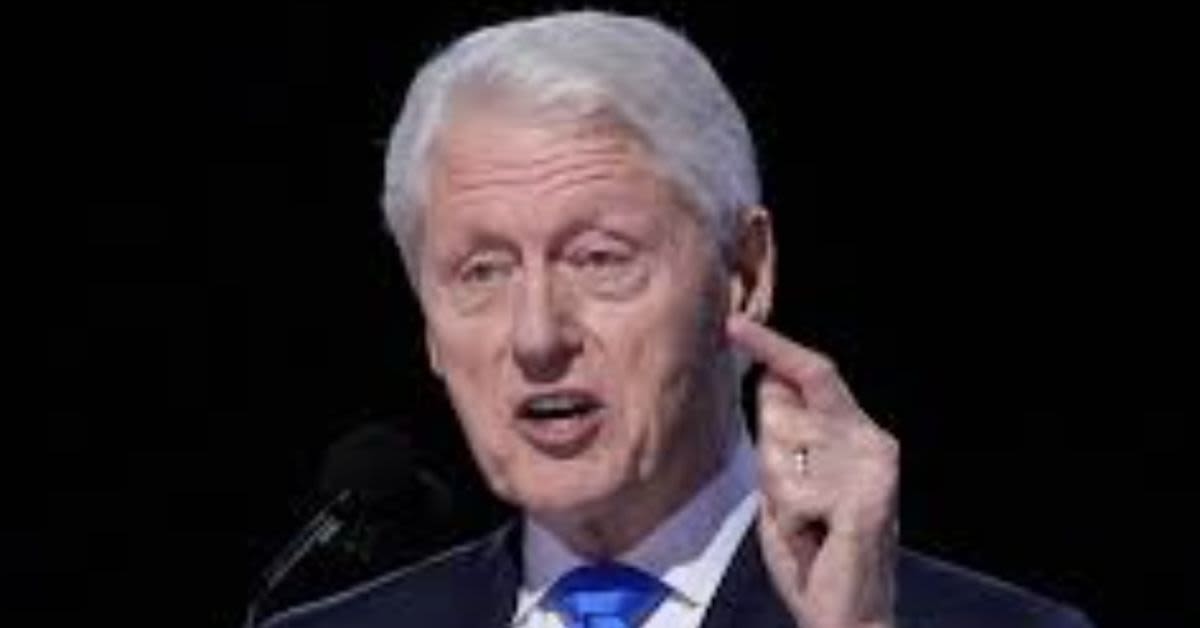
Former President Bill Clinton, under oath before House investigators on Friday, insisted he did nothing wrong in his dealings with convicted sex offender Jeffrey Epstein, even as lawmakers subjected him to hours of pointed questioning over a relationship that dates back more than twenty years.
The extraordinary closed-door deposition in Chappaqua, New York, represented the first time in American history that a former president has been compelled to testify before Congress in such a manner, according to The Associated Press.
It followed just one day after his wife, former Secretary of State Hillary Clinton, appeared for her own deposition, underscoring how deeply the Epstein scandal continues to ripple through the political class long after his death.
Clinton, who has not been charged with any crime in connection with Epstein, attempted to frame the encounter on his own terms by releasing his opening statement on social media before the session began.
I saw nothing, and I did nothing wrong, he declared, drawing a sharp line between his public defense and the suspicions that have dogged his post-presidential legacy.
The hearing unfolded against a broader backdrop of public anger over elite impunity, as lawmakers wrestled with what accountability should look like in a country where powerful men have often escaped serious consequences.
Epsteins 2008 plea deal in Floridaon state charges for soliciting prostitution from an underage girlhas long been viewed by critics as a glaring example of a justice system that bends for the well-connected while ordinary citizens face the full weight of the law.
House Oversight Committee Chair Rep. James Comer, R-Ky., framed the stakes bluntly before Clinton even entered the room.
Men and women for that matter of great power and great wealth from all across the world have been able to get away with a lot of heinous crimes, and they haven't been held accountable, and they have not even had to answer questions, Comer said, signaling a determination to pierce the protective bubble that has historically surrounded global elites.
Hillary Clinton, in her own testimony the previous day, distanced herself from Epstein and any knowledge of his predatory behavior.
She told lawmakers that she had no awareness of how Epstein had sexually abused underage girls and said she had no recollection of ever meeting him.
Bill Clinton, by contrast, has a well-documented association with Epstein and Epsteins former girlfriend, Ghislaine Maxwell, stretching from the late 1990s into the early 2000s, a period that now sits under a harsh retrospective spotlight.
Even so, Hillary Clinton told the committee she expected her husband to testify that he had no knowledge of Epsteins sexual abuse at the time they interacted socially and professionally.
Republicans on the committee, long interested in probing Clintons ties to Epstein, see the deposition as an overdue reckoning.
No one's accusing anyone of any wrongdoing, but I think the American people have a lot of questions, Comer said, emphasizing that the inquiry is as much about transparency as it is about potential legal exposure.
Their interest intensified after Epsteins 2019 death in a New York jail cell, where he was being held on federal sex trafficking charges, fueled a wave of public skepticism and conspiracy theories.
Those suspicions only deepened late last year when the Department of Justice released case files containing several photographs of Bill Clinton with Epstein and Maxwell, images that revived questions about the former presidents judgment and associations.
In one photograph, Clinton is seen on an airplane seated beside a woman whose face is redacted, his arm draped around her in a casual pose.
Another image shows Clinton and Maxwell together in a swimming pool, accompanied by a third person whose face is also obscured, a tableau that critics argue undercuts claims of a distant or purely professional acquaintance.
The documentary record extends beyond photographs, as Epstein visited the White House multiple times during Clintons presidency and later joined him on several international trips tied to humanitarian initiatives.
Comer has asserted that committee investigators have compiled evidence showing Epstein visited the White House 17 times and that Clinton flew on Epsteins private aircraft 27 times, figures that raise obvious questions about the depth of their relationship.
In the run-up to the deposition, Clinton has maintained that his knowledge of Epstein was limited and benign, insisting he was unaware of any criminal conduct.
I think the chronology of the connection that he had with Epstein ended several years before anything about Epstein's criminal activities came to light, Hillary Clinton said at the conclusion of her own deposition, attempting to draw a clear temporal boundary around her husbands involvement.
Comer has promised a rigorous and exhaustive line of questioning for the former president, reflecting a broader conservative concern that high-ranking Democrats have often been shielded from the scrutiny routinely applied to Republicans. He also claimed that during her testimony, Hillary Clinton repeatedly deflected Epstein-related questions to her husband, further heightening the importance of Bill Clintons appearance before the committee.
The panel is working to release both a transcript and video recording of Hillary Clintons deposition, a move that could provide the public with a rare unfiltered look at how senior Democratic figures respond under oath when pressed on their ties to Epstein. Such transparency, conservatives argue, is essential if Congress is to restore trust in institutions that have too often appeared to protect their own.
Democrats on the committee, while backing the effort to obtain answers from Bill Clinton, are simultaneously trying to broaden the inquiry to include President Donald Trump, who also had a past social relationship with Epstein. I think that President Trump needs to man up, get in front of this committee and answer the questions and stop calling this investigation a hoax, said Rep. Robert Garcia, D-Calif., the panels top Democrat, attempting to turn the spotlight toward the Republican frontrunner and dilute the focus on the Clintons.
Comer has pushed back on that demand, noting that Trump has already fielded questions from the press about Epstein and arguing that Democrats are using the scandal as a political weapon rather than a genuine search for truth. From a conservative standpoint, the insistence on dragging Trump into the proceedings appears less about justice and more about creating a false equivalence to shield prominent Democrats from the full consequences of their choices.
Democrats have also seized on the controversy surrounding Commerce Secretary Howard Lutnick, a Trump appointee, calling for his resignation over his own ties to Epstein. Lutnick, a longtime neighbor of Epstein in New York City, said on a podcast that he cut off contact after a 2005 tour of Epsteins home that he and his wife found disturbing, a claim now under renewed scrutiny.
Recently released case files, however, indicate that Lutnick had at least two subsequent interactions with Epstein, complicating his narrative. He reportedly attended a 2011 event at Epsteins residence and, in 2012, joined Epstein for a lunch on his private island along with his family, raising questions about why those encounters were not fully disclosed earlier.
He should be removed from office and at a minimum should come before the committee, Garcia said of Lutnick, using the revelations to argue that accountability must extend to current officeholders as well as former presidents. The push to target Lutnick also offers Democrats a way to claim bipartisan concern over Epsteins network, even as they resist deeper scrutiny of figures aligned with their own party.
Rep. Nancy Mace, R-S.C., who questioned Hillary Clinton about Lutnicks relationship with Epstein during Thursdays deposition, has joined calls for the commerce secretary to testify. Her involvement underscores that some Republicans are willing to follow the Epstein trail wherever it leads, provided the process is not hijacked for partisan score-settling.
On Friday morning, Mace and other members signaled that the committee is prepared to escalate its efforts if Lutnick does not appear voluntarily. I believe we will have the votes to subpoena him, said Rep. Ro Khanna, D-Calif., indicating that on at least this point, there may be rare bipartisan agreement to compel testimony from a sitting cabinet official.
As the Clinton deposition reverberates through Washington, the central question remains whether Congress is prepared to apply a single standard of accountability to all who moved in Epsteins orbit, regardless of party or status.
For conservatives, the moment represents an opportunity to challenge a culture in which global elitesfrom presidents to financiershave long operated under a different set of rules, and to insist that even a former commander in chief must finally answer questions about the company he chose to keep.
Login