
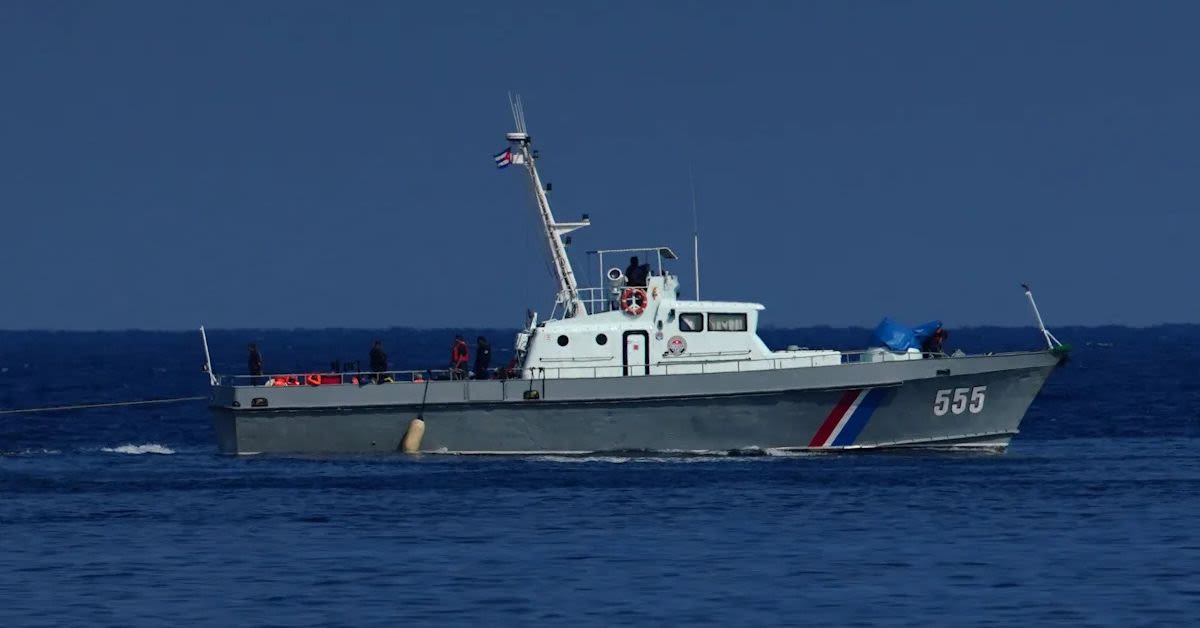
Secretary of State Marco Rubio said Wednesday evening that the Trump administration is moving to independently verify the circumstances surrounding a reported deadly confrontation at sea between a speedboat allegedly registered in Florida and the Cuban communist coast guard.
According to Breitbart, the Cuban Communist Partys foreign ministry announced on Wednesday that its forces had intercepted a Florida-registered speedboat, killed four people on board, and detained at least six others. On Thursday morning, the regimes official newspaper, Granma, published the names of six individuals it claimed were aboard the vessel and branded them terrorists allegedly attempting to carry out an attack against the Havana government.
Among those identified are figures the Castro regime had previously labeled terrorists on a largely discredited blacklist that lumps together genuine dissidents, human rights advocates, and even YouTube commentators. That list, widely viewed by Cuban exiles and democracy activists as a political weapon rather than a security tool, has long been used by the dictatorship to smear opponents and justify repression under the guise of counterterrorism.
Neither the Cuban regime nor the White House had provided additional official details as of Thursday morning, leaving a vacuum quickly filled by speculation and conflicting narratives. Some American media outlets have cited relatives of those allegedly on board, who reportedly described the men as deeply committed to overthrowing communism in their homeland, a motive that would hardly be surprising given the islands six-decade record of totalitarian rule.
The Castro regime, which still dominates Cubas political life despite the formal transfer of power to Miguel Daz-Canel, has a notorious history of unjustifiably killing civilians at sea, including children and American citizens, without facing meaningful consequences. For many in the Cuban exile community, any claim by Havana involving terrorism or aggression is immediately suspect, given the regimes long record of propaganda, disinformation, and state-sponsored violence.
Speaking to reporters in the Caribbean nation of St. Kitts and Nevis, Rubio offered few concrete details about the latest incident but made clear that Washington does not believe any U.S. government personnel were involved. He also stressed that there is no indication the speedboat was part of any American government operation, underscoring that the administration is treating the matter as a separate, private incident rather than a state-sanctioned mission.
Rubio urged journalists and the public to treat the Cuban governments narrative with extreme caution, given the regimes well-documented habit of manipulating facts to serve its political agenda. We will know quickly many more facts about this incident than we know right now. The majority of the facts being publicly reported are those by the information provided by the Cubans, Rubio noted. We will verify that independently.
The secretary of state emphasized that U.S. authorities are seeking basic information that Havana has not credibly provided, including who currently controls the vessel and the precise status of those detained. I dont know who has possession of the vessel, which is the first thing we want to have. We obviously want to have access to these people if they are American citizens or U.S. residents, Rubio added. But Im not going to speculate now because right now, still a lot of the information thats out there is information thats been provided by the Cubans. We are going to verify that information independently and reach our own conclusions.
Rubio repeatedly underscored that the United States will not simply accept the Communist Partys account at face value, a stance consistent with a more skeptical, America-first foreign policy posture. He stated that Washington would not base our conclusions on what theyve [the Cuban government] told us, and when asked whether the U.S. government had specific reasons to doubt Havanas version of events, he responded bluntly, I have every reason to want our own information. We dont generally make decisions in the United States on the basis of what Cuban authorities are saying.
The secretary of state noted that the current public narrative is embedded all sorts of facts of things that they claim to be facts, which is where the ship came from, where the boat came from, who was on it, what happened, and so forth. He declined to confirm that the vessel was indeed from Florida or to verify the identities of those on board, reiterating that the United States is conducting its own investigation rather than relying on a hostile regimes claims.
Elsewhere in his remarks, Rubio acknowledged that U.S. authorities have previously intercepted individuals engaged in illicit maritime activity involving Cuba, including human smuggling and unauthorized transport. He confirmed that the United States has caught people in the past that have run into Cuba to bring people and so on.
Rubio stressed that such operations are illegal under American law, regardless of any political motives or humanitarian justifications that participants might claim. It is illegal. It is a violation of federal law to go and run people back and forth. And weve caught people doing that in the past, he asserted. It doesnt normally lead to shootouts, to be honest with you. But Im not claiming thats whats happened here. I dont know.
The Cuban embassy in Washington, which was reopened as part of former President Barack Obamas controversial rapprochement with Havana, issued an English-language statement on Wednesday providing what it said was the registration number of the Florida vessel and confirming that fatalities had occurred. That diplomatic presence, restored under a policy many conservatives criticized as a unilateral concession to a dictatorship, has become a key channel for the regimes messaging on incidents like this one.
According to the embassys account, the confrontation began when Cuban Border Guard Troops approached the speedboat for identification. When a surface unit of the Border Guard Troops of the Ministry of the Interior, carrying five service members, approached the vessel for identification, the embassy claimed, the crew of the violating speedboat opened fire on the Cuban personnel, resulting in the injury of the commander of the Cuban vessel.
The statement went on to assert that Cuban forces responded with lethal force, killing four of the alleged assailants and wounding six others. As a consequence of the confrontation, as of the time of this report, four aggressors on the foreign vessel were killed and six were injured, it added. The injured individuals were evacuated and received medical assistance.
A subsequent statement disseminated through Cuban state media escalated the rhetoric, labeling the detainees as terrorists and attempting to frame the incident as part of a broader campaign of violent aggression against the regime. The communiqu listed six individuals said to be alive and in Cuban custody: Amijail Snchez Gonzlez, Leordan Enrique Cruz Gmez, Conrado Galindo Sariol, Jos Manuel Rodrguez Castell, Cristian Ernesto Acosta Guevara, and Roberto Azcorra Consuegra.
At least one of those named, Snchez Gonzlez, had already been publicly targeted by the regime in 2023, when Havana released a so-called terror list that lumped him together with peaceful dissidents and commentators. Amijal Snchez Gonzlez also lives in Florida. Among other things, from social networks he offers financing for terrorist actions in national territory, the regime claimed at the time. When he was in Cuba, he was prosecuted for illegal possession and carrying of firearms, theft and illegal slaughter of livestock, injuries, illegal economic activity and reckless homicide.
While the regime portrays that list as a tool against violent extremism, the vast majority of those named are known in exile circles and in the United States as legitimate human rights advocates and outspoken critics of communism. The list notoriously includes Breitbart News contributor Orlando Gutirrez-Boronat and several popular Miami-based YouTube commentators, underscoring how Havana weaponizes the language of terrorism to criminalize dissent and discredit opposition voices abroad.
For decades, the Castro regime has used similar tactics to justify brutal actions at sea, where it has repeatedly targeted unarmed civilians attempting to flee the island or assist refugees. The latest incident comes just one day after the 30th anniversary of the Brothers to the Rescue massacre, a grim milestone that still resonates deeply among Cuban exiles and human rights advocates.
On February 24, 1996, Cuban fighter jets shot down two unarmed civilian aircraft belonging to Brothers to the Rescue, a humanitarian organization that flew missions over the Florida Straits to locate and aid Cuban rafters in distress. The attack, carried out over international waters, killed Americans Carlos Costa, Armando Alejandre, Mario de la Pea, and Pablo Morales, who were engaged in efforts to save the lives of refugees fleeing communism.
Despite the clear evidence that the planes were unarmed and operating on a humanitarian mission, the Communist Party has never faced criminal prosecution or serious international sanctions for the killings. The lack of accountability has long fueled anger among conservatives and Cuban exiles, who argue that Western governments, including prior U.S. administrations, have been far too willing to overlook Havanas crimes in pursuit of diplomatic engagement.
The regimes record of maritime atrocities extends beyond that single incident, encompassing other episodes of shocking brutality against civilians. In 1994, Cuban authorities attacked the 13 de Marzo tugboat as it attempted to leave the island carrying refugees bound for the United States, resulting in the deaths of 37 people, including children as young as six months old, who were drowned when the vessel was rammed and sunk.
These historical precedents cast a long shadow over any new claim by Havana involving alleged aggressors or terrorists at sea, particularly when the only detailed account comes from the regime itself. For many observers, especially those on the right who have long warned against trusting communist dictatorships, Rubios insistence on independent verification reflects a necessary skepticism rather than mere diplomatic caution.
As the Trump administration works to establish the facts, key questions remain unanswered: whether the speedboat was indeed armed, what its precise mission was, who exactly was on board, and whether Cuban forces used proportionate force or seized on the encounter as another opportunity to send a message of fear. Until those questions are addressed through credible, independent investigation rather than the word of a one-party police state, the incident will continue to be viewed through the lens of the regimes long history of repression, propaganda, and violence against those desperate enough to challenge or escape its rule.
Login