
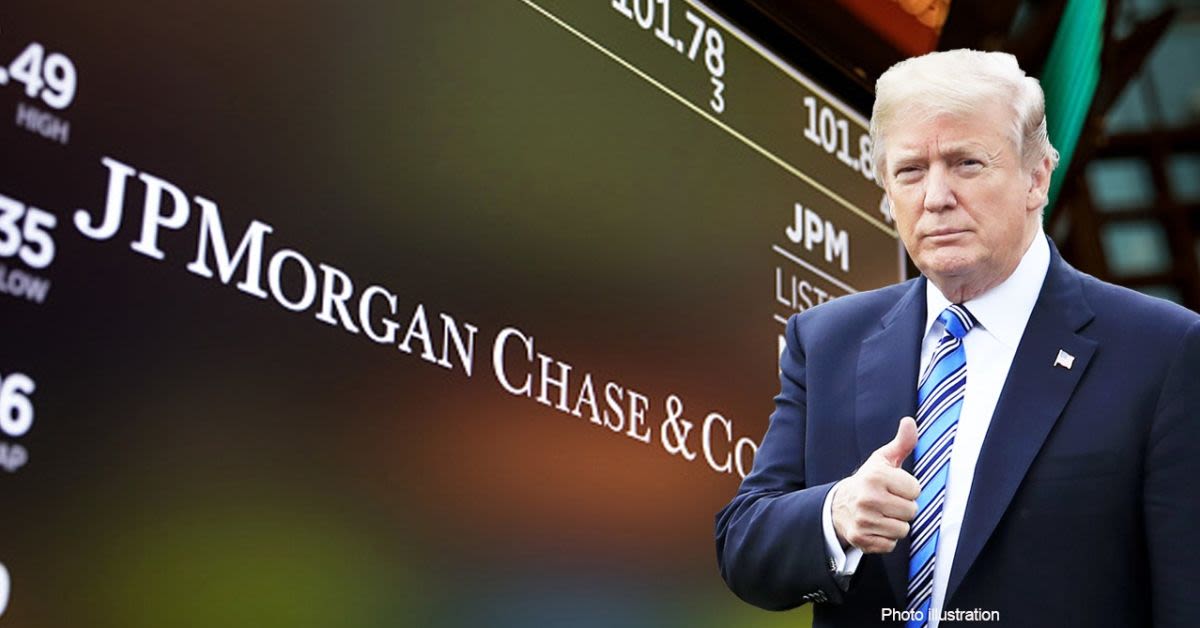
Jamie Dimon now finds himself accused not of a routine compliance misstep, but of orchestrating the political excommunication of a President from the American banking system.
According to RedState, Donald Trumps lawsuit does not treat the postJanuary 6 account closures as ordinary risk management decisions, but as targeted retaliation driven by political pressure and directed from the top of JPMorgan Chase. The complaint names Dimon personally, alleging that the banks most powerful executive oversaw a campaign to sever Trump, his family, and his businesses from mainstream finance in a way that would have been unthinkable for any favored figure on the left.
By their own admission, JPMorgan Chase, at the direction of CEO Jamie Dimon, unlawfully debanked and blacklisted President Trump, his family, and several of his businesses, causing overwhelming financial and reputational harm, a spokesperson for Trumps legal team said in a statement. That charge does more than criticize a corporate decision; it squarely assigns intent, coordination, and responsibility to Dimon himself and demands that he be held to account rather than shielded behind the corporate veil.
JPMorgans legal response is equally unambiguous and seeks to narrow the battlefield from the outset. The bank rejects not only the political narrative, but the legal theory that would allow Trump to keep Dimon in the case at all.
At the heart of Trumps complaint is the explosive allegation that JPMorgan created and circulated a blacklist of Trump-related accounts to other financial institutions, effectively warning them off doing business with the President and his network. JPMorgan does not merely contest the characterization of its conduct; it insists that, even assuming such a list existed, the law offers no viable path to hold Dimon personally liable.
But even if such a blacklist existed, there still would be no conceivable claim against Mr. Dimon under FDUTPA. Plaintiffs joinder of a non-diverse defendant who cannot possibly be held liable is fraudulent. Since there is complete diversity between the Plaintiffs and JPMorgan, the only other Defendant, this Court has subject matter jurisdiction under 28 U.S.C. 1332 to consider this matter and, ultimately, to (i) transfer the matter to another District, or (ii) dismiss the remainder of Plaintiffs claims, which lack any basis in law or fact. With that, the bank signals that its first priority is not to debate the politics of debanking, but to secure a federal forum and strip Dimon out of the case on jurisdictional grounds.
From there, JPMorgan turns to what may prove the most consequential pillar of its defense: the scope of Floridas Deceptive and Unfair Trade Practices Act (FDUTPA), the statute under which Trump is pursuing Dimon. The bank argues that the law itself forecloses individual liability for a corporate executive in the circumstances alleged, effectively insulating Dimon from being dragged into court as a personal defendant.
The application of JPMorgans exemption to its CEO is confirmed by the black-letter rule that a FDUTPA claim alleging corporate wrongdoing cannot proceed against an individual unless and until liability is established against the corporation. Because FDUTPA liability was not (and could not be) pleaded against JPMorgan, this principle likewise forecloses individual liability against its CEO. In other words, the bank contends that Trumps lawyers have tried to leapfrog the statutes structure by targeting the CEO while failing to state a proper claim against the institution itself.
That is not a procedural footnote; it is the core of JPMorgans attempt to dismantle the case at the threshold. By framing FDUTPA as a barrier to individual liability, the bank is asking the court to treat the claim against Dimon as legally impossible, not merely weak or unproven.
The filing then presses the point even further, accusing Trumps team of manipulating the rules to keep the case in a friendlier venue. In sum, Plaintiffs cannot possibly establish FDUTPA liability against JPMorgans CEO for two independent reasons based on the plain language of the Act. Applying reason and common sense, Plaintiffs assertion of this facially barred claim has no reasonable possibility of success. Mr. Dimon was fraudulently joined and his citizenship must be ignored for purposes of ascertaining the Courts diversity jurisdiction. That is the fraudulent joinder argument in full, a blunt assertion that Dimons presence in the lawsuit is a tactical ploy rather than a reflection of any real legal exposure.
In practical terms, JPMorgan is telling the court that the case belongs in federal court, where the bank presumably expects a more restrained reading of FDUTPA and a cooler reception for claims framed as political persecution. The banks lawyers make clear that this is only the opening move, not the endgame.
For now, this Notice of Removal addresses only the threshold issue: that a federal court is the proper forum for this action. Even before the underlying facts are tested, the institution is maneuvering to shift the terrain, a familiar strategy for large corporations facing high-profile litigation with significant political overtones.
The clash now takes on several distinct layers that extend far beyond a single set of accounts. Trump alleges a deliberate, politically motivated blacklisting operation directed from the top of the nations largest bank, while Dimons institution counters that the claims are legally defective, jurisdictionally flawed, and barred by the very statute Trump invokes.
Outside the courtroom, conservative advocates see something much broader at stake than one mans access to banking services. They view the case as a test of whether powerful financial institutions can quietly weaponize their influence against disfavored viewpoints while hiding behind regulatory jargon and complex statutory defenses.
Will Hild, executive director of Consumers Research, put it bluntly in an email to RedState: Jamie Dimon wants this lawsuit thrown out because it exposes the truth. From President Trump to churches, gun manufacturers, and everyday citizens, JPMorgan has a clear record of debanking conservatives simply for their beliefs. Thats not banking, its political discrimination. When the biggest banks in the country can quietly blacklist people for their views, no American is safe. For many on the right, that is the real story: a pattern of ideological enforcement by institutions that were never elected but wield enormous power over everyday life.
The emerging battlefield, then, is not confined to whether certain accounts were closed, but whether Wall Street giants can use legal technicalities and jurisdictional maneuvers as a shield while critics accuse them of enforcing a progressive orthodoxy. For Trump, the fight is personal and reputational; for Dimon, it is about regulatory interpretation and corporate protection; for conservative activists, it is about whether any citizen who dissents from the prevailing left-wing narrative can trust the financial system at all.
As the case moves toward what appears to be an inevitable transfer into federal court, the legal questions will intersect with a deeper cultural and political debate over corporate power and ideological bias. Whether or not Trump ultimately prevails on the merits, the allegations and the banks aggressive response have already intensified scrutiny of debanking and raised a stark question: in a country that claims to value free expression and equal treatment, should access to basic financial services depend on ones politics.
Login