
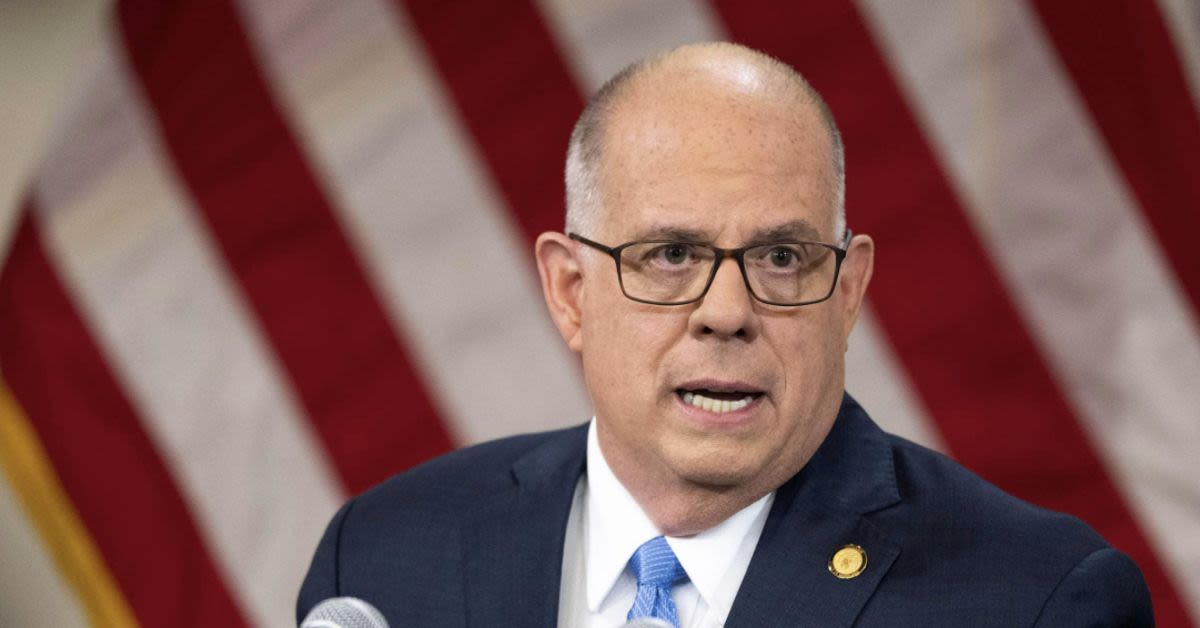
Former Maryland Gov. Larry Hogan is openly urging local law enforcement to disregard a new state law that curtails cooperation with U.S. Immigration and Customs Enforcement, putting him squarely at odds with his Democratic successor, Gov. Wes Moore.
The Republican former governor delivered his blunt assessment during a public conversation with former Arizona Democratic Gov. Janet Napolitano at the Politico Governor's Summit in Washington, D.C., where Moore had appeared on the same stage about an hour earlier. According to Newsmax, Hogan framed the issue as a matter of basic public safety and legal obligation, arguing that local agencies cannot simply walk away from working with federal immigration authorities when dangerous offenders are involved.
"All the local law enforcement, obviously, we're going to ignore that, because we're required to work with them," Hogan said, referring to the new statute Moore signed this week. "When they have violent criminals that they're holding in jail, that ICE wants to be detained, they shouldn't be left back on the street. So there's two sides to this argument."
Moore on Tuesday signed emergency legislation that sharply restricts how Maryland jurisdictions can cooperate with ICE, a move cheered by progressive activists but sharply criticized by law-and-order advocates. The measure bars local agencies from entering new agreements with ICE that allow state or local authorities to hold noncitizens for up to 48 hours and to serve administrative warrants, and it forces all existing partnerships to terminate by July.
Nine Maryland jurisdictions currently participate in such cooperative arrangements, which have long been a key tool for identifying and detaining criminal noncitizens already in custody. The new law effectively pushes Maryland toward the sanctuary model favored by the left, limiting the ability of sheriffs and local police to assist federal agents in removing offenders who are in the country illegally.
Sheriffs across the state, however, are signaling they have no intention of abandoning cooperation with ICE when public safety is at stake. Maryland sheriffs have said they will keep working with ICE despite the new law, underscoring a widening rift between local law enforcement professionals and Democratic lawmakers in Annapolis.
Carroll County Sheriff James DeWees made clear he will not allow political directives to override his duty to protect residents. "No politician or legislative body is going to tell me that I can't communicate with another law enforcement agency on matters of public safety in my community," DeWees told The Baltimore Sun. "I'm not going to stop."
Moore, attempting to reassure critics that the state is not turning a blind eye to dangerous offenders, insisted that Maryland will still coordinate with ICE in limited circumstances. After signing the bill, Moore said the state would continue to work with federal authorities on "the lawful removal of noncitizen offenders who pose a risk to public safety."
Yet many in law enforcement view those assurances as political cover for a broader ideological push to weaken immigration enforcement. Frederick County Sheriff Chuck Jenkins, whose county has long been a focal point of ICE cooperation in Maryland, dismissed the legislation as a partisan maneuver designed to appease the Democratic base rather than protect communities.
"You can put any lipstick you want on it; it's all political," Jenkins told The Sun. "The Democrats don't want any cooperation with ICE. They don't want any enforcement whatsoever."
Marylands move places it firmly within a growing bloc of Democrat-led states that are systematically restricting local collaboration with federal immigration authorities. New Mexico and Maine enacted similar measures earlier this year, following the path set by California, Illinois, Washington, and other blue states that have embraced policies limiting ICEs reach within their borders.
Supporters of these laws typically frame them as protecting immigrant communities from fear and overreach, but critics argue they create de facto sanctuaries for criminal noncitizens and undermine the rule of law. For conservatives, the Maryland legislation is another example of progressive politicians prioritizing ideological symbolism over the safety of law-abiding citizens and the integrity of the nations immigration system.
Hogan, who governed Maryland as a centrist Republican but has consistently backed strong public-safety measures, broadened his criticism beyond his home state. He pointed to Minnesotas handling of ICE enforcement activity earlier this year as a cautionary tale of how not to manage federal-local cooperation in a politically charged environment.
Hogan called Minnesotas response "an example of what not to do," arguing that officials there turned a serious law-enforcement matter into a media spectacle. "They were all on cable news performing," Hogan said. "The mayor and the governor blaming the president, the president blaming the mayor and the governor, and yet no one was talking about what was actually going on."
For many conservatives, Hogans remarks highlight a deeper concern: that Democratic leaders are more interested in staging political theater and appeasing activist groups than in confronting the real-world consequences of lax enforcement. When sheriffs warn that violent offenders could be released back into communities because ICE is sidelined, they are raising alarms that go far beyond partisan talking points.
As Maryland races toward the July deadline to unwind its ICE agreements, the practical clash between state-level edicts and local law-enforcement judgment is likely to intensify. Whether Moores administration chooses to pressure defiant sheriffs or quietly tolerate their continued cooperation with federal authorities will reveal how far Democrats are willing to go in prioritizing progressive immigration orthodoxy over the concerns of those charged with keeping their communities safe.
Login