
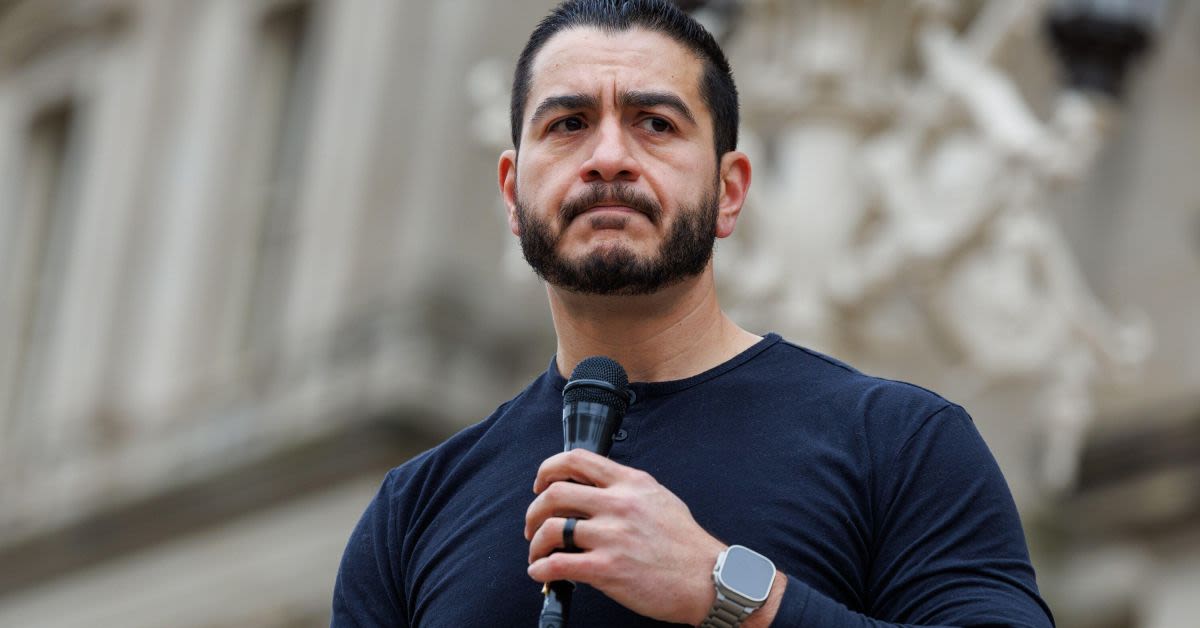
A high-profile Democratic Senate hopeful in Michigan is facing mounting criticism from within his own party over accusations that he is retreating from his once-uncompromising support for a government-run, single-payer health care system.
According to Fox News, Abdul El-Sayed, a progressive activist and former Detroit health director who previously lost a bid for Michigan governor, has built his current Senate campaign around "Medicare for All," aligning himself closely with Sen. Bernie Sanders, I-Vt., who has endorsed his candidacy.
Yet as the Democratic primary intensifies, state Sen. Mallory McMorrow, his chief rival for the nomination, is charging that El-Sayed is now softening his stance on eliminating private insurance and, in her words, "rewriting definitions to have it both ways."
El-Sayed has long marketed himself as a purist on single-payer health care, presenting Medicare for All as the only morally acceptable path to universal coverage and railing against the private insurance industry as a corrupting middleman.
But his recent comments suggesting that employer and union plans could remain under a Medicare for All framework have opened him up to accusations of political opportunism, particularly from Democrats who still favor a more incremental "public option" approach.
His campaign, however, insists there has been no shift at all.
Roxie Richner, a spokesperson for El-Sayed, told Fox News Digital that "Dr. El-Sayed is and has always been for Medicare for Allguaranteed public health insurance for every American. Cradle to grave. No premiums, deductibles, or co-pays."
Richner further argued that El-Sayeds professional background underscores his credibility on the issue and his commitment to sweeping reform.
"Dr. El-Sayed would be the first Democratic doctor elected to the U.S. Senate since 1969, and he looks forward to passing Medicare for All into law," she added, framing his candidacy as a historic opportunity for the left to cement single-payer in federal statute.
The tension arises in part from El-Sayeds own written record, which is far more explicit about the need to marginalize private insurance than his recent campaign rhetoric suggests.
On his campaign website, under the "A Healthier America" section, he cites a 2021 book he co-authored that describes Medicare for All as a "monopsony" in health carean arrangement in which the government becomes the sole buyer of medical services, thereby sidelining private payers.
"By insuring all Americans, M4A becomes a monopsony in healthcare. This is different from a monopoly, where there's only one seller of a good; in a monopsony there's only one buyer of a good. That gives the single buyer considerable negotiating leverage, which Medicare could use to rein in the cost of drugs, hospital stays, and physician services," the book reads, making clear that the power of the system depends on the absence of competing payers.
In a November post on X, El-Sayed elaborated that this monopsony "would instantaneously create a disciplining feature against rising prices," because it "takes out the profit motive on the payer end of the transaction."
The same book goes further, explicitly acknowledging that the success of Medicare for All hinges on sharply limiting private alternatives.
It states that "because alternatives to M4A [Medicare for All] would be limited, participation of providers would be virtually guaranteed," underscoring that doctors and hospitals would have little choice but to accept the governments terms.
The authors argue that such a system would simplify the administrative maze that currently burdens providers.
"Instead of spending time and money dealing with the arcane requirements of hundreds of different health plans [] providers could use one streamlined system that would free up resources to focus on clinical care," the book reads, presenting a single-payer bureaucracy as more efficient than a competitive marketplace.
This vision closely mirrors the latest version of the federal Medicare for All Act championed by Sanders, which would effectively outlaw most comprehensive private insurance plans.
The legislation would make it unlawful for "a private health insurer to sell health insurance coverage that duplicates the benefits provided under this Act; or (2) an employer to provide benefits for an employee, former employee, or the dependents of an employee or former employee that duplicate the benefits provided under this Act."
El-Sayed has not only endorsed that bill but personally testified in favor of it before the Senate in 2022. At that time, he called it "the clearest pathway to universal, durable health care insurance, bar none" and argued that "cradle to grave coverage would do away with the premiums, co pays, deductibles that leave even privately insured Americans rationing their health care today."
His earlier public comments also left little doubt that he viewed private insurance as something to be phased out, not preserved.
In a 2021 interview with NerdWallet, El-Sayed said that under a Medicare for All plan, the government would be "buying you out" of your private insurance plan, while allowing that there might remain "a few insurance companies that offered a sort of concierge-level service for folks who wanted to pay for that."
By 2024, he was even more blunt about his disdain for private insurers.
On an episode of his "America Dissected" podcast, El-Sayed declared that "we don't really need private health insurance in this country," signaling his ideological commitment to a fully government-run system.
He went on to blame private insurers for many of the worst dysfunctions in American health care.
He said that "private health insurance is a system by which you have a middleman in our healthcare system making a tremendous amount of money that is leading to a number of the biggest problems in American healthcare whether that's the fact that our costs continue to spiral upward, whether that's the fact that nearly ten million people in our country don't get health insurance at all, or it's the fact that we are consistently in this country, unable to guarantee, even people who are insurance access to the health care they need."
El-Sayed has also used his platform to attack more moderate Democratic proposals, particularly the public option that would allow individuals to buy into a government plan while preserving private coverage.
In October, he criticized McMorrow on X for supporting such an approach, writing, "a public option cant deliver healthcare to every Michigander. Medicare for All can."
His disdain for the public option was further highlighted in reporting on the primary contest.
Politico, in December, reported El-Sayed slamming McMorrows call for universal health care with a public option as "incoherent," a word that underscored his view that anything short of single-payer is fundamentally flawed.
He elaborated on that critique by arguing that a public option would fail to solve the systems core problems.
"Now a public option is exactly that; its just an option. There is no reason why it would actually address any of the foundational problems in our system. It wouldnt bring down the rising costs. It wouldnt guarantee people health care, and we dont really know how much it would cost," he said, dismissing the idea as both ineffective and fiscally uncertain.
Yet in early 2024, El-Sayeds language began to shift in ways that critics say are designed to reassure voters wary of losing their current coverage. While speaking on the Brian Tyler Cohen Podcast in January, he suggested that under Medicare for All, "if you like your insurance from your employer or from your union, that can still be there for you."
Days later, he repeated a similar formulation on Detroit public radio, again implying that existing private plans could coexist with a universal government program. Speaking on WDET, he said, "Medicare for All is government health insurance guaranteed for everyone, regardless of what circumstances youre in. If you like your insurance through your employer or through your union, I hope thatll be there for you. But if you lose your job, if your factory shuts down, you shouldnt be destitute without the health care that you need and deserve."
Even in that same interview, however, he reverted to his longstanding critique of the public option, warning that it would become a dumping ground for high-cost patients. He also said, "If you have a public option, what happens is, the private health insurance system will try to dump all of the most expensive patients onto that public option, vastly increasing the cost of that public option and making it unsustainable."
His campaign website now attempts to reconcile these competing messages by emphasizing both universal government coverage and a continued role for private plans. It states that he "believes in expanding Medicare to cover every single American from cradle to grave while sustaining the option for workers to keep supplemental private insurance their unions or employers may provide."
At the same time, El-Sayed has suggested in fundraising appeals that private coverage could go beyond mere supplementation.
Amid criticism from McMorrow, he doubled down on his Medicare for All messaging in a January fundraising message, in which he wrote that "private insurance could supplement or duplicate Medicare," language that appears to conflict with the Sanders bill he has championed, which bans duplicative coverage.
McMorrow has seized on these inconsistencies to portray El-Sayed as evasive about the real-world consequences of his preferred policy.
"Meanwhile, McMorrow has accused him of not being honest on Medicare for All," the campaign narrative now goes, as she presses the case that voters deserve clarity on whether their current plans would survive his reforms.
She sharpened that critique in a public reply to El-Sayed on social media, framing the debate as one of basic transparency.
"On an issue as important as healthcare, you have to be honest about what youre fighting for," McMorrow wrote, adding, "The Medicare for All legislation that youve championed completely eliminates private health insurance as it exists today."
For conservatives and many independents, the dispute highlights a broader concern about the lefts push for single-payer: that its most ardent advocates often downplay the extent to which their proposals would centralize power in Washington and dismantle private choice.
El-Sayeds own writings and testimony align squarely with the Sanders model that would outlaw most private plans, yet his recent assurances about keeping employer and union coverage echo the infamous "if you like your plan, you can keep it" promise that collapsed under Obamacare.
The episode also underscores a growing divide within the Democratic Party between full-scale socialized medicine and more incremental, market-aware reforms. While McMorrows public option stance is still far to the left of traditional American health policy, she is now casting herself as the more candid and pragmatic alternative to a rival whose rhetoric appears to shift with the political winds.
For now, Sanders endorsement gives El-Sayed credibility with the progressive base, but it also ties him tightly to legislation that leaves little room for the kind of private coverage he now suggests could remain.
Sanders' office did not immediately respond to Fox News Digital's request for comment, leaving unanswered whether the Vermont senator agrees with El-Sayeds recent attempts to reassure voters about keeping their existing insurance under a Medicare for All regime.
Login