
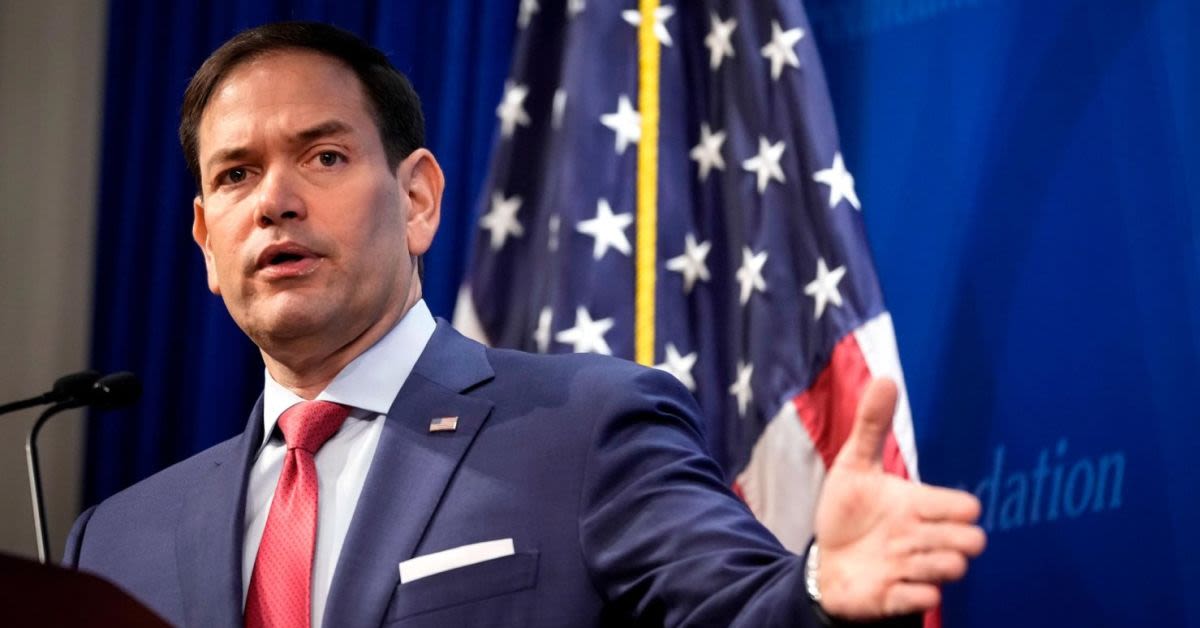
Secretary of State Marco Rubio revealed on Sunday that President Donald Trump engaged personally with both Syrian President Ahmed al-Sharaa and Syrian Democratic Forces (SDF) commander Mazloum Abdi to halt fierce clashes between the Syrian army and the Kurdish-led SDF in late January.
Speaking at a joint press conference with Slovakian Prime Minister Robert Fico in Bratislava, Rubio said, The President engaged personally not once but twice with al-Sharaa, and he said stop the fighting so that we can move the ISIS prisoners that are there. According to Breitbart, Rubio emphasized that Trumps direct intervention was aimed at preventing chaos in detention facilities holding thousands of Islamic State militants and their families, a potential disaster that could have unleashed hardened jihadists back into the region.
Rubio elaborated that Trumps message to Damascus was explicit and strategic, focused on both immediate security and long-term political stabilization. He said, Stop the fighting so that we can move these ISIS prisoners and so that you can we have more time to work on this reintegration, the integration of the Kurds into the national Syrian forces, Rubio said, underscoring the administrations effort to fold Kurdish fighters into a unified Syrian security structure rather than leave them isolated and vulnerable.
The senator was referring to the sprawling prison and camp network in northeastern Syria, where the SDF has guarded Islamic State detainees for nearly a decade under difficult and often under-resourced conditions. As the Syrian national army advanced on SDF-held areas last month, Kurdish forces began pulling back from some of these facilities, raising alarms in Washington and European capitals that ISIS prisoners could slip away amid the fighting.
In response, the United States has been pressing President al-Sharaa to secure the camps while simultaneously accelerating the transfer of detainees to more stable jurisdictions. On Thursday, U.S. Central Command (CENTCOM) announced that 5,700 adult male ISIS fighters had been moved into Iraqi custody, a significant step toward reducing the risk of mass prison breaks and reconstituted terror networks.
Rubio disclosed that the U.S. delegation skipped a high-profile Ukraine meeting with four European powers at the Munich Security Conference on Friday because we were meeting with Syria and the Kurds. The gathering he described brought together Mazloum Abdi, Syrian Foreign Minister Assad al-Shaibani, and Ilham Ahmed, the co-chairman of foreign relations for the Democratic Autonomous Administration of North and East Syria (DAANES), the political arm of the SDF.
The Florida Republican characterized that encounter as a turning point in efforts to stabilize northeastern Syria after years of war, fragmentation, and foreign interference. Rubio said the meeting was historic and would help to solidify the ceasefire agreement between Damascus and the SDF that was brokered by the United States in late January, a deal he portrayed as a hard-nosed but necessary choice to prevent Syria from splintering permanently.
Now, let me say that no one here has ever disputed that the challenge of Syria was going to be a very significant one, a very significant one, Rubio continued, acknowledging the complexity of dealing with factions that have checkered histories and competing agendas. We are dealing with elements that, as weve said in the past, you know, we have, you know, concerns about things that they have done in the past, he noted, signaling that Washingtons engagement is pragmatic rather than nave.
Addressing criticism that the United States failed to stand firmly enough behind the SDF, which fought alongside American forces against the Islamic State, Rubio argued that broader national security imperatives had to guide policy. He said that after the fall of dictator Bashar Assad, the overriding objective was to prevent Syria from becoming a permanently fractured failed state that would export instability, terrorism, and mass migration.
The bottom line was we had two choices in Syria. Choice number one was to let the place fall apart into 18 different pieces: long-term civil war, instability, mass migration, a playground for terrorists, ISIS running all over the place, Iran getting back in that was choice number one. Choice number two is to try to see if it was possible to work with these interim authorities and President Al-Sharaa and with his team, he explained, framing the administrations approach as the lesser of two evils in a deeply imperfect environment.
Guess what? We chose number two because its what made sense, he said, defending the decision to engage with the central government rather than indulge the kind of endless fragmentation that globalist elites often tolerate in the name of pluralism. Rubio stressed that Trumps personal involvement was decisive at a critical moment, preventing a breakdown that could have empowered ISIS and Iran simultaneously.
The truth is when the recent events in northeast Syria occurred, President Trump himself got involved in the matter. Twice he told President Mazloum: stop the fighting. This way, we can transfer thousands of ISIS prisoners, some of whom had managed to escape from prison, he said, highlighting the former presidents hands-on style in contrast to the more detached, bureaucratic posture often associated with previous administrations.
We also needed more time to unify coordination within the Syrian army. Mazloum listened to President Trump and stopped the fighting. We were able to do that, Rubio said, suggesting that Trumps credibility with both sides gave Washington leverage that might otherwise have been absent in such a volatile theater.
Rubio said we like the trajectory of developments in northeastern Syria since the ceasefire deal, while cautioning that the political and security architecture remains incomplete. He noted that other disaffected communities including the Druze, Bedouin tribes, and Alawite Muslims will likely seek security guarantees and political arrangements similar to those negotiated with the Kurds.
Weve got good agreements in place. The key now is implementation, and well be very involved in that regard, he said, indicating that American engagement will continue to focus on enforcing commitments, preventing Iranian expansion, and keeping ISIS from exploiting any vacuum.
Even some international media outlets that are often skeptical of conservative-led foreign policy have acknowledged that the initial steps under the January 29 agreement have been relatively orderly. Reuters noted over the weekend that preliminary steps have gone smoothly since the Jan. 29 agreement as small contingents of government forces have deployed into two Kurdish-run cities, fighters have withdrawn from frontlines, and Damascus on Friday announced the appointment of a regional governor nominated by the Kurds.
Still unresolved are core questions about how the SDF will be folded into the Syrian national military and what degree of autonomy the SDF and DAANES will retain in the countrys northeast. The SDF wants to preserve its units under longstanding commanders, while Damascus prefers to disperse them across the broader military structure, a classic tug-of-war between central authority and local control.
The Kurds are also determined to maintain border transit routes into Iraq that have long served as vital supply lines and economic arteries for their communities. The central government seized the SDF-controlled al-Rabia crossing in January, and Damascus is now pressing Kurdish authorities to relinquish control of two key oil fields and an airport near Qamishli, assets that carry both economic and strategic weight.
A central feature of the arrangement Rubio praised is that the SDF will cede much of the territory it once held, while internal security in the Kurdish-majority region will be handled by their own trusted force, the Asayish. This compromise aims to preserve local order and prevent jihadist resurgence without permanently entrenching separatist structures that could tear Syria apart.
Such an outcome, however, may not sit well with Turkey, which strongly backs the Sharaa government but views all armed Syrian Kurdish formations as a direct security threat. As Washington navigates these competing interests, Rubios remarks underscore a distinctly conservative approach: prioritize national and regional security, constrain Iran and ISIS, and favor a unified state over the kind of endless fragmentation that too often follows liberal interventionist experiments.
Login