
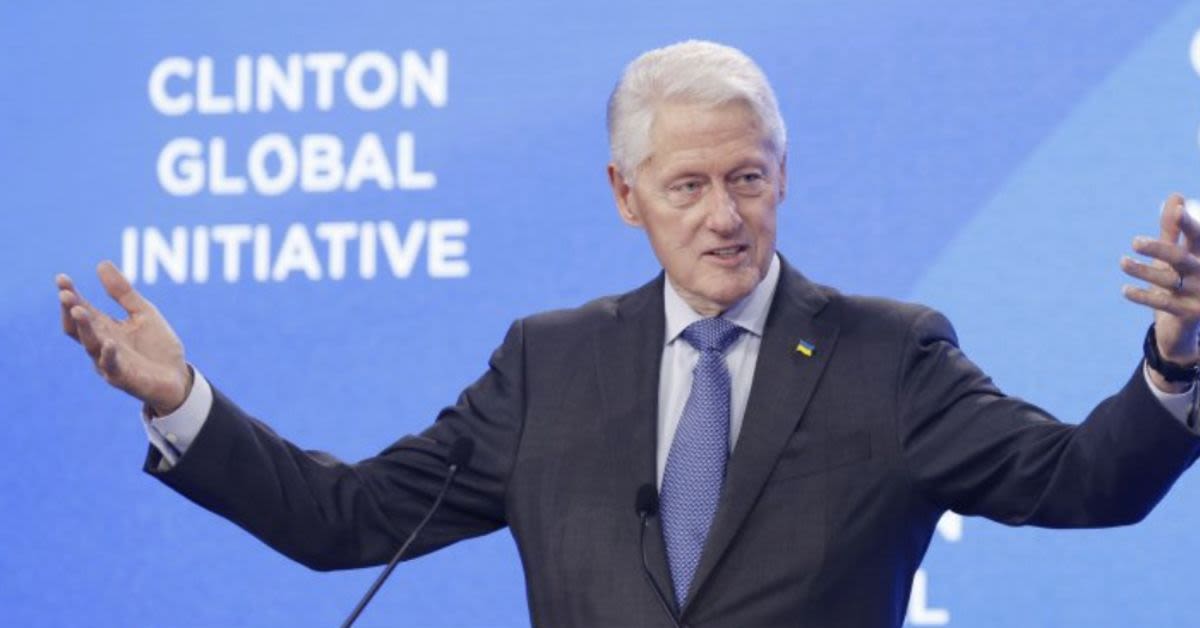
Newly released Justice Department records tied to the Jeffrey Epstein investigations are casting fresh light on the long-disputed intersection between Jeffrey Epsteins network, Ghislaine Maxwell, and former President Bill Clintons flagship post-presidency project, the Clinton Global Initiative.
According to The New York Times, internal emails contained in the trove show that Maxwell was not a peripheral figure but an active participant in the launch of the Clinton Global Initiative, including arranging a $1 million wire transfer to the global marketing firm Publicis Groupe, which helped produce the initiatives inaugural conference.
The documents, part of more than 3 million files posted online by the Justice Department under a congressionally mandated disclosure, add new specificity to questions conservatives have raised for years about the extent of overlap between Epsteins social circle and the Clintons philanthropic and political machinery.
The Justice Department has cautioned that, given the sheer volume of material, some documents may still contain sensitive information despite redactions, underscoring both the scale and the potential volatility of the release. Yet even within this massive cache, the emails involving Maxwell, Clinton aides, and Publicis executives stand out for the way they place Epsteins closest associate inside the operational planning of a high-profile Clinton venture.
In the newly disclosed correspondence, Maxwell appears to be deeply engaged in budget discussions surrounding the first Clinton Global Initiative conference, which Clinton Foundation records show was ultimately held in New York City in mid-September 2005. She worked through production issues with Clinton staff and Publicis executives and obtained wiring instructions to send $1 million to Publicis to cover work on what one email explicitly described as the Clinton project.
The source of that $1 million remains murky, a fact that only heightens longstanding concerns about transparency and influence surrounding the Clinton Foundation and its related initiatives. The New York Times reported that it could not determine whether Epstein himself supplied the funds, leaving open a critical question about whether the disgraced financiers money helped underwrite the early stages of the Clinton Global Initiative.
One email cited in the reporting shows Epstein pressing Maxwell about the payment after she received the wiring instructions, suggesting he was closely tracking the transaction. Ask him to tell you why 1 million now and where will it be going, Epstein wrote, a line that hints at his interest in both the timing and the destination of the funds.
For critics who have long argued that the Clinton orbit blurred the lines between charity, politics, and access to power, the new material reinforces the perception of a network in which wealthy and often unsavory figures could gain proximity to a former president through philanthropic branding. The fact that Maxwell was apparently serving as a conduit for a seven-figure payment tied to the Clinton project will likely fuel renewed calls from the right for a fuller accounting of who financed the Clinton Global Initiative and what they expected in return.
Maxwells own account, given in a Justice Department proffer interview conducted over two days, July 24 and July 25, 2025, further underscores her self-described importance to the project. Asked whether Epstein had business dealings with the Clintons, she responded that she was part of the beginning process of the Clinton Global Initiative and that Epstein may have helped me help them, adding that he may well have involved himself only through her role.
When pressed on just how central she was to the effort, Maxwell did not minimize her involvement. I I would say very central to that, yes, she replied, a characterization that, if accurate, places a convicted sex traffickers chief accomplice at the heart of one of the most celebrated global initiatives associated with the Democratic Partys most powerful political family.
Maxwell, who was sentenced in June 2022 to 20 years in federal prison for conspiring with Epstein to sexually abuse minors, spoke as part of a broader Justice Department effort to document the full scope of Epsteins operations and connections. The department has now publicly posted redacted transcripts of her interview sessions on its website, including the July 24, 2025, transcript and the July 25, 2025, continuation, making her statements available for public and congressional scrutiny.
In the same interview, Maxwell was questioned about her last personal contact with Bill Clinton, a topic that has long drawn public interest given the former presidents repeated attempts to distance himself from Epsteins crimes. She answered: It was in was late 2000 and, I don't know, '16, '17, '18, something in it was in Los Angeles, indicating that their paths crossed well after Epsteins conduct had become a matter of public controversy.
Maxwell added that she believed Clinton was hosting something, or he was at an event, and that she had dinner with him there, suggesting that social ties between the two persisted into the late 2010s. For many Americans, particularly on the right, such details will reinforce the perception that the Clinton circle has never fully reckoned with the depth of its association with figures later exposed as predators.
The timing of these disclosures is politically significant, coming as the House Oversight and Government Reform Committee prepares to question both Bill and Hillary Clinton in transcribed, video-recorded depositions later this month as part of its inquiry into Epstein. Lawmakers will now have a fresh set of documents and sworn statements to probe, including Maxwells claim that she was very central to the Clinton Global Initiatives early planning and her acknowledgment that Epstein may have helped me help them.
For conservatives who have long argued that there is a double standard in how the political and media establishment treats scandals involving prominent Democrats versus Republicans, the new records will likely be seen as further evidence of a protective bubble around the Clintons. The involvement of Maxwell and the unresolved questions about the $1 million wire to Publicis raise issues not only of judgment but of basic accountability in how elite philanthropic projects are funded and staffed.
As the Justice Departments document dump continues to be mined by journalists, lawmakers, and the public, the unanswered questions loom large: who ultimately provided the $1 million for the Clinton project, what expectations, if any, were attached to that money, and why did a future federal inmate convicted of facilitating child sexual abuse play such a very central role in launching a marquee Clinton initiative.
With the House Oversight Committee poised to put those questions directly to Bill and Hillary Clinton under oath, the political and moral implications of these revelations are unlikely to fade from the national conversation anytime soon.
Login