
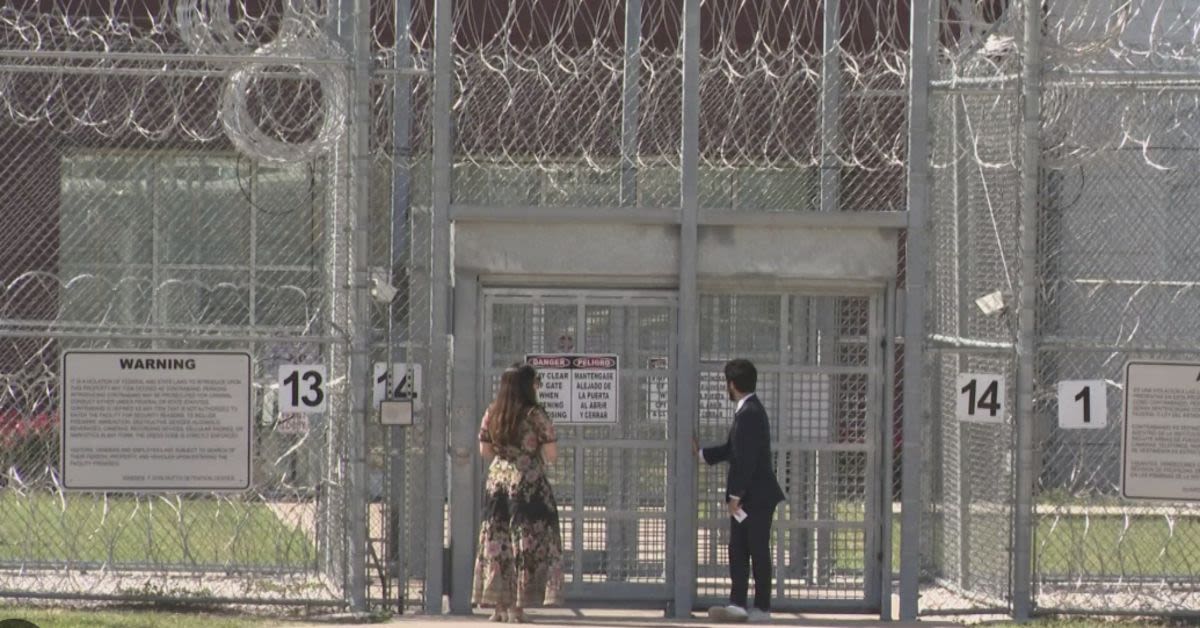
A fresh clash between congressional oversight and executive authority is unfolding over access to Immigration and Customs Enforcement (ICE) facilities, with a federal judge temporarily blocking the Biden administrations seven-day notice rule while the White House prepares an aggressive legal counteroffensive that could ultimately land before the Supreme Court.
According to Gateway Pundit, the conflict traces back to December 2025, when a federal court invalidated the Department of Homeland Securitys (DHS) requirement that lawmakers give seven days advance notice before visiting ICE detention centers. That ruling reaffirmed long-standing statutory protections that allow members of Congress to conduct surprise inspections as part of their constitutional oversight role, a key check on executive power that Democrats once championed but now appear willing to curtail when it suits the current administration.
DHS Secretary Kristi Noem moved quickly to reassert control, reimposing the same notice requirement on January 8, 2026, despite the earlier court decision. She argued that certain ICE facilities were operating under funding from the One Big Beautiful Bill Act rather than traditional appropriations and were therefore exempt from the usual oversight rules that limit how federal funds can be used to obstruct congressional access.
On the same day, DHS issued a memo instructing ICE to enforce the advance-notice policy using reconciliation bill funds, effectively attempting to carve out a parallel funding track insulated from statutory inspection mandates. Critics described the maneuver as a calculated effort to sidestep the courts ruling and to shield the administrations immigration enforcement practices from meaningful, real-time scrutiny by elected representatives.
The reimposed policy was put to the test on January 10, when Representatives Ilhan Omar, Angie Craig, and Kelly Morrison attempted to inspect the Bishop Henry Whipple Federal Building in Minneapolis. The lawmakers were initially allowed into the building but were later asked to leave and denied a tour of the facility, underscoring the administrations willingness to enforce the contested rule even in the face of ongoing litigation.
In a move that raised eyebrows, Democratic lawmakers tried to link the earlier shooting of Renee Good to their demand for more unannounced visits to detention centers. They argued that the incident required additional oversight to ensure detainees were treated humanely, a rhetorical pivot that critics saw as politicizing a tragedy to justify expanded congressional intrusion into secure law-enforcement environments.
Members of Congress unquestionably possess oversight authority over the executive branch, including ICE and DHS, but that authority has never been understood as a blank check for unrestricted access to sensitive operational spaces. Even where unannounced visits are permitted, facilities may lawfully restrict entry to certain areas, bar interference with ongoing operations, and delay or deny access when immediate safety or security concerns are present, a reality often ignored in partisan narratives.
A similar balance exists in the federal prison system, where oversight is structured rather than chaotic. While Congress oversees the Bureau of Prisons, unannounced inspections are conducted by the Department of Justice Inspector General under the Federal Prison Oversight Act of 2024, not by individual lawmakers staging surprise visits for cameras, and congressional prison tours are typically coordinated in advance as a matter of professional comity rather than statutory entitlement.
These competing interpretations of oversight collided on February 2, 2026, when a federal judge in Washington, D.C., halted DHSs seven-day notice policy. Judge Jia M. Cobb issued a temporary restraining order restoring the ability of members of Congress to conduct unannounced visits to ICE detention facilities, at least for the moment.
The court found that the policy likely violates federal law, specifically Section 527 of the appropriations code, which prohibits the use of government funds to block congressional access to detention facilities. Judge Cobb rejected the administrations claim that alternative funding streams under the One Big Beautiful Bill Act override statutory inspection rights and suggested that the January reimposition of the policy appeared to be an unlawful attempt to evade judicial oversight rather than a good-faith interpretation of budget law.
As of February 4, 2026, the ruling sharply curtailed DHSs ability to restrict access through internal policy changes alone, limiting the administrations room to maneuver without further court approval. However, because the decision came in the form of a temporary restraining order, it only suspends the policy briefly while the court weighs whether to impose a more durable preliminary injunction.
The administration is widely expected to appeal to the D.C. Circuit Court of Appeals, pressing the argument that ICE facilities funded under the One Big Beautiful Bill Act are not bound by Section 527 restrictions embedded in earlier appropriations statutes. If that statutory argument fails, the Department of Justice is likely to pivot to constitutional claims grounded in presidential authority over national security and federal property, framing unannounced visits as operational hazards and partisan interference with executive functions.
At the same time, ICE has begun attempting to reclassify certain locations, including the Whipple Building, as field offices or processing centers rather than detention facilities. Because Section 527 applies only to sites used to detain or house aliens, a broader reclassification campaign could effectively remove additional facilities from unannounced visit requirements, narrowing congressional access through bureaucratic relabeling rather than open debate.
With a Supreme Court that currently holds a conservative majority and has recently emphasized the unitary executive theory, the administration may seek emergency relief if the D.C. Circuit does not act quickly or rule in its favor.
By mid-February, Judge Cobb must decide whether to convert the temporary restraining order into a preliminary injunction, a decision that will determine whether Congress retains meaningful, on-the-ground access to ICE facilities in the coming months or whether the White House succeeds in tightening control over immigration enforcement behind a wall of legal technicalities and executive privilege claims.
Login