
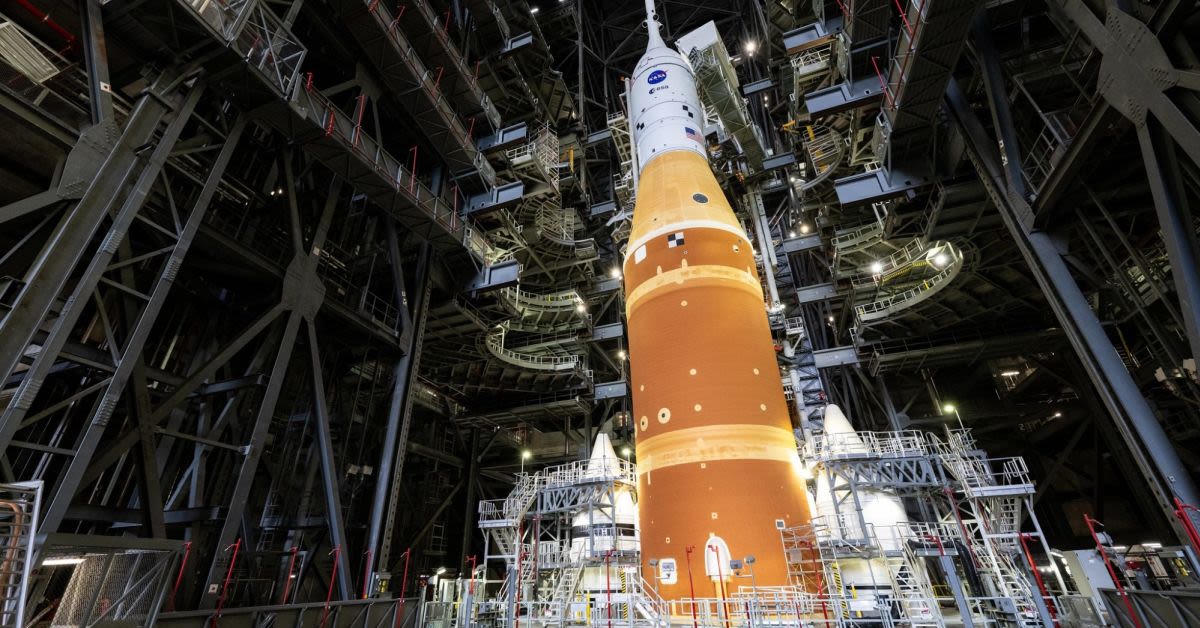
NASA has postponed the launch of its long-awaited Artemis II mission to no earlier than March after engineers detected a liquid hydrogen leak during critical fueling tests this week.
The 10-day mission, which will send astronauts around the moon for the first time in more than half a century, had been targeting a February launch from Launch Complex 39B at NASAs Kennedy Space Center in Florida. According to Fox News, the crew will ride atop the Space Launch System (SLS), the most powerful rocket NASA has ever constructed, in a high-stakes test of Americas renewed ambitions for deep-space exploration.
In a statement issued after the test, the agency said, "NASA concluded a wet dress rehearsal for the agencys Artemis II test flight early Tuesday morning, successfully loading cryogenic propellant into the SLS (Space Launch System) tanks,?sending a team out to the launch pad to closeout [the] Orion [spacecraft], and safely draining?the rocket. The wet dress rehearsal was a prelaunch test to fuel the rocket, designed to identify any issues and resolve them before attempting a launch," NASA said.
The agency emphasized that the exercise largely met its objectives despite the setback, underscoring the importance of catching such problems on the ground rather than in flight. "Engineers pushed through several challenges during the two-day test and met many of the planned objectives. To allow teams to review data and conduct a second wet dress rehearsal, NASA now will target March as the earliest possible launch opportunity for the flight test," it added.
NASA disclosed that the countdown was halted when a leak emerged late in the test sequence, forcing controllers to stop the clock just minutes before the simulated liftoff point. The agency said earlier this morning that, "The Artemis II wet dress rehearsal countdown was terminated at the T-5:15 minute mark due to a liquid hydrogen leak at the interface of the tail service mast umbilical, which had experienced high concentrations of liquid hydrogen earlier in the countdown, as well."
The schedule change will also temporarily free the four-person crew from the strict health protocols that accompany human spaceflight. "Moving off a February launch window also means the Artemis II astronauts will be released from quarantine, which they entered in Houston on Jan. 21," according to NASA. "As a result, they will not travel to NASAs Kennedy Space Center in Florida Tuesday as tentatively planned. Crew will enter quarantine again about two weeks out from the next targeted launch opportunity."
Officials declined to name a specific March launch date, stressing that technical rigor must come before calendar pressure. The agency said teams must "fully review data from the test, mitigate each issue, and return to testing," and before Tuesdays delay, the earliest opportunity to send commander Reid Wiseman and his crew toward the moon had been no sooner than Sunday.
On Monday, launch controllers began loading the 322-foot SLS with super-chilled liquid hydrogen and liquid oxygen around midday, a complex operation that must be sustained for hours during a real countdown. More than 700,000 gallons of propellant were required to fill the massive tanks and remain stable long enough to validate the procedures and hardware.
Trouble surfaced when sensors detected a dangerous buildup of hydrogen near the base of the rocket, a recurring vulnerability in large cryogenic systems. Hydrogen loading was halted at least twice as the team applied workarounds refined during the first SLS test campaign in 2022, a rehearsal that was also "plagued by hydrogen leaks before finally soaring without a crew."
Artemis II is the follow-on to the uncrewed Artemis I mission, which sent an Orion capsule around the moon and back in a demonstration of the integrated rocket and spacecraft. This second flight will be the first to carry astronauts, serving as a pivotal test before NASA attempts a crewed lunar landing on a subsequent mission.
For an American public that has watched Washington pour billions into space programs while often neglecting priorities at home, Artemis II represents both a technological milestone and a test of government competence. NASA says the mission is a key step toward long-term lunar exploration and eventual crewed missions to Mars, and its success or failure will shape whether future deep-space efforts are driven by accountable, results-focused leadership or by the same bureaucratic drift that too often defines federal projects.
Login